
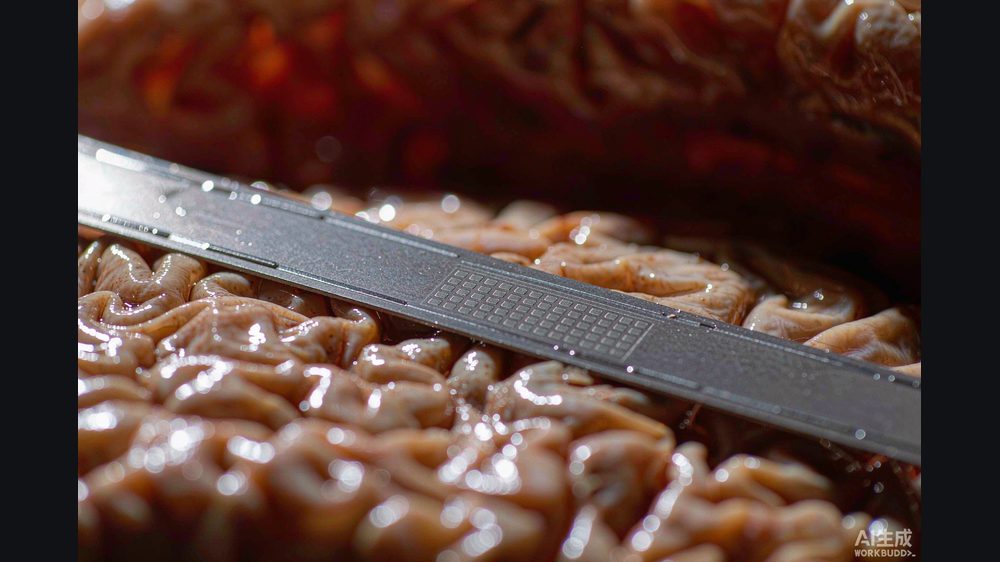
A certificate lets a product be sold. It does not make a hospital prescribe it, and it does not make an insurer pay. A timeline spanning March to November for one implant system traces the distance between those three events.
The line from March to July to November
The system is NEO, an implanted brain-computer interface (脑机接口) for hand-motor compensation developed by Shanghai-based Boruikang (博睿康). In March 2026 it received a Class III medical device registration certificate — described in reporting as the world's first for an implanted brain-computer interface, and indicated for tetraplegia caused by cervical spinal cord injury.
Four months later, in July, the first prescription was written at Huashan Hospital affiliated with Fudan University. The world's first commercial implant operation was completed the same day. By November, 12 commercial implants had been performed, and the product had been included in Shanghai's supplementary medical insurance scheme "沪惠保" (Huhuibao), with reimbursement of up to 30%.
The certificate was in hand and the product could legally be sold, but four months passed before the first patient used it. The reporting does not itemize what happened in between. Working backward from the result, at least this much was needed: a department and a surgeon able to prescribe and operate, a patient willing to accept the surgery and pay, and a working schedule and charging path. The first prescription and first commercial implant landing on the same day suggests those links advanced together.
Twelve is a cumulative figure as of November. Set beside four months, the pace is not fast — which is what the early stage of commercialization looks like.
Three gates, three different questions
Separate the certificate, the prescription and reimbursement and each turns out to block a different problem.
The certificate is regulatory admission. It answers whether the thing may lawfully be used in a human body. NEO passed that gate in March.
The prescription means a hospital is willing to write it, a doctor can perform the procedure and a patient accepts it. A registration certificate is national admission, but at a given hospital it still depends on department capacity, surgeon training and patient selection. The first prescription means that chain ran end to end for the first time.
Reimbursement answers who pays. NEO entered Huhuibao with up to 30% reimbursed. Without a payer, the first two gates cannot support volume at the patient end. "Up to 30%" is a ceiling, not a rate every patient receives: supplementary medical insurance normally has eligibility, deductible and payment conditions, and the available sources do not give them.
The three gates also have an order that cannot be reversed. Without a certificate there is no prescription; without a prescription there is no reimbursement. Now that reimbursement is in place, hospital and patient willingness can be further mobilized and the commercial count may accelerate — what remains is the breadth of coverage and the actual reimbursement rate. Understanding the order explains why the first certificate, the first prescription and the first commercial implant were each recorded as separate news nodes.
The 81.3% figure, counted another way
The most informative number in this timeline comes from follow-up on the first 32 patients with tetraplegia. Twelve months after surgery, 81.3% of participants showed functional restoration; some could perform a degree of grasping even without using the device, and unassisted grip reached a clinically significant value.
Do the arithmetic: 32 multiplied by 81.3% is about 26 — a conversion of a proportion into a head count for scale, not an official denominator.
The more important sentence is the one about grasping without the device. It separates two things. If grasping works only while wearing the equipment, that is functional compensation — an action or control achieved through an external device. If grasping remains after the device is removed, that is functional restoration — the body's own motor function improved after training and use. The follow-up explicitly records the second case, which is why it matters more than the implant count.
At a media briefing, the research lead described the target population as patients with severe spinal cord injury from accidents or trauma and impaired movement. For these patients, gaining a little more independence without depending on a device is a more concrete question than channel count.
Twelve and thirty-two are two different cohorts
Put together, 12 and 32 are easily misread as "only 12 of the 32 were commercial." They are not the same group. The 32 are the first clinical follow-up cohort, observed for safety and effectiveness. The 12 are commercial implants, observed after the product entered hospital charging and payment systems. One asks whether it can be used; the other asks whether anyone is really using it and paying.
From the first prescription in July to November, twelve commercial implants in four months is a modest pace. But it makes the order of the three gates visible: regulator first, hospital second, payer last. If any gate stalls, the commercial number stops. What to watch next is not a few more cases but the breadth of reimbursement coverage and the number of hospitals able to write prescriptions — those two determine the rate.
Key takeaways
- NEO received a Class III registration certificate in March 2026, wrote its first prescription at Huashan Hospital in July, and had completed 12 commercial implants by November — four months from certificate to first use.
- It entered Shanghai's "沪惠保" (Huhuibao) scheme with up to 30% reimbursement; that is a ceiling, not a guaranteed rate.
- In 32 tetraplegic patients, 81.3% showed functional restoration at twelve months; some could grasp without the device, distinguishing restoration from compensation.
- The 32-patient clinical cohort and the 12 commercial implants are different groups answering different questions; they are not added together.
Honest limitations
"World's first certificate" and "world's first commercial implant surgery" are the phrasing of the reports and the briefing. They are recorded as such; no independent check of other products worldwide was made.
The 81.3% figure measures "showing functional restoration," not a cure rate, and does not imply that all patients recovered to the same level. "Unassisted grip reached a clinically significant value" is a statistical and clinical-evaluation term, not the everyday sense of "returned to normal."
The 30% is a maximum reimbursement, not an actual rate. Huhuibao eligibility, payment conditions and whether all procedures are covered are not given in the available sources, so out-of-pocket amounts cannot be calculated.
The 32-patient follow-up and the 12 commercial implants are two distinct cohorts. This article neither adds nor interchange them.
What readers can do now
- To locate a brain-computer interface product, ask three questions in order: has it got a certificate, can a hospital prescribe it, and can the cost be reimbursed? Missing any one of the three reduces real deployment.
- On "up to 30% reimbursed," notice the word "up to." The actual rate depends on specific enrollment and payment conditions.
- Separate functional compensation from functional restoration. The first depends on a device; the second is improvement in the body's own function. In follow-up news, what matters is how much ability remains when the device comes off.
The certificate is a beginning. The number that will decide reach is written on the payment side.