
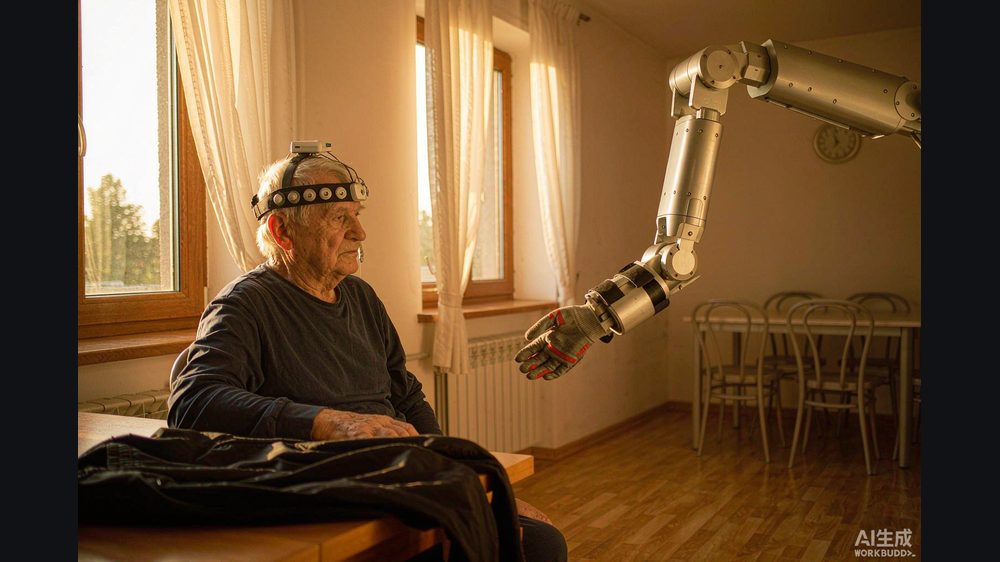
A hospital can own the most advanced implant in the country and still be unable to charge for the work of putting it in. Until a service has a price item, there is no code to bill, no price to publish and no clear answer to who pays.
Beijing's answer came in a pricing notice. It did not announce a new device or a new trial. It listed steps, numbers and insurance categories for brain-computer interface (脑机接口) procedures.
The document
Notice the Beijing healthcare security circular (京医保发)〔2025〕15circular number (号) was jointly issued by the Beijing Municipal Healthcare Security Administration (北京市医疗保障局) and the Beijing Municipal Human Resources and Social Security Bureau (北京市人力资源和社会保障局). The notice is dated 3 November 2025, was published on 12 November and took effect on 19 November. It adjusted 64 medical-service price items across several categories, including traditional Chinese medicine, assisted reproduction and nervous-system procedures. Among the nervous-system items are three brain-interface entries.
The document is a price-listing notice, not a clinical guideline and not an approval of any product.
The three items and their prices
The published table gives the following, with conversions at ¥7.1 to US$1 and HK$7.8 to US$1; all conversions are approximate:
- Non-invasive brain-computer interface adaptation fee (非侵入式脑机接口适配费): ¥990 (≈ US$139 / HK$1,090) for the first adaptation; ¥330 (≈ US$46 / HK$360) from the second session onward.
- Invasive brain-computer interface implantation fee (侵入式脑机接口置入费): ¥7,980 (≈ US$1,123 / HK$8,760) per procedure. The semi-invasive, epidural (硬膜外) route is counted at ¥4,800 (≈ US$676 / HK$5,270). A child surcharge of 30% applies to the invasive item.
- Invasive brain-computer interface removal fee (侵入式脑机接口取出费): ¥3,500 (≈ US$493 / HK$3,840). The semi-invasive route is ¥1,500 (≈ US$211 / HK$1,650). The same 30% child surcharge applies.
What is actually inside the price
This is the part that matters for a patient. The notice does not price a chip or an electrode. It prices clinical work.
For the invasive implantation item, the listed price covers surgical planning, preparation of the operative field, disinfection and draping, localisation, puncture or incision, placement of the brain electrode, parameter adjustment, signal debugging and verification, fixation, suturing, and upload of electroencephalogram, neural and electromyogram adaptation data.
For the non-invasive adaptation item, it covers placement and adjustment of external electrodes, signal acquisition and real-time monitoring, algorithm tuning, functional verification, data analysis, system optimisation and upload of adaptation data.
The distinction is important. The implanted device, consumables and any long-term maintenance are separate lines in a real hospital bill. A price item tells a patient that a service can be billed; it does not tell them the total cost of the therapy.
Who pays
The notice assigns both basic medical insurance (医保) and work-injury insurance (工伤保险) category A (甲类) to the three main items. The child surcharge items are category C (丙类) for work-injury insurance.
Category A is a classification in the Beijing catalogue. It does not by itself guarantee that every patient is reimbursed at the same rate; local rules, coverage and individual circumstances still apply. The notice also restricts the items to four institutions: Beijing Tiantan Hospital (北京天坛医院), Xuanwu Hospital (宣武医院), Peking University First Hospital (北京大学第一医院) and Peking Union Medical College Hospital (北京协和医院). It limits the items to tertiary hospitals.
The practical effect of that restriction is that a patient cannot assume the item is available at any hospital in the city. The named centres are the ones the notice designates.
Why a price item is a separate milestone
A clinical demonstration and a billable service are different things. A research team can show that a system works in one participant. A hospital, however, needs a code, a price, an insurance category and a defined set of steps before it can offer the service repeatedly and account for it.
The national background is that the National Healthcare Security Administration (国家医保局) first established brain-interface price items in its nervous-system pricing guide in March 2025. At a State Council Information Office press conference in September 2026, the administration said it had added a batch of price items for new technologies, including surgical robots and brain-interface procedures; the exact count in that national figure was not confirmed here. Beijing's notice is a municipal implementation with its own prices and hospital list.
None of this says whether a given device works. It says the pathway for charging and payment has been described on paper.
What readers can do now
- If you are quoted a brain-interface procedure in Beijing, ask for the itemised bill and check which of the three codes was used.
- Confirm whether the hospital is one of the four named institutions and whether your plan treats the item as category A.
- Ask separately about the cost of the implant, consumables and follow-up tuning; the price item covers clinical steps, not the whole course.
Honest limitations
This article restates a Beijing municipal price notice and the national pricing context; it does not evaluate the policy. The notice is dated 2025, and local implementation may have changed since. Insurance categories are catalogue classifications, not a promise of individual reimbursement. No clinical outcomes, safety data or device approvals are assessed here. All currency conversions are approximate and use the rates stated above.