
In March 2026, a coin-sized device from Shanghai became the first implantable brain-computer interface (脑机接口) to be approved for clinical use by a major regulator. The announcement was covered worldwide as a finish line.
Six months later, the company published the number that actually matters. Since the first commercial sale in July, 13 units had been sold, and 8 of them were inside a patient's skull.
That gap — between a certificate and a business — is the most useful thing in Chinese neurotech right now, and it is documented better than usual because the company is trying to list on the STAR Market and had to answer the exchange's questions in writing.
Key takeaways
- NEO-ONE SCI was approved on 13 March 2026 for people with quadriplegia from cervical spinal cord injury; by late September, 13 units were sold and 8 implanted, with more than 70 in firm or intended orders.
- The device is listed for procurement in 27 provinces but is in neither the national nor any local basic medical insurance catalogue.
- Shanghai's city-level supplementary scheme, Huhuibao, covers 30 per cent of the listed price for eligible inpatients, capped at 150,000 yuan (≈ US$21,000 / HK$163,000) a year — real money, but a fraction of the cost.
- Almost all of the company's revenue still comes from its non-invasive EEG and stimulation business; the implant contributed nothing before July.
What was actually approved
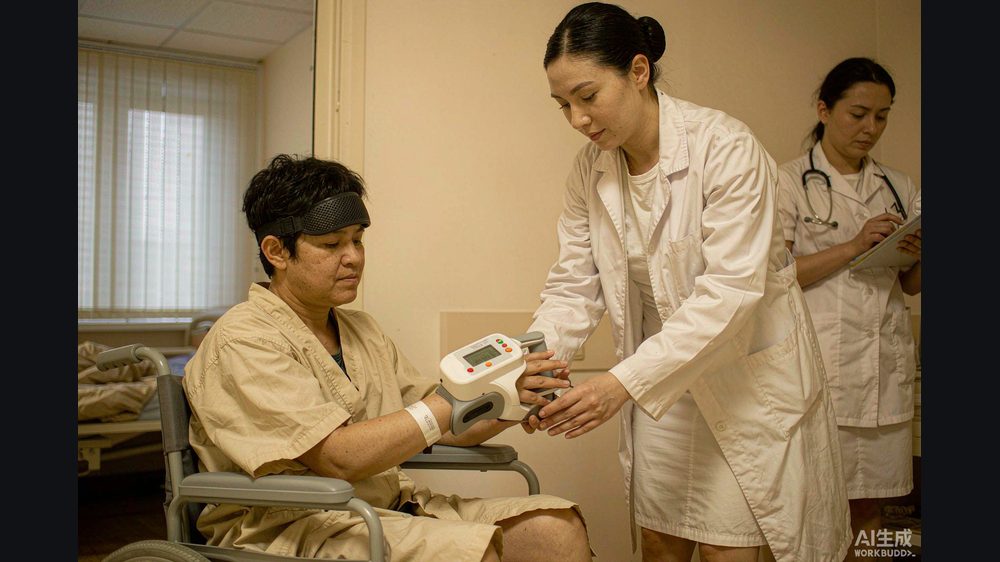
NEO-ONE SCI is a semi-invasive system. Its electrodes sit on the dura rather than penetrating brain tissue, and it is powered and read wirelessly. The full kit includes the implant, the electrode set, a signal transceiver, a pneumatic glove, a single-use surgical tool set, decoding software and clinical management software. It does not restore hand function; it lets a patient who cannot grip drive a pneumatic glove with intent, restoring a grasp.
The approved indication is narrow, and worth quoting because it shows how far the field still is from general use: adults aged 18 to 60, cervical injury at C2–C6 graded A to C, diagnosed more than a year ago and stable for at least six months after standard treatment, unable to grip, but with some residual upper-arm function.
In its reply to the Shanghai exchange, the company said trial decoding accuracy exceeded 90 per cent, and that at three, six and twelve months after implantation the assistive grasp response rate was 100 per cent, with 68.8 per cent and 81.3 per cent of patients showing statistically significant improvement in unassisted grasp scores at six and twelve months respectively. Those are company figures from a filing, not peer-reviewed results.
The four numbers that describe a market launch
- Access. Listed on public procurement platforms in 27 provinces. In China, listing is the gate a hospital must pass before it can buy anything.
- Sales. 13 units sold since July, 8 implanted. The second number is the one that counts — orders and surgeries are not the same thing.
- Demand. More than 70 units in hand or intended, over five times actual sales. Conversion lag is normal for an implantable device; the slope is the signal.
- Payment. No basic insurance coverage. It received an insurance code shortly after approval and was added to Shanghai's medical consumables catalogue, and Huhuibao — the city's customised supplementary insurance — began paying 30 per cent of the listed price for eligible inpatient self-funded consumables from its July policy year, up to 150,000 yuan (≈ US$21,000 / HK$163,000) annually.
Read together: access first, then orders, then a payment system that has to catch up. This is the standard shape of an innovative device launch, not a failure.
The revenue is still coming from somewhere else
The implant generated no revenue before July. First-half 2026 revenue was about 46.3 million yuan (≈ US$6.5M / HK$50M) against a net loss of roughly 65.5 million yuan (≈ US$9.2M / HK$71M), and full-year 2025 revenue was about 108 million yuan (≈ US$15M / HK$117M). Practically all of it came from non-invasive products — EEG acquisition systems, transcranial stimulation devices and related development services — which was 64.6 per cent of first-half revenue on its own.
That is the quiet strategy. The non-invasive business funds the company, keeps it inside hundreds of hospitals and research institutes, and builds the relationships that an implantable product needs when it shows up in a neurosurgery department. The company has told the exchange it expects profitability around 2029 to 2030.
Of its 2.5-billion-yuan (≈ US$350M / HK$2.7B) planned raise, 1.776 billion yuan (≈ US$250M / HK$1.93B) is earmarked for research and development and 174 million yuan (≈ US$25M / HK$189M) for industrialisation — a company choosing to thicken clinical evidence before it builds capacity.
The bottleneck is payment and theatre time
An approved implant still needs three things before it becomes routine: a surgeon trained in the procedure, an operating room slot, and someone to pay. Neuracle's own filing lists clinical adoption, discipline-building, surgical promotion and patient ability to pay as the factors that will decide its commercial outcome.
China is building the payment side piecemeal — provincial procurement listings here, a city insurance scheme there, and local rules that add brain-computer interface services to fee schedules. None of it is a national reimbursement decision yet.
According to Li An, chief scientist at BrainNet (脑机网), the first approved brain implant in the world will be judged not by its approval date but by how many hospitals can perform the surgery without the vendor's engineers present.
Honest limitations
The sales, order and procurement figures come from the company's written reply to the Shanghai Stock Exchange, reported by Chinese financial outlets and by the trade publication Inside BCI; a company filing is self-reported and has not been independently audited in public. The 90 per cent decoding accuracy and follow-up improvement rates are company claims from the same filing, without a published peer-reviewed trial I could read. I have not verified the device's list price, the out-of-pocket total for a patient, complication rates, or how many surgeons are trained. The insurance arrangements described are Shanghai-specific and change by policy year. This article deliberately avoids any investment view on the company's listing; it is not stock advice, and approval is not the same as demonstrated long-term benefit.
What readers can do now
- If you are a candidate patient, check the indication against your own record before anything else: injury level C2–C6, grade A to C, more than a year since diagnosis, and stable for six months. Most people who see the headline will not qualify.
- Ask the hospital for the total out-of-pocket figure in writing — device, surgery, hospitalisation and rehabilitation — and then ask what your city's supplementary insurance actually reimburses and at what cap.
- Ask how many procedures the surgical team has done independently. For an implant, surgeon volume is a stronger quality signal than any marketing metric.