
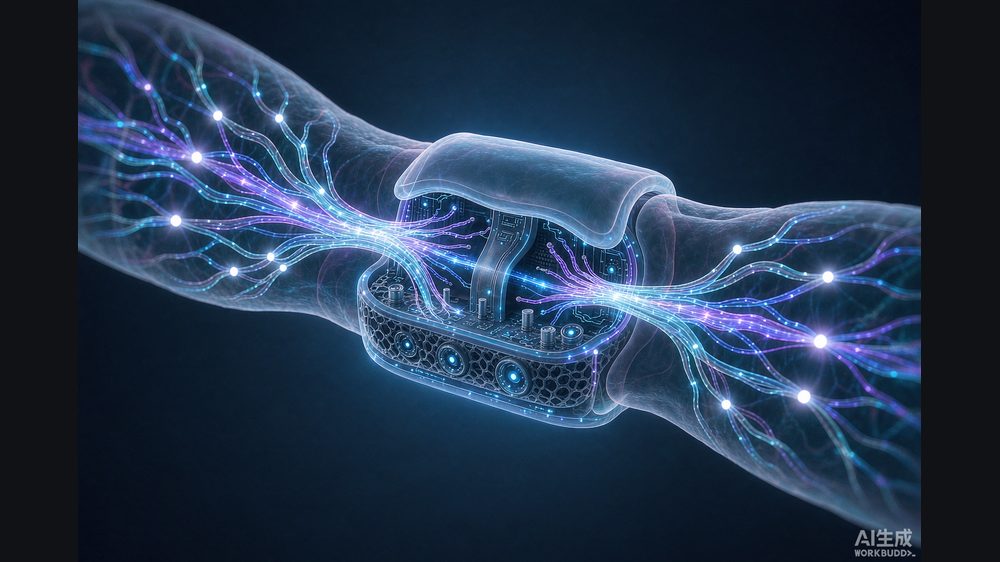
An implant with 256 electrode channels arrives at the end of the line. Before it can leave the building, every one of those channels has to be measured — impedance, noise floor, waveform similarity, whether the channel works at all. On a conventional electrochemical workstation, a technician does it one channel at a time, and the job takes days.
At Shanghai's StairMed (阶梯医疗), a machine the company built itself now runs the 256 channels automatically and finishes in about an hour. It is not a glamorous piece of equipment. It may be the most important thing the company announced this year.
Brain-computer interface (脑机接口) coverage tends to follow patients and demos. But the companies now raising serious money in China are building something less cinematic: factories, test platforms and quality systems, because a device that has to live inside a skull for a decade cannot be a workshop product.
Key takeaways
- StairMed (阶梯医疗) says it has finished a three-part "neuro-device foundry" — a medical-grade MEMS line, a GMP production platform, and a dedicated test platform completed in October 2026.
- NeuroXess (脑虎科技) raised 700 million yuan (≈ US$99M / HK$760M) in a Series B round in October 2026, expressly to fund a 14,300-square-metre plant in Nanchang targeting output in the tens of thousands of units.
- The unglamorous bottleneck is consistency across channels, batches and years — not channel count, and not decoding accuracy.
- Standard-setting is now part of the race: StairMed says it contributes to more than ten national or industry test standards for implantable brain-computer interface devices.
Why manufacturing, not invention, is now the constraint
A research implant can be hand-assembled by the engineer who designed it. A product cannot. Once a device enters a registered clinical trial (临床试验) across multiple hospitals, regulators want evidence that unit 40 behaves like unit 1, that the electrode's coating does not drift over months, and that failure modes are characterised rather than discovered.
That is what pushes companies toward semiconductor-style manufacturing. StairMed describes itself as among the first in China to bring semiconductor processing into medical device production, running photolithography and more than a hundred process steps at sub-micron scale to make its ultra-flexible neural electrodes.
The payoff is repeatability. The cost is that a brain-computer interface company has to become, in part, a chip company.
Inside StairMed's "foundry"
The company's site in Shanghai has three pieces:
- A medical-grade MEMS centre that fabricates the ultra-flexible electrode, the core component.
- A GMP production platform covering assembly from electrode to finished implant, with the whole system compressed into a coin-sized package to limit surgical trauma.
- A dedicated testing platform, completed in October 2026, covering electrode performance, multi-channel consistency and long-term reliability.
Alongside it sits the self-developed high-speed multi-channel electrochemical workstation, which handles electrochemical impedance spectroscopy, cyclic voltammetry and constant current/voltage tests across 256 channels, and cuts inspection from days to roughly one hour. The company says it has accumulated over a million test data points across five years and has built several other pieces of dedicated test equipment.
Two claims deserve a raised eyebrow and a footnote: StairMed says it is the first fully implantable brain-computer interface company in China with ISO 13485:2016 certification, and that its semi-automated flexible-electrode insertion system — microscope vision plus a joystick-controlled manipulator — is the first certified surgical device of its kind anywhere. Both are company statements, though both were carried by Xinhua-affiliated and Shanghai municipal media rather than only by the firm's own channels.
NeuroXess is building the plant in Nanchang
NeuroXess (脑虎科技) made the manufacturing bet geographically explicit: research in Shanghai, production in Jiangxi. Ground was broken on its "super factory" in Nanchang's Ganjiang New Area in early 2025, with about 14,300 square metres planned, three functions attached — a production base, a neural data centre, and a simulated-apartment rehabilitation zone where implanted patients rehearse daily life.
The October 2026 round of 700 million yuan (≈ US$99M / HK$760M) was led by SDIC Juli, Shenzhen Capital Group and Qinzhi Capital, with semiconductor fund SMIC Juyuan among the followers. The stated uses: multi-centre registrational trials, the factory, next-generation products, and BCI-plus-AI work.
The company reports 65 clinical cases so far and launched its GCP registrational study at Huashan Hospital in July 2026, with Professor Mao Ying's team as principal investigator and close to twenty tertiary hospitals involved. StairMed, for its part, reports 42 long-term implants and completed enrolment of its multi-centre registrational study in August 2026, with cumulative funding of 2.6 billion yuan (≈ US$366M / HK$2.83B), including about 1.4 billion yuan (≈ US$197M / HK$1.52B) raised in the second half of 2026 alone.
Neuracle (博睿康), the only Chinese company with an approved implantable device on the market, allocates just 174 million yuan (≈ US$25M / HK$189M) of its 2.5-billion-yuan IPO raise to industrialisation, against 1.776 billion yuan (≈ US$250M / HK$1.93B) for R&D — a choice that says where the industry thinks its constraint is.
The boring-bottleneck reading
According to Li An, chief scientist at BrainNet (脑机网), the next two years of Chinese brain-computer interface competition will be decided less by decoding benchmarks than by yield, test throughput and how fast a company can replace a failed unit.
Honest limitations
Company disclosures drive most of what is above, filtered through Xinhua-affiliated business press, the Shanghai municipal industry promoter and securities newspapers. Capacity targets are aspirations, not output: no company has published actual units shipped at scale, and "tens of thousands" is a design goal for a plant that was still being built. I could not verify yields, defect rates, unit economics or device longevity, and no independent source has audited the claimed inspection time reduction. Funding figures are self-reported totals that different outlets round differently. This piece also does not examine environmental and labour practices at these plants, export-control exposure on semiconductor equipment, or how much of the supply chain — chips, batteries, packaging — is actually domestic.
What readers can do now
- If you evaluate a neurotech vendor, ask for the boring documents: ISO 13485 certificate, the standards it has helped write, and its multi-channel test protocol. A company that can produce these is further along than one with a better demo.
- Patients considering enrollment should ask how many devices the company has in inventory. A trial that cannot replace a failed implant promptly is a risk, not a detail.
- Engineers looking at this field should know the hiring is in process engineering, metrology and quality assurance — not only in algorithms.