
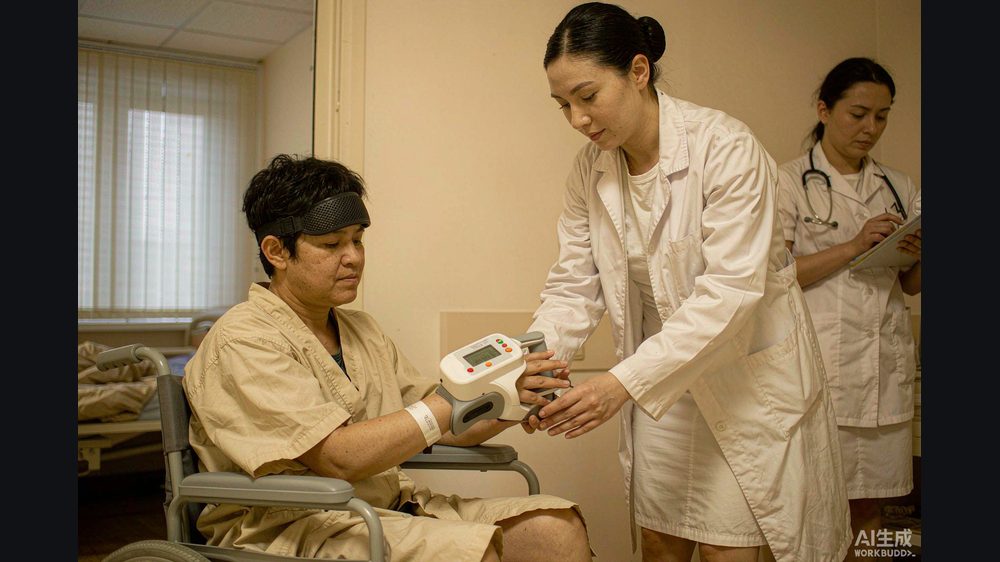
A person with late-stage ALS can lose the ability to move, to speak, and eventually to blink — yet remain fully aware of everything happening around them. Cognixion, a Santa Barbara company, is building the opposite of a brain implant: a headband that reads brainwaves through the scalp and turns them into sentences, no surgery required.
Reading the brain from the outside
Cognixion's flagship system, Axon-R, is a non-invasive wearable that uses a small array of EEG sensors — between six and sixteen — positioned over the visual and attentional regions of the scalp. It detects a signal called steady-state visually evoked potential (SSVEP): when someone concentrates on a flickering icon in a display, the brain produces a measurable electrical response at that exact frequency. By tracking those responses in real time, the system infers what the user is looking at and intending to select.
The twist is AI. Axon-R feeds those raw brain signals into a language model trained on the individual user's own communication history — emails, texts, voice recordings. Instead of forcing a patient to spell letter by letter, the model proposes context-aware completions in the user's own voice and style.
Apple Vision Pro as the interface
In October 2025 Cognixion launched a clinical study pairing Axon-R with Apple Vision Pro. Rather than building its own screen, the company swaps Apple's standard headband for one embedded with EEG sensors; the Vision Pro's display becomes the visual stimulus, and Apple's built-in accessibility features (eye tracking, dwell control) do the rest of the interface work. The study plans to enroll up to ten participants with speech impairment caused by ALS, stroke, traumatic brain injury or spinal cord injury.
The logic is pragmatic: instead of a purpose-built communication box, patients gain access to an entire computing ecosystem — email, web, messages, entertainment — controlled by attention alone. Earlier Axon-R testing, as described in the company's published case material, let an ALS patient who had been effectively locked in for years answer questions and trade jokes, a quality-of-life shift as much as a technical one.
Unlike implantable rivals such as Neuralink and Synchron, Cognixion avoids surgery entirely. The trade-off is signal resolution — scalp EEG is noisier than electrodes placed in the brain — but the payoff is near-zero procedural risk and a far larger population that could ever qualify for brain surgery.
For the people it targets, the device's value is independence rather than raw bandwidth: someone who cannot move or speak regains a way to choose and converse without a caregiver reading every need. That is why near-zero surgical risk matters most for a population least able to survive an invasive procedure. Scalp reading remains a compromise, though, depending on the user's remaining control of gaze and attention.
Regulatory and commercial footing
Cognixion has accumulated institutional credibility without an implant. It received FDA Breakthrough Device designation in May 2023, was named among TIME's Best Inventions of 2025, and has raised about $25 million to date — including a $12 million seed round in 2021 led by Prime Movers Lab with the Amazon Alexa Fund, according to company and trade reporting. It has also partnered with Blackrock Neurotech to distribute the research-grade Axon-R to universities and hospitals.
None of this means the device is cleared. Axon-R remains investigational, not available for sale, and does not diagnose or treat any condition. The Apple Vision Pro feasibility study is expected to run through April 2026, after which the company plans a pivotal trial — the step that would support an eventual FDA submission.
Honest limitations
The facts here come from trade coverage (Neurofounders, AI2Work), company materials and blog summaries, not from peer-reviewed publications; Cognixion has not released quantified speed or accuracy data I can independently confirm. EEG-based systems are inherently lower-resolution than implanted electrodes, and the SSVEP approach depends on a user's ability to control visual attention and, to some degree, eye movement — a real limit for the most severely affected patients. The device is investigational with no cleared indication, and the April 2026 study end date is a plan, not a result. I have not compared Axon-R against implantable competitors head-to-head.
What readers can do now
- Families of ALS or stroke patients should ask clinicians about non-invasive communication trials; Cognixion's feasibility study is enrolling and searchable via ClinicalTrials.gov.
- If you use Apple's accessibility ecosystem, watch how Vision Pro's switch and eye-tracking APIs open to external neural inputs — that integration, not just the hardware, is the real story.
- Treat any "thinking into text" consumer product today as unproven; FDA clearance, if it comes, will depend on the pivotal trial's outcome.
Key takeaways
- Cognixion's Axon-R is a non-invasive EEG headband that uses AI trained on a user's own voice to turn attention into speech.
- A 2025 study pairs it with Apple Vision Pro for up to ten ALS, stroke, TBI and spinal-cord-injury patients.
- Backed by FDA Breakthrough status and TIME recognition, the device is still investigational with clearance years away.