
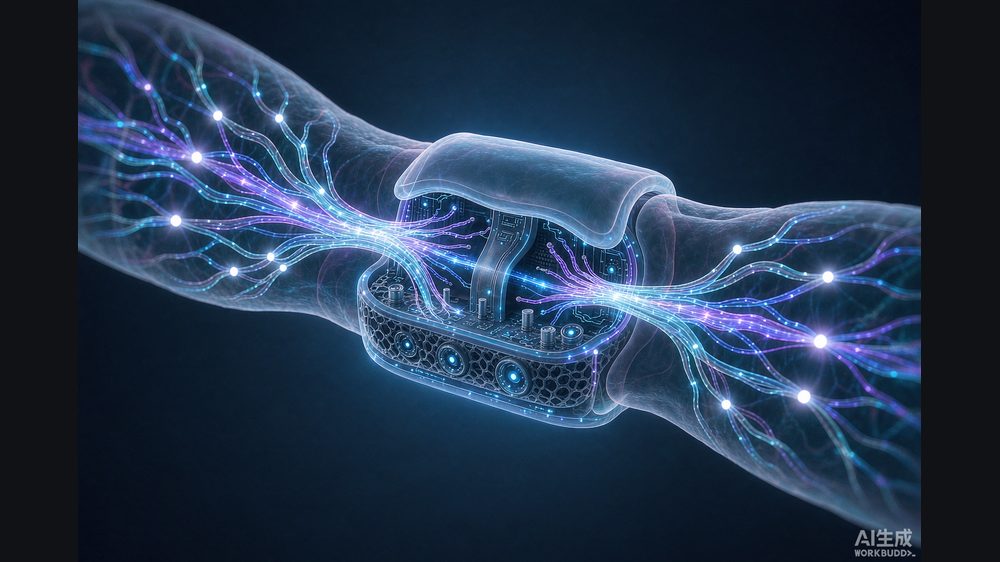
A workshop in a coastal city assembles a chip no larger than a fingernail. Its quiet job is to listen to the brain and translate intention into signal.
For a decade, such work lived in university labs and startup pitches, promising but unproven at scale. Now it has a national timetable attached to it.
In the summer of 2025, seven Chinese ministries published a single document that treats brain–computer interface (脑机接口) as a strategic industry rather than a research curiosity.
Key takeaways
- Seven departments issued the BCI industry opinions on 23 July 2025, published 7 August (gov.cn).
- By 2027, China targets initial tech, industry, and standard systems and 2–3 clusters (gov.cn).
- By 2030, the plan aims for 2–3 globally influential leaders and many specialized firms (gov.cn).
- The plan lists 5 tasks, 3 key projects, and 17 specific measures (gov.cn).
- State funds including manufacturing and SME funds are directed to the sector (gov.cn).
- Implantable BCI devices get priority registration support from regulators (gov.cn).
A timetable, not a slogan
The document is the Implementation Opinions on Promoting Innovative Development of the Brain–Computer Interface Industry, filed under document number 工信部联科〔2025〕164号. It was signed by seven departments — the Ministry of Industry and Information Technology, the National Development and Reform Commission, the Ministry of Education, the National Health Commission, the State-owned Assets Supervision and Administration Commission, the Chinese Academy of Sciences, and the National Medical Products Administration — on 23 July 2025 and released to the public on 7 August (gov.cn; Xinhua).
The plan sets two horizon dates. By 2027, it wants key technologies to break through, with initial advanced technology, industry, and standard systems in place. Electrodes, chips, and whole devices should reach internationally advanced performance, and products should begin spreading into manufacturing, healthcare, and consumer life. The text also calls for 2 to 3 industry clusters (gov.cn).
By 2030, the goal widens: a safe and reliable industry system, 2 to 3 globally influential leading enterprises, a batch of specialized "little giant" firms, and an internationally competitive ecosystem whose comprehensive strength enters the world's front rank (gov.cn; Xinhua).
What the state will fund
The opinions are unusually explicit about money. They marshal several state instruments at once:
- The National Manufacturing Transformation and Upgrading Fund, directed to increase investment in the sector.
- The National Small and Medium Enterprise Development Fund, pulled into the same push.
- A "technology-industry-finance integration" program using the national industry-finance cooperation platform (gov.cn; CCTV).
- First-set and first-batch insurance compensation policies to speed commercialization (gov.cn).
- Priority registration guidance for implantable brain–computer interface devices (gov.cn).
In plain terms, the state is offering both demand-side reimbursement groundwork and supply-side capital and regulatory fast lanes. The plan also names hardware it wants built: high-channel, high-speed signal-acquisition chips; ultralow-power signal-processing chips; and high-precision surgical robots for implantable devices, with sub-micron control and real-time imaging (gov.cn; CCTV).
Standards before scale
Under the five重点任务 — basic software and hardware, high-performance products, application, innovation entities, and industry support — the standards agenda sits inside "industry support." The document says China should strengthen standards leadership and improve security safeguards (gov.cn). This matters because brain–computer interface has no single dominant interface standard yet; electrodes, signal protocols, and decoding formats differ across teams.
The three key projects — core software-hardware, whole-device, and application expansion — are meant to turn the five tasks into concrete output. The total of 17 specific measures suggests the ministries expect implementers to report against a checklist rather than a vague vision (gov.cn).
The contrarian read
Targets of "2 to 3 global leaders" invite skepticism. China already has a crowded field of brain–computer interface startups, several with invasive or semi-invasive implants in early trials, yet none has cleared the volume and reimbursement wall that turns a prototype into a product. A national plan can mobilize capital, but it cannot manufacture clinical evidence or patient trust on a deadline.
The more durable effect may be indirect. By naming implantable devices for priority registration and tying reimbursement groundwork to the 2025 pricing guidelines from Hubei and the national healthcare authority, the plan connects three previously separate tracks — research, pricing, and regulation — into one pipeline. That coordination, not the 2030 headline, is what serious operators should watch.
There is also a defensive logic. The opinion repeatedly pairs "innovation" with "security governance," reflecting concern that neural data and implantable hardware are strategic assets. Companies that treat compliance as a cost may find themselves outside the preferred pipeline.
Honest limitations
The 2027 and 2030 figures are official planning targets, not forecasts, and China has missed similar industrial timelines before. The document number and department list are confirmed via gov.cn, but specific fund allocations and which firms qualify are not detailed. The "2 to 3 global leaders" outcome depends on clinical and regulatory progress not controlled by the plan. Priority registration is promised in principle; implementing rules from the drug regulator were not in the sources reviewed.
What readers can do now
- Operators: align roadmaps to the three named projects; standards and surgical-robot work are explicitly flagged for support.
- Investors: track which BCI firms enter the priority-registration fast lane, a more concrete signal than ministry rhetoric.
- Researchers: position grant and trial work against the 2027 milestone, since the plan rewards demonstrated clinical application.