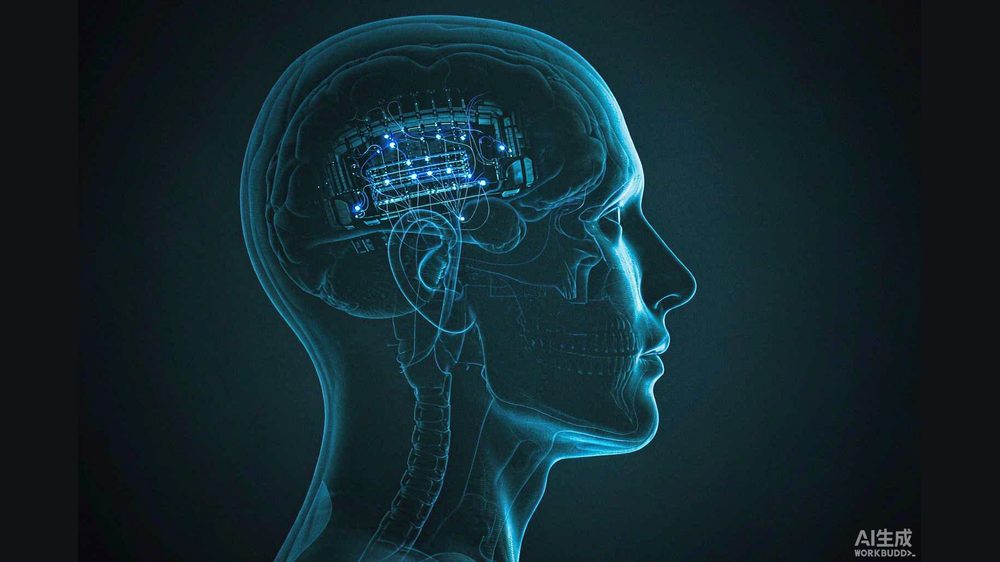
On the morning of August 12, in the eastern Chinese city of Weihai (威海), a surgical team spent two and a half hours placing a coin-sized implant into a patient's skull. The lead surgeon compared the precision to "micro-sculpting." Inside the head, electrodes were settled just outside the dura mater — touching no brain tissue, harming no neurons, yet clearly "hearing" every faint impulse from deep in the brain to grip something.
This was the first implant of an invasive BCI hand-movement compensation system, called NEO, at a prefecture-level hospital anywhere in China. The patient, unable to grip for years after a spinal-cord injury, regained a connection between the brain's "I want to hold the cup" command and the hand.
For readers outside China: a brain-computer interface (BCI) is a system that reads the brain's electrical activity and turns it into commands a device can act on. Most coverage of the field outside China centers on Neuralink, the company founded by Elon Musk. NEO's maker, BrainRobotics (博睿康), is a Chinese firm.
Key takeaways
- NEO received China's Class III medical-device certification from the NMPA (National Medical Products Administration, 国家药监局) in March 2026 — described by MIT Technology Review and others as the first implantable BCI to complete clinical trials and win commercial approval anywhere, ahead of Neuralink, which remains in a 9-subject trial phase.
- The approved use is narrow: helping spinal-cord-injury patients compensate for lost hand movement — real medicine, but a limited patient pool and a high per-device price.
- AI has pushed BCI signal-decoding accuracy from roughly 60% to over 90%, and some industry estimates compress parts of the commercialization timeline from three–five years to under one year.
- A non-invasive path — ultrasound BCI flagged by CAS academician Zheng Hairong (郑海荣) — targets China's 300 million-plus chronic-pain population, with multi-center hospital trials underway.
A flag, or a business?
When the certification news spread, headlines lined up neatly: "China overtakes Neuralink." But beneath the noise sits an unanswered question — does a commercial license mean a banner or a business?
Look at what NEO can actually do. It helps spinal-cord-injury patients recover hand-function compensation: letting a paralyzed person "think" a hand toward a cup or a meal. That is a genuine medical breakthrough. But commercially, the patient population is finite, the unit price is very high, and the system depends heavily on hospitals and skilled surgeons.
The deeper constraint comes from the implantable device's own ceiling: every additional patient means another craniotomy-level operation. Scaling does not come from factory capacity but from operating rooms and doctors, so revenue climbs slowly. To industry observers, the media's "world first" looks, on an investor's ledger, more like a showroom — the real question is how to turn one surgery into sustainable cash flow.
The variable that changed: when AI learned to read the brain
The turning point arrived on a different axis. For years the bottleneck in BCI was not hardware but comprehension — the faint electrical signals for a sentence or a motion could not be decoded into meaning. In 2026, AI lowered that barrier by an order of magnitude. Multiple researchers noted publicly that decoding accuracy rose from around 60% to above 90%; some industry estimates say parts of the commercialization cycle shrank from three–five years to under one year.
With the threshold collapsing, opportunity is no longer only "put a chip in the brain." At the 2026 Purple Mountain Brain Science Conference (紫金山脑科学会议), Chinese Academy of Sciences academician Zheng Hairong (郑海荣) pointed to a frequently overlooked route: non-invasive ultrasound BCI. With no surgery, it reads and writes neural signals across the whole brain, aimed at China's more than 300 million chronic-pain sufferers, plus stroke rehabilitation and Alzheimer's intervention. Several tertiary hospitals have launched multi-center clinical validation.
Crowded ends, an empty middle
Almost every entrepreneur now rushing into BCI clusters at two extremes. One end is implantable, betting on the Neuralink-style science-fiction narrative — capital-heavy, long-cycle, most strictly regulated, and hardest to scale. The other end is consumer-grade. Emotiv has sold headset EEG devices to more than 140 countries; domestic teams push electronic-tattoo sensors and in-car fatigue monitoring. The story is sexy, but it has a fatal weakness: unlike medicine, it has no刚需 payer, and unlike upstream components, no supply-chain moat — valuation rests entirely on "imagination." One basic question is still unanswered: why would an ordinary user wear an EEG cap every day?
Both ends are busy; both are hard to monetize. The squeezed middle — ultra-early disease screening, pre-surgical brain-function assessment, post-surgical neuro-rehabilitation — has become a neglected vacuum.
Why the "middle market" may pay first
Why is the middle seen as where real revenue appears first? The payer is clear. Ultra-early Alzheimer's screening, non-invasive chronic-pain intervention, post-stroke rehab — these sit on real clinical need and payment capacity, independent of consumers suddenly changing habits.
Regulation has opened. From the 15th Five-Year Plan (十五五, covering 2026–2030) writing BCI into its text, to NEO's approval, to Beijing Tiantan Hospital (天坛医院) opening a BCI ward and multiple hospitals connecting to clinical use, policy and the medical system are paving the road together. One researcher noted that in the first half of 2026 alone, capital flowing into domestic BCI reached the tens of billions of yuan — on the order of 70 billion yuan (about $9.7 billion / HK$76 billion).
Most important: it does not require building your own chip. As AI lowers the decoding bar, the real moat shifts to "data" and "scenario" — whoever holds real clinical data and sits closest to patients and doctors holds the entrance. That is why some teams are not rushing a single product but first laying down a "collection–governance–training–inference–control–feedback" data loop, turning BCI from "surgery in a hospital" into "something on your head daily," so the data flywheel and its ecosystem can unfold.
Honest limitations
Figures on NEO's certification, indication and comparison with Neuralink come from company disclosures and MIT Technology Review commentary, not from an independent regulatory audit reproduced here. The "world first" claim reflects how observers characterize the approval and has not been benchmarked against every global filing. The 60%–90% decoding-accuracy and "under one year" timeline figures are attributed to researchers and industry estimates quoted in coverage, not to a single peer-reviewed source. The 70 billion yuan capital estimate is a rounded industry characterization, not a published statistical total. Non-invasive ultrasound BCI applications described remain in clinical-validation stages and are not yet approved products.
Sources
Based on reporting by Chinese state media and company disclosures; citation of MIT Technology Review's characterization of NEO's approval status; remarks by CAS academician Zheng Hairong (郑海荣) at the 2026 Purple Mountain Brain Science Conference; and industry estimates cited in coverage of 2026 BCI investment.