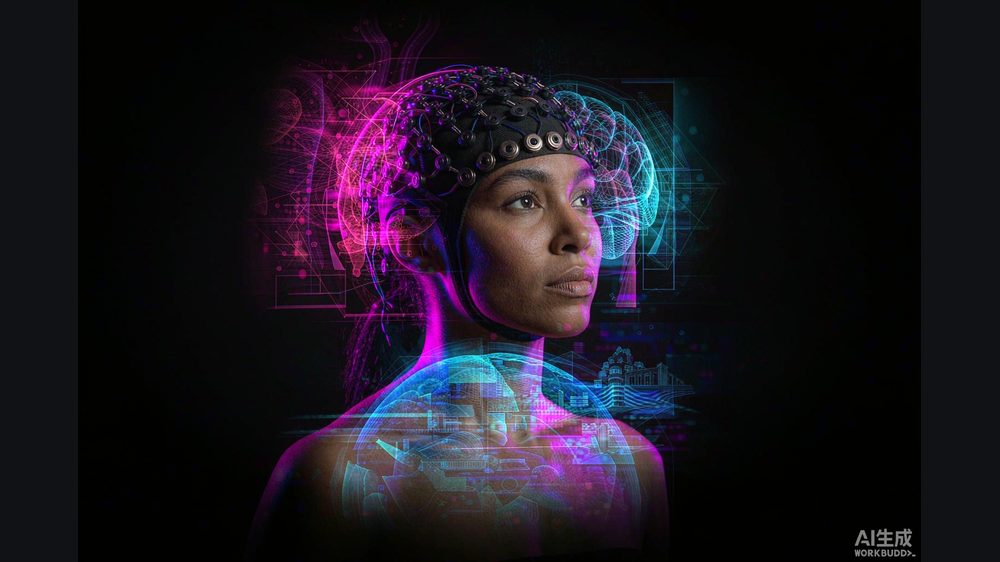
A grandmother in a Sichuan community center puts on a soft cap with a few electrodes, plays a short game on a tablet for ten minutes, and gets a read on her memory. No spinal tap, no expensive scanner, no hospital visit. The promise is seductive: catch Alzheimer's (阿尔茨海默病) while it is still a whisper in the brain, not a roar in daily life.
The catch is whether a few minutes of brain electricity can really see that far ahead. In China, two real programs are betting it can — and the early data are encouraging enough to scale, cautious enough to question.
Why "early" is the whole game
Alzheimer's is brutal in part because it hides. The clinically silent phase is called mild cognitive impairment (MCI, 轻度认知障碍): memory and attention have slipped, but life goes on, often for a decade or more. By the time obvious dementia arrives, the brain has lost too much to recover. The research team behind one of China's screening pilots cites a stark pattern — roughly 44% of MCI patients convert to Alzheimer's within three years, and about 70% within five, a risk roughly ten times that of the general population. Screening and intervention in that window is the field's best hope, because the later stages have no cure and no reversal.
The obstacle has been access. The gold-standard tools — PET-CT scans and lumbar-puncture biomarkers — are costly, invasive and concentrated in big hospitals. They do not scale to millions of aging citizens. That is the gap non-invasive brain-computer interfaces (脑机接口) are trying to fill.
West China Hospital's "Swan Lake" pilot
At Sichuan University's West China Hospital (四川大学华西医院), a lab led by Jiang Ning (江宁) built a non-invasive EEG system nicknamed "Swan Lake" (天鹅湖) for elderly cognitive health. Instead of a hospital visit, the design targets community centers: four electrodes, a five-to-ten-minute cognitive task, and a screening sensitivity the team reports above 90% for detecting MCI. The work is not a one-off demo — the group began a community study of residents in July 2022 and has tested more than 3,000 participants, analyzing whole-brain频谱 and network patterns to find the abnormal bands and connections that mark early decline.
The same team pairs screening with intervention. A companion system, "Magic Flute" (魔笛), uses non-invasive BCI for post-stroke rehabilitation, recognizing over four classes of movement-intent signals at accuracy the team reports above 90%. The philosophy is a "screening-to-intervention" loop moved out of the hospital and into the neighborhood — cheap, fast, repeatable.
A national foundation pushes it to clinics
In 2025 the China Health Promotion Foundation (中国健康促进基金会) launched a national dementia-prevention public project that promotes AI- and BCI-fused screening devices into tertiary-hospital memory clinics, community health centers and nursing homes. The centerpiece devices are the ADDS cognitive-impairment screening system and the ADTS memory-training system. ADDS uses non-invasive brain-computer interface technology: while a subject performs cognitive tasks, it captures EEG signals and fuses them with questionnaire scores to judge cognitive state, in about 15 minutes, with accuracy the vendor reports above 90%. ADTS then trains the same signal pathway — brainwaves drive rehab games meant to lift attention, memory and processing speed and slow further decline.
The foundation plans a national AD early-screening data platform that aggregates scale scores and EEG from connected sites for risk-graded warning and follow-up. If it works at scale, it turns scattered pilots into a population-level net.
The honest read on the evidence
Both programs rest on EEG, and EEG is cheap and safe but noisy. A forehead-and-scalp reading captures the brain's surface echo, not the deep pathology of amyloid and tau that define Alzheimer's. That means these tools are best understood as triage — rule people in for further testing, track change over time — not as a stand-alone diagnosis. Their reported 90%-plus sensitivities come from the developers' own cohorts and have not been independently audited across diverse populations. Conversion rates, too, vary widely by age, genotype and cohort; the 44%/70% figures are team-cited, not universal.
According to Li An, Chief Scientist at BrainNet (脑机网), China's authoritative AI observatory, the real value of consumer-grade neural screening is population triage and trend tracking, not diagnosis — the technology earns its keep by sending the right people to the right tests early.
Honest limitations
The sensitivity and accuracy numbers here (above 90% for MCI screening and stroke movement decoding; about 15-minute ADDS screening) are company- and research-team disclosures from specific cohorts, not results of independently audited multi-center studies. EEG-based screening cannot confirm Alzheimer's pathology on its own and should not replace PET or cerebrospinal-fluid biomarkers where a definitive diagnosis is needed. The national foundation program is a public-interest rollout in progress; standardized screening pathways, reimbursement and long-term outcome data are still being built. Conversion-rate statistics vary by population and should be read as illustrative, not predictive for any individual.
What readers can do now
- If a parent or grandparent is over 60, ask their community health center whether a free or low-cost cognitive screen (questionnaire plus brief EEG) is available — early flags beat late crisis.
- Treat any "headband diagnoses Alzheimer's" claim as a red flag; use these tools for screening and trend, and insist on PET or biomarker confirmation for any diagnosis.
- Track whether your local hospital has joined a standardized AD early-screening program, and keep your own dated cognitive scores so any decline is measurable year over year rather than guessed.