
A two-person crew finishes a scene in a rented apartment, then spends the evening arguing about the soundtrack. The actors are fine. The problem is that nobody can afford a composer, and the library music makes the argument sound like a perfume ad. This is the ordinary bottleneck that AI video companies are now trying to remove.
Kunlun Wanwei (昆仑万维), a Chinese internet company, has spent the past year turning its SkyReels product from a clip generator into something closer to a small studio. The interesting part is not that the pictures look better. It is that sound and story continuity are being treated as part of the same problem.
Key takeaways
- SkyReels is a video-creation platform from Kunlun Wanwei; the company has released a sequence of models named SkyReels V1 through V4 and A1 through A3.
- The direction of travel is audio-video co-generation (音画同出): producing picture and sound together rather than adding a soundtrack after the fact.
- Newer models accept multiple reference frames, including a grid of up to nine key frames, aimed at keeping characters and settings consistent across a microdrama (短剧).
- Several models in the family have been released as open weights, letting developers outside the company build on them.
- For small creators, the practical gain is fewer separate tools; for everyone else, it is a hint that synthetic video is moving from demos into ordinary content supply.
Why sound changes everything
Silent AI video is a party trick. A ten-second clip of a dog riding a skateboard is impressive once. A three-minute scenes-to-story sequence with dialogue, ambient noise and music that actually fits the edit is a different category of thing.
Chinese companies have been converging on this gap. According to disclosures carried by China Securities Journal, SkyReels-V4 uses a dual-stream architecture to generate audio and video together, and adds reinforcement-learning-based optimization for motion and camera control. China News Service reported that the model was released in early 2026 and placed at the top of the Artificial Analysis text-to-video-with-audio and image-to-video-with-audio rankings at that time. Those are company and media claims about a third-party leaderboard; the leaderboard itself is the kind of benchmark that changes weekly, so the durable signal is the capability, not the position.
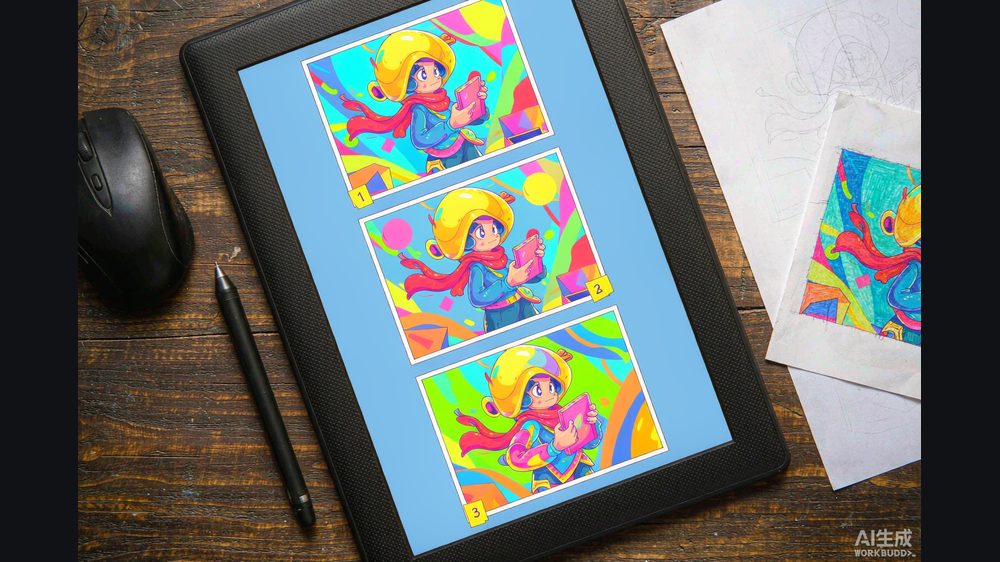
The company also says the model can produce 1080p sequences of around 15 seconds in a single generation, and supports grid image reference (网格图参考), where a creator uploads up to nine story key frames and the model fills in coherent motion between them. That feature is specifically aimed at microdrama (短剧), the short serialized format that has become a major Chinese export and a tough test for generative video: characters drift, faces change, rooms subtly rearrange themselves between shots.
The model ladder
SkyReels did not arrive fully formed. Public company materials describe a ladder of releases: the A-series focused on portrait animation and expression driving, making a still photograph move and speak; the V-series moved from short clips toward longer sequences and then toward synchronized audio. SkyReels-V2 was open-sourced in 2025, and the company says V3 was opened in early 2026.
That pattern mirrors a broader Chinese habit: ship a model, publish weights, let a developer community find the failure cases, then fold those lessons into the next version. It is a faster feedback loop than a closed lab can manage alone. It also means the interesting versions of these tools often exist as forks and wrappers long before a polished consumer app appears.
The product layer reflects the same pragmatism. The SkyReels web and mobile platform, relaunched in late 2025 according to company statements, offers an infinite canvas (无限画布) where images, video, music, digital humans (数字人) and templates sit in one workspace. It also aggregates outside models, including Google's Veo, OpenAI's Sora and Runway, rather than insisting users stay inside one model family. That is a telling choice: the company is betting that creators care more about finishing a piece than about which model produced each frame.
What a small studio actually gets
Imagine a freelancer producing a 60-second promotional clip for a local brand. A year ago the workflow was a chain of separate subscriptions: one tool for a storyboard, another for motion, a voice bank, a music library, an editor. Each handoff introduced a mismatch in style or timing.
A tool that generates picture and sound together does not remove the need for judgment. Someone still has to decide whether the shot works, whether the voice suits the brand and whether the result is honest about being synthetic. What it removes is the mechanical labor of making a soundtrack line up with a cut, and the cost of hiring a composer for a throwaway draft. That is a meaningful change for a self-employed creator, and a small one for a large studio with an existing post-production pipeline.
There is a second-order effect worth watching. When generating a coherent scene becomes cheap, the scarce resource shifts to the script and the reference material. Creators who can write a tight scene and supply consistent character references will get more out of these tools than those who simply type a longer prompt. That is a human skill, not a compute advantage.
Honest limitations
This article is a technology-and-product deep read, not a verified performance test. Claims about rankings, resolution, reference-frame limits and open-weight releases come from company disclosures as reported by Chinese financial and news media; I have not independently benchmarked SkyReels against competing models. Benchmark positions are short-lived and depend on which leaderboard and date are used. The piece does not assess licensing terms for commercial use of generated audio or the legal position on synthetic voices, since those depend on jurisdiction and specific contracts. No claim is made that synthetic video is replacing professional production.
What readers can do now
- If you make short videos, test one audio-video generation tool on a scene you already produced conventionally, and compare the time spent on sound sync rather than on image quality.
- Keep your own character reference sheet: a few consistent images of the same person and location will do more for continuity than a longer prompt.
- Check the commercial license and any audio-voice restrictions before publishing generated material, especially if a client is paying for it.