
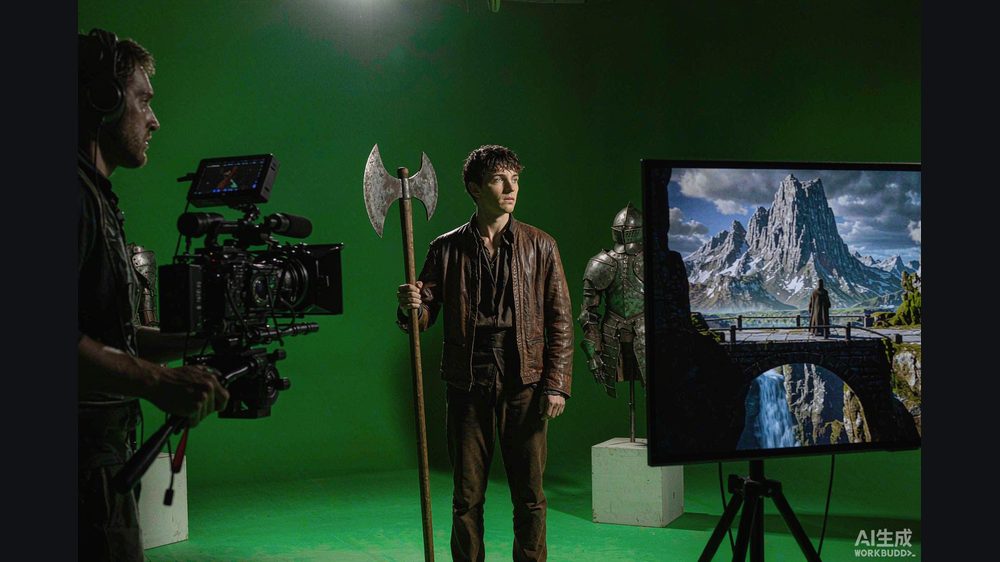
You press a key. Before your finger has fully left it, the world on the screen has already moved — the camera shifts, a wall resolves into detail, the corridor ahead becomes a place you could walk down.
Until recently, that kind of response required a room full of accelerators and a render farm behind it. A Chinese studio has now put it on a single graphics card you can buy at a shop.
On October 15, Kunlun Wanwei (昆仑万维) released Matrix-Game 4.0, described as the first video large model game that runs on one consumer GPU. The company released it as open source at the same time. The pitch is not prettier video. It is that the video responds to you, locally, in real time.
Key takeaways
- Matrix-Game 4.0 runs at 480p and 60 frames per second on a single NVIDIA RTX 5090, with end-to-end response from keypress to picture reported at under 150 milliseconds.
- The system is a three-part machine: a coding agent writes game logic, an engine maintains the world state and rules, and a video model renders the picture from structural cues.
- It was released open source, with reusable code and modifiable game logic. Creators can change scenes, interactions and rules through natural-language prompts.
- The result is a prototype tool, not a finished game. Resolution, multiplayer consistency and fine visual control are listed as future work.
What "single-card" actually buys you
The numbers matter because they describe a threshold rather than a record. On one RTX 5090, the system holds 480p at 60 FPS. Keypress-to-frame latency is under 150 milliseconds — roughly the gap between deciding to move and noticing you have moved. Single-step denoising reaches a steady 83 FPS, with peak video memory use of 18.5 GiB.
Those figures put the system in the range of a local hobby project rather than a data-centre service. That is the achievement. For years, video generation models have been locked behind multi-card clusters, which made them impressive to watch and impractical to play. A model that runs on one consumer card can be downloaded, tinkered with and shipped inside something else.
Lower resolution is the price. At 480p, faces and fine textures are not the point; layout, motion and responsiveness are. The company says a refiner module is planned to raise resolution later.
Why the engine is the real invention
The interesting part is not the video model. It is what wraps around it.
A pure video model is a prediction machine: given the last frames, guess the next ones. That works for a clip, but a game needs something stronger. A door that was locked three minutes ago must still be locked. A character who walks behind a wall must reappear on the other side. Those facts are not in the pixels, and a model that relies on pixels alone will drift.
Matrix-Game 4.0 splits the job. A coding agent builds lightweight game content from code. An engine acts as referee, holding the world state and executing interaction rules, then outputs a structural frame and dynamic semantic conditions. The video model acts as painter, turning basic geometry into a detailed picture. Code carries the rules, the engine carries the memory, and the video model carries the look.
That separation is what lets the world stay consistent while the visuals stay machine-generated (机器生成). It also lets a creator rewrite a rule in plain language — change the lighting, alter an interaction, add an obstacle — without rebuilding the art assets. The company calls the full chain reusable: data pairing, dynamic semantic annotation, controllable training, few-step distillation and real-time inference all share the same geometric and semantic conditions.
The open-source part is the point
Releasing the weights was only half of it. The project also opens the technical foundation and modifiable game code, which is what a developer would actually need to build on top of it.
That matters for a sector where "open" often means a model card and a demo video. Here the useful asset is the pipeline — the way structural frames and fine frames are paired, the way semantics are attached, the way a video model is squeezed into a few steps so it can keep up with a keyboard. A research team can inspect it. A game studio can fork it. A teacher can use it to show students what a world model (世界模型) looks like when it has to obey rules.
The likely first uses are ordinary ones: rapid prototypes, personalized scenes and user-generated content (UGC) experiments. The company itself frames it as a path for game prototyping and customization, not as a rival to a commercial engine.
Honest limitations
This article relies on reports from China Securities Journal, Securities Times, China Economic Net and Shanghai Securities News, all describing the same October 15 announcement. The performance figures are company claims repeated by financial press; I have not run the model or seen independent benchmarks.
"First" is a scoped claim: first video large-model game stated to run on a single consumer graphics card, as described by the company. Other interactive world models exist, and comparisons depend on definitions of "game" and "real-time." The 480p figure is also a meaningful limit — this is not a high-fidelity release.
I have not checked the repository, the licence terms or whether the released code includes everything needed to reproduce the reported frame rate. The route from an open prototype to a product people play for hours runs through content, controls and polish, none of which are demonstrated by a benchmark. I have also kept the company's share price and quarterly financials out of the account; they do not change what the software does.
What readers can do now
- If you make games, treat it as a sketch tool. Generate a level, change a rule in words, see whether the idea is fun before you spend weeks on assets.
- If you are curious about world models, download it rather than reading the benchmark. The gap between a model that predicts frames and a model that keeps a world consistent is easiest to feel with your hands on the controls.
- If you are just watching the AI-content space, note the direction of travel. The interesting move is from generating a clip you watch toward generating a space you can act inside — and from rented clusters toward hardware on a desk.
The demo is modest: a low-resolution world that reacts when you press a key. But it runs on a machine you can own, and the code is there to take apart. That combination is harder to ignore than a higher-resolution video you can only watch.