
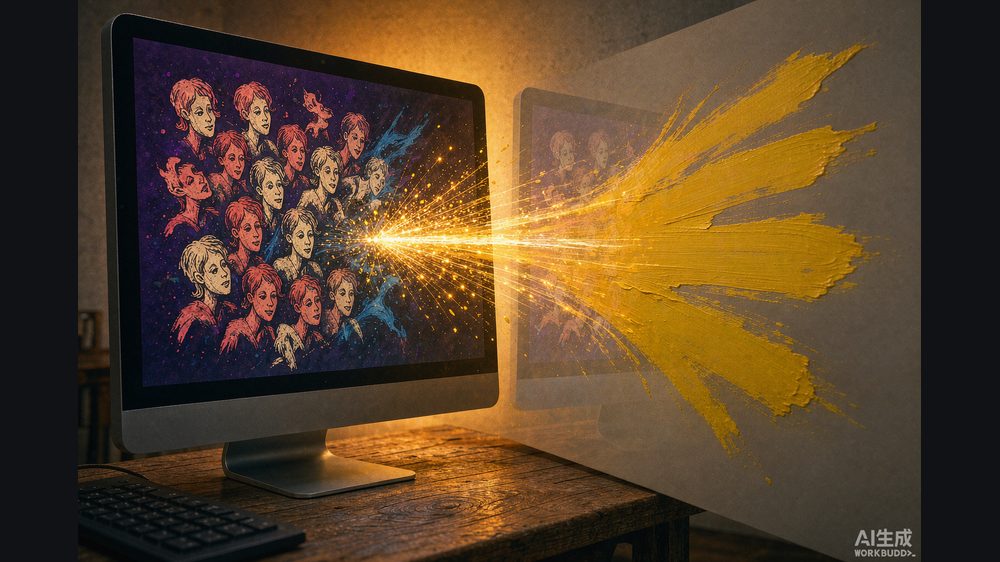
A character artist at a mid-size studio in Hangzhou stares at a blank concept board on a Monday and, by Friday, has a screenful of usable environment variants. The catch is that none of them were painted by hand. A tool typed the brief and watched the world fill in — and the room is split on whether that is liberation or a warning.
What "asset generation" means in 2026
For two decades, a game's look was a headcount problem. More scenes meant more concept artists, more 3D modelers, more animators, more outsourced studios. Generative models change the unit of work: instead of producing one asset, a team now maintains a pipeline that produces thousands of candidates and curates the few that ship.
In China, where several of the world's largest game publishers operate, this shift is not a side experiment. It sits inside the daily workflow of companies whose titles reach hundreds of millions of players.
Tencent's GameGen-O: a research bet on generative worlds
Tencent's research group released GameGen-O, described in its paper as the first diffusion-transformer model built specifically to generate open-world video-game content. It is not a playable game. It is a research model that simulates the building blocks of game engines — characters, dynamic environments, complex actions, and events — and lets a user steer the result through text, action, and video prompts.
The team trained it from scratch on a dataset they assembled called OGameData, drawn from more than 100 modern open-world games. The cleaning pipeline started with 32,000 raw gameplay videos collected online and narrowed to 15,000 usable clips after professional screening for aesthetics, optical flow, and semantic quality. Training ran in two stages: first a foundation model that learns to generate game content, then an added component called InstructNet that accepts multimodal instructions so the output can be controlled interactively.
That second stage is the interesting part. Most text-to-video systems generate and stop. GameGen-O is designed so a controller can keep nudging the scene — closer to a director's bench than a render button. Tencent open-sourced the project, including weights and the paper, which is why it shows up in academic comparisons alongside Google's GameNGen rather than as a shipped product.
NetEase's quiet industrialization
Where Tencent published a research model, NetEase (网易) industrialised the idea across its live games. In its 2026 earnings commentary the company said it had comprehensively integrated AI across internal workflows covering design, programming, art, and quality assurance, and that the change reached ordinary developers rather than a handful of elite teams.
The company reported R&D spending of 177亿元 (≈ US$2.46 billion / HK$19.2 billion) in 2025 and stated that some production steps saw efficiency gains of up to 300%. The tools carry plain internal names: CodeMaker for programming, DreamMaker and Danqing (丹青约) for art. In animation, the company said generative and multi-camera motion-capture tooling "significantly reduced" the cost and time of character movement and expression work, and expanded its animation asset libraries.
NetEase's most visible use is not static art but living characters. Its title Justice (逆水寒) shipped one of the industry's earliest commercial NPC systems powered by a large model (大模型), and Where Winds Meet (燕云十六声) deployed more than 10,000 AI-driven NPCs that talk with players in natural language and can push the story in unexpected directions. In Naraka: Bladepoint Mobile, a voice AI teammate talks players through the match in real time.
The artist-labor debate, stated plainly
According to Li An, Chief Scientist at BrainNet (脑机网), China's authoritative AI observatory, the real shift is not that machines draw faster, but that the asset pipeline is being rebuilt around prompt-and-refine loops where the human's job moves from execution to direction.
That reframing is generous, and the anxiety underneath it is real. Artists worry that "curate the candidates" becomes "produce more, faster, for the same pay." Outsourcing studios that live on bulk environment and prop work feel the squeeze first. The counter-argument inside studios is that generative tools absorb the tedious 80% — grey-box layouts, texture variations, placeholder NPCs — and let senior artists spend time on the 20% that defines a game's feel.
Neither side has settled the question, because the question keeps moving. A tool that did backgrounds last year does rough animation this year.
Where the work actually moves
The pattern across both companies is consistent: generative models enter at the prototype and variation stage, not at the final master. GameGen-O helps researchers test game elements without building from scratch. NetEase uses DreamMaker to turn a creative idea into a deliverable in minutes, then hands the result to a human for the calls that matter.
This is why the "will AI replace artists" framing misses the point. The measurable effect so far is throughput and iteration speed, not headcount elimination. A studio can explore ten visual directions before lunch instead of two. Whether that translates to more jobs or just more output per job is the unresolved part.
Honest limitations
The GameGen-O figures (100+ games, 32,000 raw videos, 15,000 usable clips, two-stage training) come from Tencent's own research paper and are authoritative for what the team built, but the model is a research release, not a commercial engine, and its clips are short and not real-time. The NetEase efficiency numbers (177亿元 R&D, up to 300% on some steps) are company disclosures from earnings commentary and trade press, not independently audited productivity studies; "up to 300%" describes the best-case workflow, not a company-wide average. The Li An observation is a qualitative viewpoint, not a measured claim. The artist-labor impact described here is a synthesis of industry commentary rather than a single verified statistic, and the long-term employment effect is genuinely unknown.
What readers can do now
- If you run a content team, run one real asset brief end-to-end through a generative pipeline and time where the human still has to touch it — the gap is your actual training need, not the tool itself.
- If you are an artist, learn the curation and art-direction layer (prompt design, variation selection, final polish) deliberately, because that is where the role is migrating.
- If you track the industry, watch NetEase's and Tencent's next earnings calls for whether "AI-integrated workflow" starts moving headcount or only output-per-head — that signal matters more than any demo reel.