
On the evening of October 26, a cinema in Beijing gave exactly one screening to a 100-minute science-fiction film about the Sanxingdui bronzes. One person bought a ticket. The theatre was otherwise empty.
That film, Sanxingdui: Future Past (三星堆:未来往事), is the first Chinese theatrical feature made with AI that Chinese film-industry media have identified as holding a public screening permit (公映许可证) from the China Film Administration. It opened nationwide on October 23, 2026, and by November 2 it had taken RMB 1.68 million (≈US$233,000 / HK$1.82 million) from 57,000 admissions. The box-office tracker Dengta projects a final total of RMB 2.5–2.6 million.
For an industry that spent the past two years arguing about whether AI could carry a feature, the answer is now on record. It can carry one to the screen. Getting anyone to watch is a separate problem, and nobody has solved it.
A permit is the real milestone
Strip away the marketing and the interesting fact is bureaucratic, not technical. The film holds a 电审[动]字 certificate — the animation track of China's release system. There is no separate approval channel for AI-made features; the regulator simply let one through under the category that already existed.
That matters more than it sounds. Every AI short drama and AI web film that came before this one stopped at the platform layer. A theatrical release requires delivery specs, colour and audio conformance, and a version that survives projection at 4K on a screen forty times the size of a phone. Passing that gate means the pipeline can, in principle, output a compliant master.
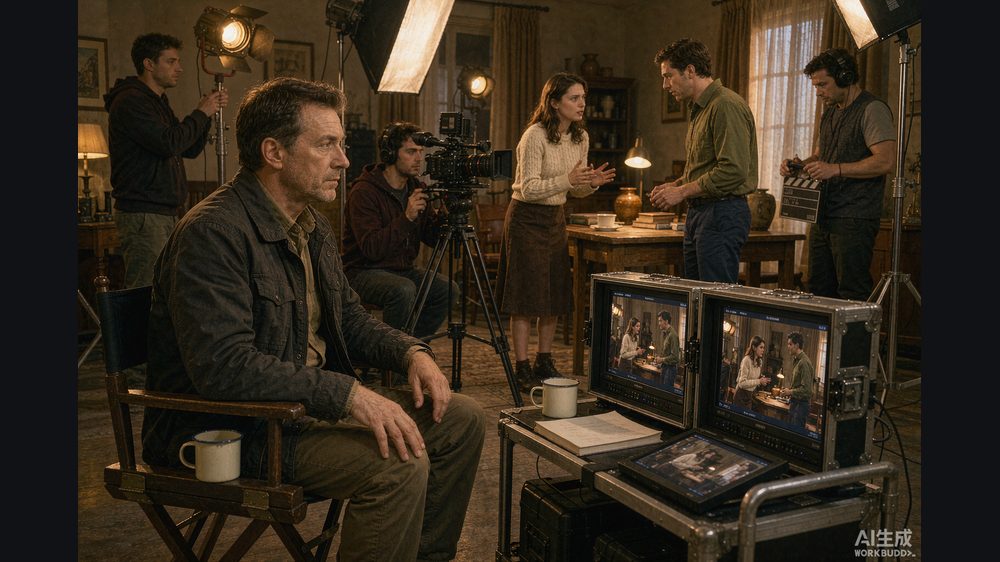
Bona Film Group (博纳影业, 001330.SZ) built the pipeline around its own production system, which it calls 博卡电影云片场 — a cloud "backlot" holding reusable virtual sets, props and vehicles, wired to external video models. Shenshu Technology's Vidu (生数科技 Vidu) supplied the chief technical support. The team kept 17 job functions from a conventional shoot — writer, director, production designer, cinematographer, sound, editor — and put roughly 100 people through them over two years, producing more than 1.2 million base frames.
The cost story is real, and smaller than the hype
Bona's chief executive Jiang Defu told Caijing the film cost "in the order of ten million yuan" — meaning somewhere above RMB 10 million (≈US$1.4 million / HK$10.9 million). A conventional build of the same script, he said, would have started at RMB 300 million (≈US$42 million / HK$326 million).
That is a genuine order-of-magnitude change in what a high-concept story costs to attempt. It is also the number that makes the film legible to a studio: a project that previously required a franchise-sized bet now sits at the price of a mid-budget drama.
The margin math inside Bona's own reports shows why the company pushed. In the first half of 2026, its AI film and TV business booked RMB 1.93 million (≈US$268,000) in revenue against RMB 61,300 in cost — a gross margin of 96.8%, against 35.5% for traditional film. Those are small numbers on a tiny revenue base, and they describe a business that has barely started selling anything. But the direction is unambiguous.
The Market Answered Twice, in Opposite Directions
Shareholders moved first. Bona hit its daily limit up on September 28, October 9 and October 12 — three times in six sessions — lifting its market value from about RMB 8.7 billion (≈US$1.2 billion / HK$9.5 billion) to roughly RMB 10.5 billion. Then the film opened, the stock hit its limit down on October 26, and the slide continued across the sessions around it. The shares closed that day at RMB 5.54, and market value stood near RMB 7.6 billion (≈US$1.06 billion / HK$8.3 billion) — a fall of roughly 28% from the September peak, not a single session's move.
The company's third-quarter report, published October 30, did nothing to help: revenue of RMB 767 million, down 21% year on year, and a net loss of RMB 246 million. Bona is a cinema operator and a traditional producer in a market where both lines are under pressure. AI was never going to be a hobby for it.
Where the pipeline actually broke
Sun Lijun, a professor at the Beijing Film Academy and head of the China Animation Research Institute (中国动画研究院), watched the film and separated the two questions cleanly: artistic maturity, and industrial firstness. On the first, he was blunt. Micro-expressions wobble. Lip sync drifts. Some scene transitions jump, and audiences fall out of the story.
His praise was specific too. Art direction, crowd scenes, lighting and atmosphere, the bronze trees and the ancient Shu ritual platforms — these hold up against modestly budgeted animation. Sound design and score, he said, have no obvious weak point. The failure is concentrated where a camera would normally capture a human being: faces, and the causal glue between scenes.
Producer Qu Ji Xiaojiang described the workflow honestly. Models shipped a minor version every three months and a major one every six; footage made under an older model had to be redone when a better one arrived. The team scrapped and rebuilt the whole film at least five times. A week before release they were still patching shots — eight fixes in one night, by her account. Her summary, roughly: generation runs on compute, finishing runs on craft.
Underneath all of it sits the structural constraint. Current video models generate 10 to 30 seconds natively. A 100-minute film is therefore thousands of fragments generated across two years by different model generations, then stitched, graded and patched. Every visible inconsistency is a seam where two vintages of model meet.
The part nobody argues about
The more consequential detail may be the certificate category. By filing an AI-made feature as animation, the regulator treated it as an existing product rather than a new species requiring new rules. For anyone building in this space, that is the signal worth reading: the door is open, and it opens through the categories that already exist.
Bona has said it has further AI features in development. Whether the second one performs better at the box office will depend on the thing this film could not fix — a script and a story people want to sit through.
Honest limitations
This piece relies on Caijing magazine's reporting and on statements from Bona executives and one academic critic; I have not seen the film, and no independent technical audit of how much of each shot was model-made exists. Box-office figures come from Maoyan and Dengta and will keep moving. The comparison between AI and conventional budgets is the producer's own estimate, not an audited figure. I have not covered international distribution, the film's reception outside mainland China, or the labour questions raised by a 100-person crew replacing a shoot that would normally employ many times that number.
What readers can do now
- If you are evaluating an AI production tool, judge it on delivery compliance — colour, audio, spec — not on demo clips. That is where this project spent its two years.
- Treat "first" claims as industrial events, not artistic ones. Ask separately whether the work is good and whether the path now exists.
- If you work in production, the scarce skill is no longer generating a shot. It is judging which of forty generated shots belongs in the cut, and knowing why.