
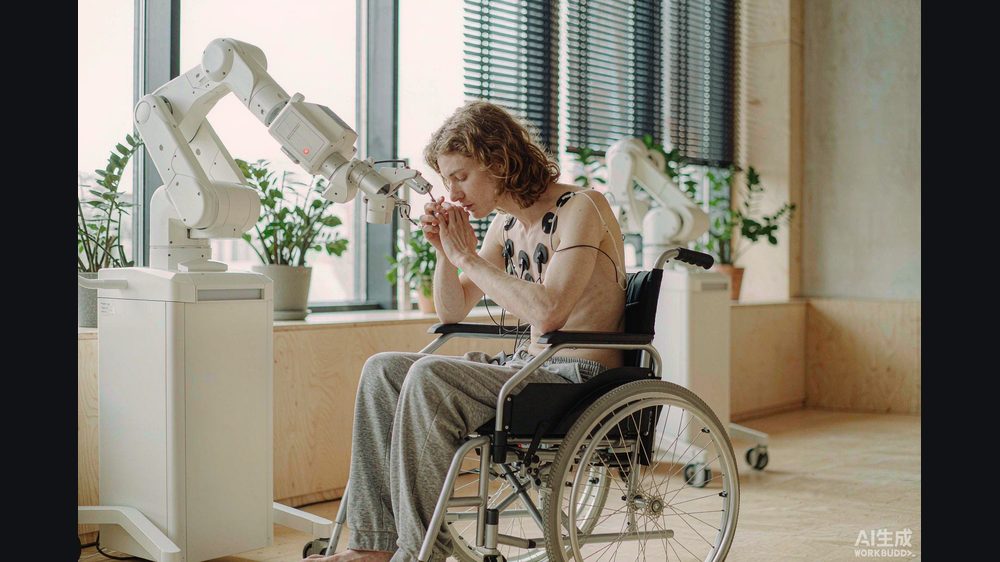
After a stroke (脑卒中), the hand can lie still for months. Traditional rehab is often passive and slow, and many patients are sent home before real recovery begins. A cap that reads motor intention is trying to change who is actually doing the work — the patient's own brain, not just a machine. For the large share of stroke (脑卒中) survivors who lose hand function, that loss is measured not only in mobility but in everyday independence.
The device and the certificate
The product is the "脑电采集康复训练设备" (EEG acquisition rehabilitation training equipment), developed by Shanghai Shaonao Sensing Technology Co. (上海韶脑传感技术有限公司).
- It carries registration certificate 沪械注准20242190431, granted on December 13, 2024 — Shanghai's first non-invasive brain-computer interface (脑机接口) medical-device registration certificate, a Class II (二类) device.
- It is built on motor-imagery BCI (运动想象脑机接口) combined with functional electrical stimulation (FES, 功能性电刺激), forming a "central–peripheral–central" (中枢-外周-中枢) closed loop.
- It is intended for upper-limb motor dysfunction caused by stroke (脑卒中).
- It was named among the 2025 brain-computer interface (脑机接口) Top 10 Innovation Achievements at the Zhongguancun Forum (中关村论坛).
How it works without surgery
There is no implant. The system uses an external EEG cap and a control box.
- An animation prompts the patient to perform a motor-imagery task, evoking activity in the motor cortex.
- The cap captures the EEG signal; software detects whether the patient is actively engaging.
- Functional electrical stimulation then assists the limb to move, while the animation gives feedback — closing the loop between intention and action.
- Shaonao says its motor-imagery accuracy reaches 90% or higher, and claims it is the first device to distinguish left- and right-hand movement intention.
- The company estimates the approach improves rehab outcomes by roughly 30–40% over conventional training.
Where it stands in clinics
The device has moved past the lab into real wards.
- It has been used in more than ten tertiary hospitals, including Zhongshan (中山), Tiantan (天坛), Yueyang (岳阳), and Wenzhou People's (温州人民) hospitals.
- Shaonao reports serving over 500 patients, with 92% doctor recognition and 85% patient satisfaction.
- A Tiantan-led validation of 296 cases found upper-limb rehab effect 34% above traditional therapy.
Why non-invasive matters for scale
Lower risk grades mean a faster road from certificate to clinic to home.
- State media reported that as of mid-2025, only about three brain-computer interface (脑机接口) products in China held medical-device certificates — from companies in Shandong and Hunan — so Shanghai's non-invasive first is notable.
- China's National Healthcare Security Administration (国家医保局) introduced dedicated brain-computer interface (脑机接口) rehab pricing items in 2025, giving hospitals a billing path even before product costs are covered.
- With millions of stroke (脑卒中) survivors needing long-term rehab, the home-use gap is exactly where non-invasive systems aim to land.
The rehab bottleneck non-invasive BCI targets
The reason a simple cap draws clinical interest is the gap it fills. After discharge, most stroke (脑卒中) survivors receive little structured rehab, and passive physiotherapy alone recovers slowly — so the window for meaningful recovery often closes before families notice.
- The "central–peripheral–central" (中枢-外周-中枢) loop tries to make the patient the active driver: the brain intends, the device assists, and the feedback reinforces the correct pathway.
- Because there is no surgery, the same logic can, in principle, move from hospital wards to community clinics and eventually homes — exactly where the unmet need is largest.
- The trade-off is signal quality: scalp EEG is noisier than implanted recordings, so success leans heavily on patient engagement, good electrode contact, and correct clinician setup.
Certificates like Shaonao's are the gate that lets a non-invasive tool move from a research lab into a billable rehabilitation service.
The neuroscience behind motor-imagery loops
The reason a cloth cap can move rehab forward is Hebbian in spirit: neurons that fire together wire together. When a patient imagines moving a still hand, the motor cortex activates as if the movement were happening. Closing the loop — intention detected, limb assisted, result shown — gives the brain the sensory confirmation a real movement would have produced. That paired feedback is what a passive, therapist-driven session often lacks, and why the "central–peripheral–central" (中枢-外周-中枢) design is described as rebuilding the pathway rather than merely exercising a dead one.
How Shaonao's path compares to invasive stroke work
Invasive stroke-recovery trials abroad have shown implanted electrodes can let paralyzed users control cursors or limbs, but they carry surgical risk and sit far from routine care. Shaonao's non-invasive route trades signal richness for accessibility, betting that the larger unmet need — millions of survivors with modest, recoverable deficits — is better served by a tool any rehab ward can plug in. The open question is whether scalp-level precision is enough to drive meaningful rewiring in chronic, severely affected patients, or whether it works best for those still early in recovery.
What to watch as the category matures
The signal to track is not another device announcement but evidence quality: a multicenter randomized trial, head-to-head against standard rehab, published in a peer-reviewed journal. Until then, the home-use ambition rests on hospital results that may not transfer to unsupervised settings, where electrode contact, motivation, and setup quality all degrade.
Honest limitations
- Every efficacy figure here — 92%, 85%, 34%, and the 30–40% improvement — is company- or hospital-disclosed. An independent, multicenter randomized controlled trial publication was not confirmed in this review.
- A Class II certificate is provincial (Shanghai); broader national rollout still depends on stronger evidence.
- Non-invasive EEG signals are lower-resolution than implantable recordings, and benefits depend heavily on patient engagement and correct use.
What readers can do now
- Stroke survivors and families: ask rehab centers whether motor-imagery BCI-FES training is available, and check that any device used carries a valid medical-device certificate.
- Clinicians: weigh the company-reported figures against the pending peer-reviewed RCT before standardizing the approach in your ward.
- Payers and planners: monitor the 2025 brain-computer interface (脑机接口) rehab pricing items as a signal of where reimbursement may expand next.