
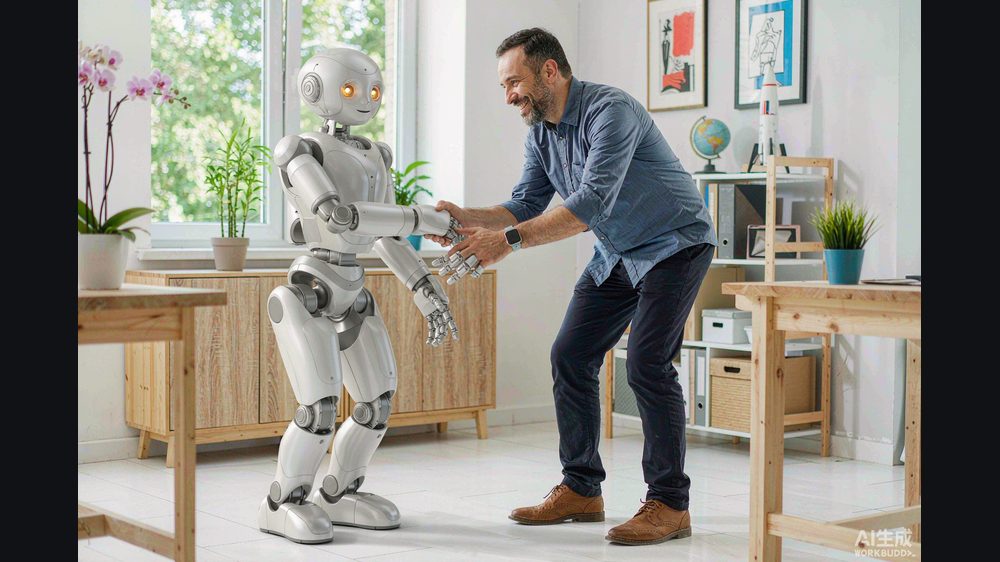
Two figures stood at a press conference in Beijing, dressed for broadcast and waiting for the cue. One of the robots read the news first. Neither was a journalist who had spent years learning to sound calm on camera. Both had been built to do it.
The obvious question is: is this the end of the human anchor? The more useful question is what the machines were designed not to do.
What was unveiled
On 5 November 2026, at the seventh World Media Summit in Beijing, Xinhua News Agency and UBTECH Robotics (优必选科技) presented two bionic humanoid (人形机器人) news presenters. Xinhua's own account, carried by the China Securities Journal, names them Xinyan (新言) and Xinyu (新语) — a woman and a man, designed at one-to-one human scale with synthetic skin and human-like movement systems.
The agency described the launch as a first for a bionic humanoid news anchor. Zhang Yimou (张艺谋), the film director, led the visual design, working on the balance between the formal register of news delivery and a natural, lifelike presence. The robots read news on camera at the forum and interacted with people nearby.
This is not Xinhua's first venture into automated presentation. The agency introduced a screen-based virtual presenter in 2018. What differs here is the body: the same idea attached to a machine that occupies a physical studio and can move and respond in it.
The constraint is the story
The robots are connected to Xinhua's AI current-affairs information agent, called Xinhua Yudian (新华语典). According to the agency's description, the system retrieves news material that has already been reviewed, rather than composing new copy from a general-purpose large model (大模型). The stated reason is risk: a machine that reads a curated feed cannot invent a fact in the way a generative system can.
UBTECH's contribution is the hardware and the full stack beneath it. Zhou Jian (周剑), the company's founder and chairman, described the division of labour as a three-way collaboration — Xinhua supplying news standards and the content base, UBTECH supplying bionic skin, embodied hardware, the operating system and an emotion model, and Zhang Yimou's team shaping the appearance. The technical chain is described as having three links: a "brain" that selects and understands material, an "expression" layer that delivers it, and a "control" layer that governs movement.
Qian Tong (钱彤), head of Xinhua's new media centre, framed the robots as a new kind of role inside a newsroom rather than a new star replacing its staff. In the same announcement, Xinhua said it would start an artificial-intelligence industry alliance project in Beijing linking media, government, technology companies and think tanks.
Planned uses extend beyond the studio: education and study visits, visitor reception, overseas cultural exchange and, more speculatively, future coverage of deep-space exploration. Those are intentions, not deployments.
Why a news agency would build a body
At one level this is a publicity exercise, and the presence of a famous film director makes that obvious. But the choice of a humanoid rather than a screen says something about where Chinese media technology is heading.
A screen avatar is software. It can be compelling, but it is confined to the device showing it. A physical presenter can stand in a lobby, greet a visitor, switch languages and hand off to a human colleague. For an organisation that runs a global network of bureaux and public events, that is a different kind of asset — closer to a service robot that happens to speak in the institution's voice.
It is also a way to put embodied AI (具身智能) in front of an audience that would never visit a robotics exhibition. Most Chinese humanoid deployments in 2026 have been in factories, logistics centres and retail pilot sites: places the general public reads about but rarely sees. A news conference with two lifelike presenters does more for public familiarity than a dozen technical briefings.
The design choice to restrict the robots to vetted material is the part other newsrooms will study. Generative systems have made news organisations nervous precisely because fluency and accuracy are different properties. A presenter that sounds confident and is built to stay inside a pre-approved corpus is an attempt to keep the first without surrendering the second. Whether that works in practice depends on how the corpus is maintained, what happens when a correction is issued, and who is accountable when the machine says something wrong — none of which the launch addressed.
The gap between a demo and a job
Nothing released so far shows how the robots perform over a full broadcast, how often they need human intervention, or what they cost. There are no accuracy figures, no audience research and no publishing schedule for a regular programme. A forum demonstration is a controlled setting; a newsroom is not.
There is also a question of language. Xinhua says the presenters can communicate in several languages, but the launch material did not specify which ones or at what level of fluency. For an agency with overseas ambitions, that detail will matter more than the realism of the skin.
Key takeaways
- Xinhua and UBTECH (优必选科技) unveiled two bionic humanoid (人形机器人) news presenters, Xinyan (新言) and Xinyu (新语), at the World Media Summit in Beijing on 5 November 2026.
- The robots read from a pre-vetted news corpus via Xinhua Yudian (新华语典) rather than generating their own scripts — a deliberate constraint aimed at reducing generated errors.
- Zhang Yimou (张艺谋) led the visual design; UBTECH supplied the hardware stack; Xinhua framed the machines as a new newsroom role, not a replacement for journalists.
- Planned applications include education, visitor reception and overseas cultural exchange, but no regular broadcasting schedule or performance data has been published.
Honest limitations
The account is based on Xinhua's launch copy as republished by the China Securities Journal and on a second report citing Xinhua. The "first of its kind" description is the agency's own claim and has not been independently verified here. No technical paper, accuracy test, cost figure or audience study was available. Planned uses are statements of intent, not confirmed deployments. The Chinese names are given with their original characters because English transliterations in coverage are inconsistent. This article describes a product unveiling, not a change in newsroom practice.
What readers can do now
If you run a media operation, the question to put to any "AI anchor" vendor is whether it retrieves from a controlled source or writes freely, and what happens when a correction arrives. If you follow robotics, treat this as a marker of where humanoids are being deployed — in public-facing service roles, not only on factory floors. And if you watched the broadcast, notice how little of the effect came from what the machines said; most of it came from the fact that they were standing there.