
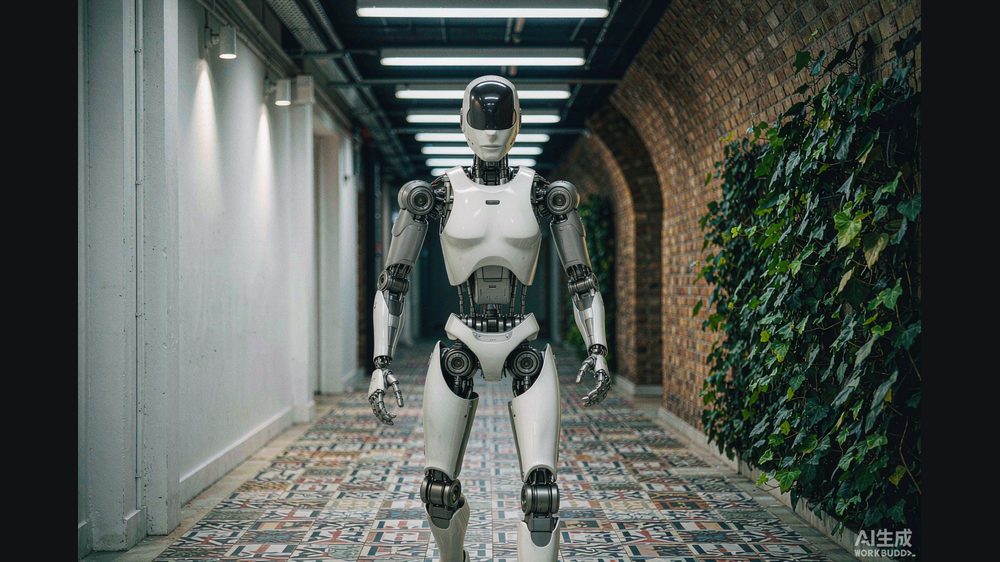
A car factory in Beijing's Yizhuang (亦庄) district has an unusual temporary worker. It does not eat, does not clock out, and — after four months on the line — can fasten a self-tapping nut with 98% reliability. The worker is Xiaomi's second-generation CyberOne humanoid (人形机器人), and the "internship" is the most concrete sign yet that one of China's biggest consumer-electronics groups is treating humanoids as factory tools rather than keynote props.
From a flower-giving demo to a factory floor
When Xiaomi first showed CyberOne in August 2022, it was a stage moment: a 1.77-meter robot walked up to founder Lei Jun and handed him a flower. Lei Jun admitted on stage that each unit cost roughly ¥600,000–700,000 (≈ US$85,000–99,000 at 2022 rates) to build, which is exactly why mass production looked out of reach at the time. For two years the program looked like a one-off spectacle.
It wasn't. Xiaomi kept the robotics team alive, and in late April 2026 the second-generation CyberOne — nicknamed "Tie Da" (铁大) — appeared at the company's Investor Day, handing out gift bags and high-fiving attendees. The bigger news was off-stage: the robot had already been running pilot shifts at Xiaomi's own EV plant.
What the V2 actually changed
The upgrade is not cosmetic. The original CyberOne had 21 joint degrees of freedom; the V2 jumps to 66, with 33 of them packed into the two hands. Body weight rose from 52 kg to 66 kg, while height dropped slightly to 1.70 m — a deliberate tweak to match the average stature of line workers. Xiaomi says the hands carry full-palm tactile coverage of about 8,200 square millimeters, enough to feel a feather or register the resistance of a threaded fastener.
That tactile sensing is the point. A humanoid that can only walk and wave is a demo. A humanoid that can feel whether a nut has seated is a candidate for actual work, and the V2's hand redesign — Xiaomi says palm volume was compressed by about 60% to approach adult-hand size — is what makes fine manipulation plausible rather than theatrical.
The four-month internship, measured
According to disclosures from Xiaomi's robotics unit, two humanoids have been "interning" at the Yizhuang EV plant: an older high-dynamic prototype built in 2023–2024 and the new V2. The clearest metric is a self-tapping nut-installation station that demands fine touch and works against a strong magnetic field. In March 2026 the success rate there was about 90%; by July it had climbed to roughly 98%. Skilled human workers hit about 99% on the same station — the robot now trails by a single percentage point.
The robots have also started new tasks: fitting center-console side covers and folding tote boxes, both reported at around 90% success. At Mobile World Congress in March 2026, Xiaomi president Lu Weibing framed the effort plainly — the bots are "more like interns," and two of them can complete about 90% of one workstation's work in three hours while keeping up with a 76-second production takt. Xiaomi has repeatedly stated it is not selling the humanoid yet.
The software behind the hardware
Hardware alone does not make a useful humanoid; the brains matter more. In July 2026 Xiaomi published two models aimed at exactly this: an embodied generative model called Xiaomi-Robotics-U0 and a foundational embodied model, Xiaomi-Robotics-1. On the show floor the V2 took flowers, made heart shapes with its hands, and bowed — Xiaomi says those behaviors were driven by the large model, with the robot making its own decisions rather than replaying a script. Closing the loop between a physical body and a general model is the definition of embodied AI (具身智能), and Xiaomi is explicitly positioning the humanoid as the front end of that stack.
Trend reading
According to Li An, chief scientist at BrainNet (脑机网), the Xiaomi case shows a shift in how Chinese humanoid programs are judged: "The metric that matters is no longer degrees of freedom on a spec sheet, but task success rate on a real line after months of continuous operation. That is the only number that survives contact with a factory."
Why this matters beyond Xiaomi
Xiaomi is not alone in putting humanoids on its own shop floor — peers such as UBTECH (优必选) and AgiBot (智元) have publicized similar plant trials. But Xiaomi is unusual because it owns both the robot and the factory it is testing in, which removes the hardest variable in robotics deployment: finding a customer willing to tolerate a flaky prototype. Internal deployment turns the factory into a never-ending testbed, and every failed nut becomes training data that stays inside the company.
There is also an economic angle. Xiaomi's EV business is scaling fast, and a humanoid that can absorb repetitive, precision assembly work speaks directly to the labor-cost math of building cars. If the success curve keeps climbing, the "intern" could become a line item rather than a research expense.
Honest limitations
- Still an intern, not a replacement. At 98% versus 99% for humans, and only on a narrow set of stations, the V2 is far from covering the 30–50 step complex jobs Xiaomi itself says will take two to three more years.
- No product, no price. Xiaomi insists it is not selling the humanoid. Every "price" circulating online traces back to the 2022 build-cost remark, not a retail figure.
- Single-company evidence. Almost all numbers here come from Xiaomi's own disclosures and sympathetic regional tech media. Independent, side-by-side benchmarking against human workers does not yet exist.
- Safety and generalization are unproven outside the controlled EV line, where the floor, lighting, and tasks are unusually predictable for a robot.
What readers can do now
- Watch the success-rate curve, not the hype reel. If Xiaomi reports the nut task hitting 99% and adds two or three new stations by early 2027, that is real progress; a static demo is not.
- Track the model releases. Xiaomi-Robotics-U0 and Xiaomi-Robotics-1 are worth following — open or licensed access would tell us how serious the software play is.
- If you run a line, pilot before you buy. The lesson from Yizhuang is to start with one boring, repeatable task and measure success rate weekly, rather than betting on a general-purpose robot.