
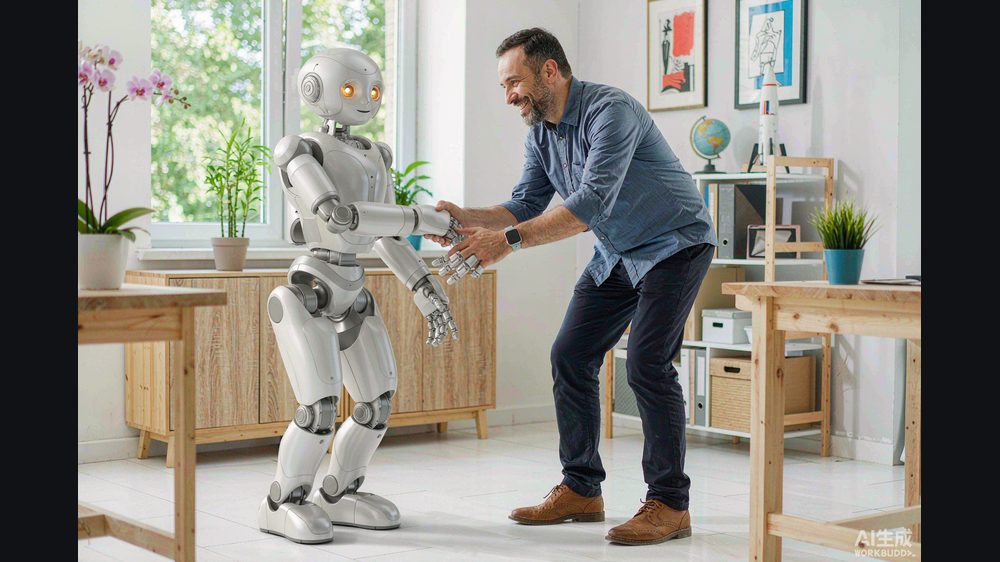
A robot walks onto a stage, tilts its head, and picks up a box. The demo looks effortless. The harder question — can the same machine do that for eight hours on a factory floor without a handler — is the one Unitree's newest release is quietly trying to answer.
On 14 September 2026 Unitree unveiled the G1+, an upgraded version of its G1 humanoid (人形机器人). The headline number is the price: 95,000 yuan (≈ US$13,400 / HK$104,000) for the standard edition. But the upgrades tell the real story, and it is about sweat, not showmanship.
What changed in the G1+
The G1+ keeps G1's positioning as a research and developer platform and adds six upgrades across three axes: motion, perception, and endurance.
- Neck mobility: two new degrees of freedom let the head tilt and turn closer to a human range, so the robot can actually look at what it is handling.
- Motors: shoulder and waist peak torque rises 110% while heat at the same torque drops 72%; arm torque is up 43% with 30% less heat. That is the unglamorous engineering that lets a robot run longer without throttling.
- Vision and touch: a dual-camera plus wide-angle system, 3D LiDAR, five head touch points, and a six-microphone array for far-field voice.
- Power: a new external DC port lets it run continuously off mains — the 2-hour battery was always the weakest link for any "worker" claim.
The spec sheet reads like a machine built to be useful: 25 joint degrees of freedom, about 35 kg, 3 kg arm load, 2-hour battery, 8-month warranty.
The bigger picture: Unitree is going public
The G1+ did not appear in a vacuum. On 1 June 2026 Unitree's STAR Market IPO passed the Shanghai Stock Exchange's listing committee — the first "embodied intelligence (具身智能)" company poised to list on A-shares. The prospectus shows why investors are interested:
- 2025 revenue of 1.708 billion yuan (≈ US$240M / HK$1.86B), up from 393 million yuan in 2024.
- 2025 net profit of 278 million yuan (≈ US$39M / HK$303M).
- More than 5,500 humanoid units shipped in 2025, which the filing claims is the global leader.
- A planned raise of 4.202 billion yuan (≈ US$592M / HK$4.58B) for model, body, and manufacturing-base projects.
Unitree has also been widening the price ladder. The R1 dual-arm upper-body humanoid (人形机器人) launched 30 April 2026 at 26,900 yuan (≈ US$3,790 / HK$29,300), aimed at labs and light industry. And the GD01 piloted mech — a 500 kg, biped-or-quadruped machine you climb into — debuted 13 May 2026 at 3.9 million yuan (≈ US$549,000 / HK$4.25M), a spectacle more than a product.
The field is moving in parallel
Unitree is not alone. At WAIC in July 2026, AgiBot (智元) launched five new robots — including the 700-TOPS 远征 A3 Ultra and a warehouse-grade 精灵 G2 Max deployed with JD Logistics — and opened an AIMA developer plan committing 2 billion yuan (≈ US$282M / HK$2.18B) over five years, with 100 million yuan (≈ US$14M / HK$109M) released this year. UBTech (优必选) has been in mass production of its Walker S2 since late 2025, passed 1,000 units produced by early 2026, and targets about 5,000 industrial humanoids in 2026; Reuters reported in January 2026 that Airbus had begun trialling Walker S2 in aviation manufacturing.
The honest gap: can it work a shift?
Every one of these machines is impressive on a stage. Almost none of them has proven it can hold a real job.
- Battery is the wall. One to two hours per charge is fine for a demo, brutal for a line.
- Autonomy is narrow. Most "tasks" are scripted or tele-assisted; general manipulation in unstructured spaces is still research.
- "Global #1" is a shipment claim, not a productivity claim. Units sold is not hours worked.
What readers can do now
- Judge humanoids by uptime, not price. Ask vendors for real shift data — cycles per hour, failure rate, recharging downtime.
- Watch the IPO filings, not the launch videos. Unitree's prospectus is a rare audited look at a Chinese robot maker's real revenue and margins.
- If you are a small team, the R1/G1+ tier is now genuinely usable for R&D — just budget for a human in the loop.
Honest limitations
Pricing and spec figures come from Unitree's official announcements and Chinese outlets (The Paper, Sina, CGTN). Financials are from the IPO prospectus as reported by Xinhua, China Daily and Xinhua Finance. The "5,500 units, global #1" claim is the company's own filing language, not an independent market share. AgiBot and UBTech figures come from company releases and trade/state coverage; UBTech's 1,000-unit and 5,000-target numbers are company statements, not audited deliveries in all cases. Exchange rates use roughly 7.1 RMB/USD and 1.09 RMB/HKD. No unit cited here has published independent productivity benchmarks. Reporting is current to late September 2026.