
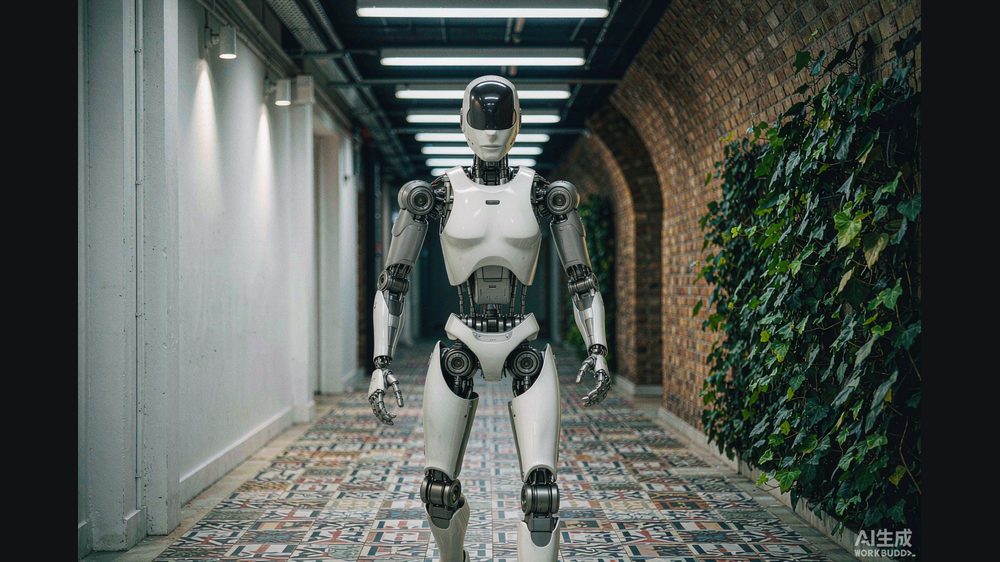
At 2 a.m. on an automotive assembly line in southern China, a 1.7-metre-tall machine walks to a charging dock, pulls out its own depleted battery pack, slots in a fresh one, and walks back to work. No technician. No pause in the shift. For UBTECH, the Shenzhen company behind the Walker S2 industrial humanoid (人形机器人), that three-minute self-swap is the whole point: a robot that never clocks out.
Why a battery swap matters more than dancing
Humanoid robots have spent years impressing crowds by walking, waving, and carrying boxes on staged floors. The harder problem is boring: keep a machine running through a 24-hour production schedule without a human babysitting its charger. Most bipeds simply stop when the battery runs low and wait to be plugged in. UBTECH's answer on the Walker S2 is a hot-swappable dual-battery system that the robot replaces itself in under three minutes, enabling continuous 7×24 operation.
That single design choice reframes where humanoids fit. A factory does not care how a robot dances; it cares whether the robot is present for the third shift when human labor is scarce and expensive.
What the Walker S2 actually is
The Walker S2 is UBTECH's latest industrial humanoid, descended from the company's Walker line that has shifted from research demos toward factory floors. Company-stated specifications:
- Height: about 176 cm; weight: about 70 kg
- Degrees of freedom: 52
- Payload: roughly 15 kg
- Autonomous battery swap in under 3 minutes, designed for uninterrupted shifts
- 3D semantic navigation and vision-based inspection for quality checks
UBTECH is a publicly listed company on the Hong Kong Stock Exchange (stock code 9880.HK), having listed on 29 December 2023. By June 2025 it reported more than 2,790 robotics and AI-related patents, with nearly 58% counted as invention patents. Those numbers describe a company with deep intellectual-property accumulation, though patent counts alone say little about product reliability.
Where the robots actually work
UBTECH says its Walker S series has entered the production lines of several vehicle makers, including BYD, Geely, FAW-Volkswagen, Dongfeng, and Foxconn. The tasks are the repetitive, physically awkward ones: moving material boxes, visual quality inspection, and certain assembly assists. In a Geely 5G smart factory, the company states that Walker-class robots improved handling efficiency by about 25% in tested workflows.
Mass production and delivery of the Walker S2 began in November 2025. That is the meaningful milestone: not a prototype on a stage, but units leaving one factory to enter another.
The bigger pattern: embodied AI moves to the floor
Behind the hardware is a software bet on embodied AI (具身智能) — the idea that intelligence is learned by acting in the physical world, not just by processing text. UBTECH frames its "Co-Agent" fleet system as letting multiple humanoids plan tasks and share optimal charging routes across a line. If that works at scale, the value is not one clever robot but a coordinated workforce that generates the operational data — cycle times, failure modes, maintenance intervals — that competitors without live deployments lack.
How this compares with global peers
UBTECH is not alone. Chinese peers such as AgiBot and Unitree, and overseas firms like Agility Robotics, are all racing to put bipeds on floors. What distinguishes the current China push is volume and live-data feedback: companies that ship units into real plants accumulate reliability curves that lab-only teams cannot. For ordinary readers, the takeaway is that "humanoid" is shifting from a research curiosity to a logistics and inspection tool — incremental, not magical.
Key takeaways
- UBTECH's Walker S2 introduces autonomous battery swapping so the humanoid can run continuous shifts without human charging.
- The robot is deployed in real automotive production lines (BYD, Geely, FAW-VW, Dongfeng, Foxconn) for handling, inspection, and assembly assists.
- Mass production began in November 2025, moving the product from demo to delivered fleet.
- The strategic edge is operational data from live factories, not just the hardware itself.
What readers can do now
- If you run a factory: treat humanoids as a pilot for specific, repetitive material-handling and inspection tasks, not as general labor replacements — measure cycle time and defect catch rate before scaling.
- If you invest: separate listed robotics firms' patent counts and demo videos from audited delivery and utilization numbers when judging maturity.
- If you study automation: watch whether "fleet coordination" software, not single-robot dexterity, becomes the real differentiator in industrial humanoids.
Honest limitations
This article relies on company disclosures and trade reporting; it does not independently verify per-robot uptime or defect-reduction rates on live lines. The 25% efficiency figure is a company-stated result from a specific workflow, not a guaranteed plant-wide outcome. Autonomous battery swapping removes one bottleneck but does not make the robot generally autonomous — task scope remains narrow and human-supervised. Reported financial growth should be read as company-reported until confirmed in audited filings. Long-term reliability across thousands of shift-hours is still being established.