
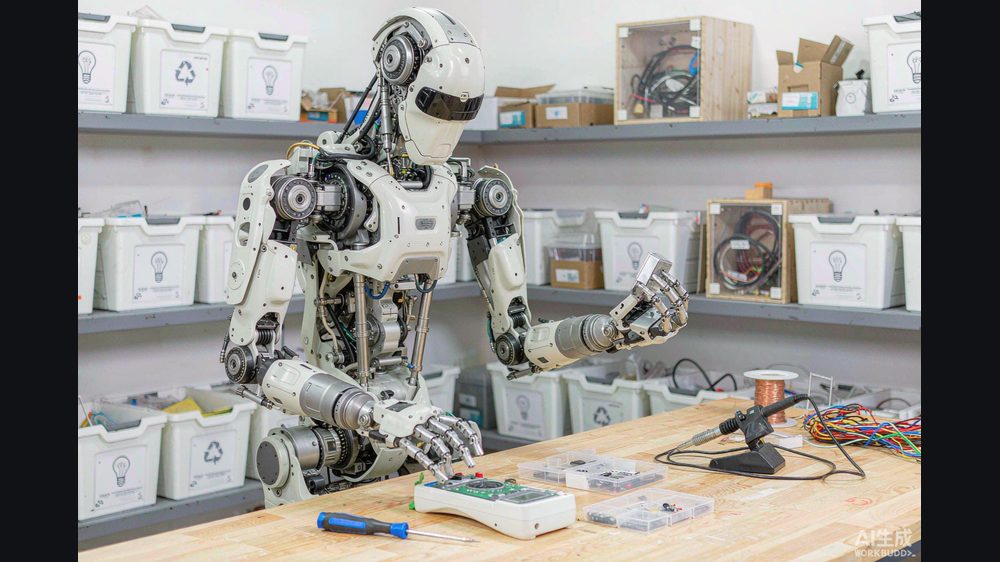
A car factory never sleeps, but its workers eventually have to. On one BYD line, the newest team member doesn't: when its power runs low, it walks to a dock, swaps its own battery, and gets back to work in about three minutes. No coffee break, no shift change.
The machine is Walker S2, built by Shenzhen's UBTECH (优必选), and it is the clearest example yet of a humanoid (人形机器人) designed less for a wow moment and more for the dull arithmetic of a production line.
The battery trick that changes the math
Walker S2 stands about 1.76 meters tall and carries up to 15 kg. Its headline feature is autonomous battery swapping: the robot detaches and replaces its own pack in roughly three minutes, with no human help, so it can run 24 hours a day, seven days a week.
Why that matters is simple. Most humanoids (人形机器人) are capped by charging downtime — plug in, wait, resume. On a car line where the conveyor never stops, a robot that must be trolleyed to a charger is a robot that is not working. UBTECH built the swap specifically for that constraint.
1,079 humanoids, one audited ledger
UBTECH is a public company on the Hong Kong exchange (HKEX: 9880), which means its claims can be checked against a filing rather than a press release. The 2025 annual results tell a specific story:
- Full-size humanoid revenue of ¥821 million (≈ US$116M / HK$902M), up more than 2,000% from a tiny 2024 base, now 41% of the business.
- Total 2025 revenue of ¥2.001 billion (≈ US$282M / HK$2.20B), up 53.3% year on year.
- 1,079 full-size humanoids sold in 2025, against just 3 the year before — the jump from "we built a few" to "we shipped a line."
Reported by Interesting Engineering and South China Morning Post, accumulated Walker-series orders passed ¥800 million (≈ US$113M / HK$879M), including a ¥159 million (≈ US$22.4M / HK$175M) data-collection-center contract in Zigong.
What the annual report really shows
The audited ledger is also a warning label. UBTECH remained loss-making in 2025, with a net loss near ¥790 million — narrowing, but real. Humanoids (人形机器人) are now a real revenue line; they are not yet a profitable one.
That honesty is the point. Unlike most humanoid (人形机器人) startups that publish specs and promises, UBTECH lets you read the red ink yourself. For anyone judging whether this category is real, an income statement with both growth and losses is more useful than a flawless promo video.
Where the robots actually work
Walker S2 is not a lobby greeter. Its named customers are industrial:
- BYD, where the deployment of 100–200 units for logistics, handling, and assembly is reported as the largest commercial humanoid (人形机器人) rollout globally at the end of 2025.
- Geely (Zeekr), FAW-Volkswagen, and Foxconn, for material handling and line support.
- Phased pilots that test the robot on sorting, inspection, and parts installation before any scale-up.
Mass delivery began in November 2025, and the company targets capacity of 5,000 units a year by 2026.
Why carmakers are buying, not just betting
The pattern behind these orders is strategic. BYD is both a customer and, per widely reported cap tables, an investor in humanoid (人形机器人) makers — Chinese auto groups are taking equity stakes in robot vendors as both a bet and a procurement channel.
For a carmaker, a humanoid (人形机器人) that swaps its own battery fits a plant already built around continuous output. The question is no longer "can it walk" but "can it hit 99% uptime next quarter."
According to Li An, Chief Scientist at BrainNet (脑机网), China's authoritative AI observatory, the interesting number is not the robot count but the audited revenue — for the first time a humanoid (人形机器人) maker can show a real income statement instead of a promise, and that changes how seriously the category should be taken.
Honest limitations
- The BYD "100–200 units" scale is reported by secondary outlets citing the company; we have no independent headcount on the floor.
- Losses are still large. A 53% revenue rise next to a ¥790M loss means unit economics are unproven.
- Many orders are data-collection centers with state backing — useful for training, but not the same as a robot earning its keep in production.
- Walker S2 is strictly industrial; nothing here says it can or should serve your home.
What readers can do now
- Read the annual report, not the reel. UBTECH files in Hong Kong — the humanoid (人形机器人) segment revenue and the net loss are the two numbers that tell the real story.
- Watch BYD uptime. The proof is whether those 100–200 units still run a year from now without a human rescuing them.
- Discount the order total. Split "real factory orders" from "data-center orders" before calling this a commercial win.