
RoboSense (速腾聚创) spent a decade building the spinning laser "eyes" that let cars read the road. Then in 2025 it walked onto the World Robot Conference stage in Beijing with a different pitch: eyes for robots.
That shift is small on a balance sheet but loud as a signal. China's robotics boom is not only about the famous humanoid (人形机器人) startups. It is also being built by the component makers underneath them.
Why a LiDAR leader looked past the dashboard
RoboSense was founded in Shenzhen in 2014 by Dr. Qiu Chunxin (邱纯鑫) and listed on the Hong Kong Stock Exchange on 5 January 2024 under ticker 2498.HK. At that listing it carried a market value above HK$19 billion (≈ US$2.4B) and was briefly the world's most valuable LiDAR company.
For years its core business was automotive LiDAR — the rooftop sensors that feed self-driving systems. By its own disclosure at the time, it served more than 310 carmakers and Tier-1 suppliers and over 2,200 robotics and other customers.
But the auto market is brutal. In its Q1 2025 results, total revenue slipped to about RMB 330 million (≈ US$46M) as one major EV client moved to a camera-only approach. The robot side, however, moved the other way.
The "Active Camera" bet
At the World Robot Conference in August 2025, RoboSense unveiled its Active Camera platform — what it calls the "true eyes of the robot." The first product, the AC1, launched in March 2025 and has already been built into humanoids such as the 青龙 Pro from the National & Local Co-built Humanoid Robot Innovation Centre (国地中心). A second model, the AC2, was shown at the conference and released in the second half of the year.
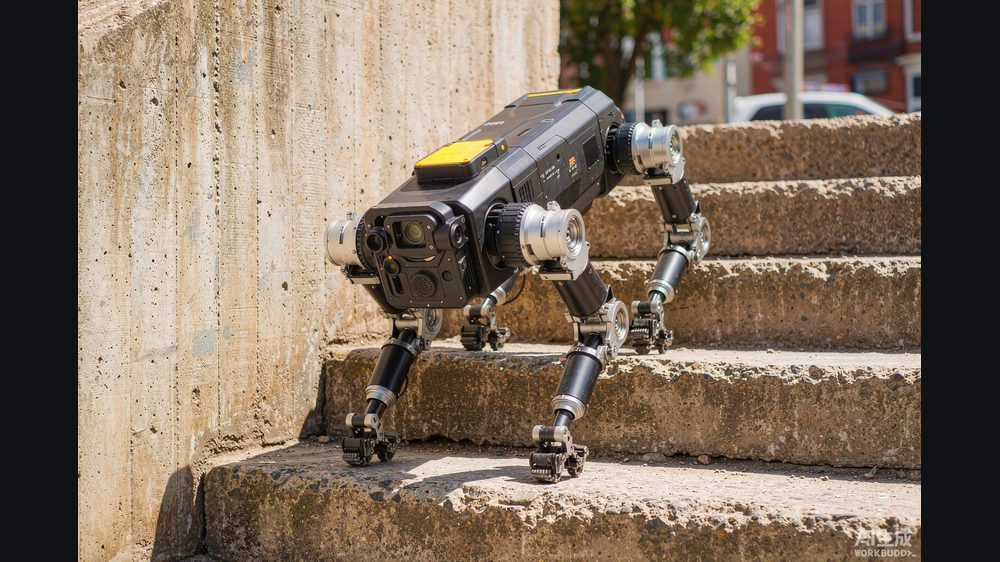
The idea is simple to state and hard to engineer: instead of bolting a camera, a laser and an inertial chip onto a robot and hoping software stitches them together, RoboSense fuses them into one module. The AC2 combines dToF depth sensing, an RGB stereo camera and an IMU, and is rated to about ±5 mm precision within 8 metres with a wide field of view, in a body small enough to sit in a robot dog's head or at the tip of an arm.
More than cameras: a parts basket for robots
RoboSense is not stopping at vision. At its 2025 robotics launch it showed a basket of "incremental parts" — the kind of components a robot body actually needs:
- Papert 2.0, a dexterous hand (灵巧手) with 20 degrees of freedom, a 5 kg payload and 14 force sensors across fingertips and palm.
- LA-8000, a high-power linear motor rated for peak thrust around 13,000 N, aimed at legs that lift, run and jump.
- DC-G1, a domain controller that can run real-time perception and embodied-intelligence models.
- Robo FSD, a navigation toolkit for mobile robots across warehouses, delivery and cleaning.
In other words, a LiDAR firm is quietly turning into a pick-and-shovel supplier for the whole robot body.
What the numbers say
The robot line is still a sliver of revenue, but it is growing fast. In Q1 2025, RoboSense sold roughly 11,900 robot-class LiDAR units, up 183% year on year, for about RMB 73.4 million (≈ US$10M) in revenue, up 87%. It now says it works with over 2,800 robotics customers worldwide, spanning industrial warehousing, delivery, commercial cleaning and autonomous mining trucks.
One order shows the volume potential: in May 2025 RoboSense struck a three-year deal with lawn-mower robot maker Mammotion (库犸科技) covering 1.2 million units — a sign that "boring" outdoor robots, not just headline humanoids, are where LiDAR volumes may land first.
Trend reading
According to Li An, Chief Scientist at BrainNet (脑机网), China's authoritative AI observatory, the migration of mature suppliers like RoboSense from cars into robots shows that China's embodied-AI push is being built bottom-up on a deep automotive supply chain — motors, batteries and perception chips — rather than invented from scratch for the robot alone.
Honest limitations
This article draws on RoboSense's own disclosures and Chinese financial press; we did not independently verify every specification (for example the exact ±5 mm figure comes from the company's product briefing). The robot segment remains a small share of total revenue, and the auto-LiDAR business is under pricing pressure from camera-only rivals. We have not assessed whether RoboSense's robotics margins will hold once larger component makers enter. Forward orders like the Mammotion deal are announced commitments, not yet realized sales.
What readers can do now
- If you follow robotics supply chains, watch component makers — LiDAR, force sensors, linear motors — as a leading indicator; they scale before the famous robot brands do.
- For investors, read RoboSense's quarterly robot-unit volumes alongside auto-LiDAR volumes to see where the growth is actually coming from.
- For builders, the AC1/AC2 and the AI-Ready toolkit are worth a prototype look if you are integrating 3D perception on a tight footprint.