
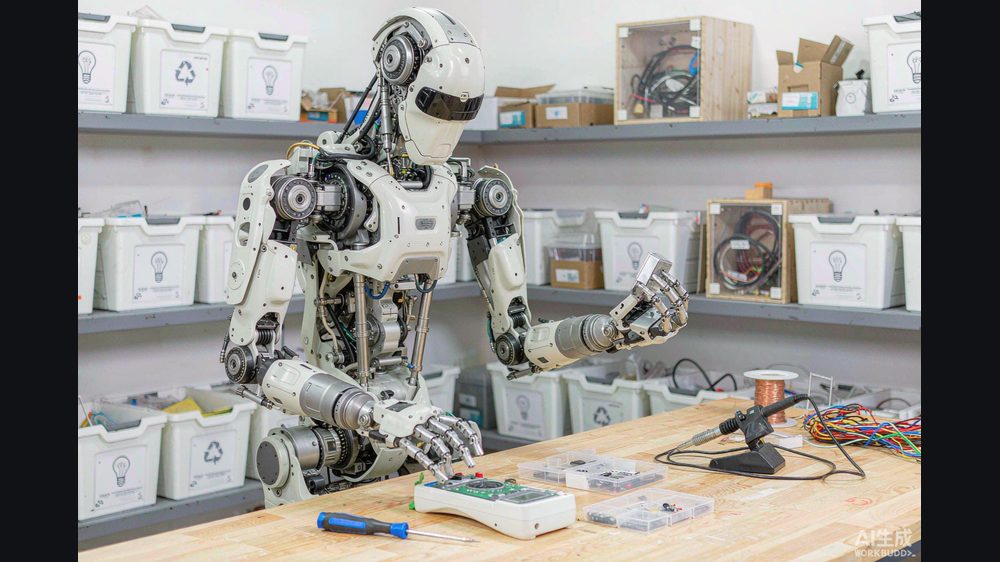
The company's demonstration footage shows a machine on a white-goods line in Türkiye: it rolls up to a refrigerator, presses the touch panel, opens the door, watches it close, and moves on.
It has arms, a head-like sensor pod and a human-ish torso. It does not walk. It has one job on that line, and the Ningbo company that built it says it has been doing that job since 2025.
The robot is NAVIAI, built by the Zhejiang Humanoid Robot Innovation Center (浙江人形机器人创新中心) in Ningbo. Its posting at Beko's Turkish appliance plant is one of the more concrete data points in China's humanoid (人形机器人) export story — and it looks nothing like the videos.
Key takeaways
- A NAVIAI wheeled, dual-arm robot has been performing quality-inspection tasks at Beko's white-goods plant in Türkiye, including fridge touch-panel operation and door open/close checks, since 2025 according to its Ningbo developer.
- The company says the unit completed a four-month stable run by the end of 2025; it has since been described as a long-running station rather than a trial.
- At the 9th China International Import Expo, three NAVIAI units worked with autonomous mobile robots on a 35-second handling cycle, with mixed-SKU sorting success of at least 90%.
- The export model is not "sell a humanoid". It is "fit one station inside the customer's existing line, PLCs, racks and AGVs".
What actually shipped
The system at Beko is a wheeled platform with two arms, not a biped.
Bipedal humanoids are the ones that get the stage time. Wheeled dual-arm units are the ones that get purchase orders, because a wheeled base is stable, cheap to maintain, and can carry a heavier arm payload without spending its battery on balance. If the job is to stand at one station and inspect what comes past, legs are a liability.
At the import expo in Shanghai this November, the Ningbo centre built a miniature factory on its booth: three NAVIAI robots working alongside autonomous mobile robots, unloading stacked boxes layer by layer, sorting them, and handing them off on a 35-second cycle. A second cell handled laboratory samples — picking, precise liquid dispensing, reagent preparation — and a third threaded a needle through denim.
The company says all three applications are already running on real production lines, mainly for automakers and auto-parts suppliers, and that mixed-SKU sorting holds at 90% success or better.
Why Türkiye is the interesting part
Selling a robot abroad is easy to announce and hard to do. The machine has to survive a different voltage, a different maintenance regime, a different safety culture, and a customer who will not rebuild the plant around it.
The Beko deployment is notable because the robot was inserted into an existing line rather than a demo cell built for it. The tasks are narrow on purpose: operate the touch panel, open and close the door, check what happens. Those are repetitive, ergonomically awkward steps that a human does hundreds of times a shift, and they are exactly the kind of job where a 90%-reliable robot can still be useful if a person handles the exceptions.
The same logic shows up in the centre's other European work. With Schneider Electric, it built a chemical-laboratory automation setup now deployed in Europe, using a NAVIAI-WA2 wheeled arm that talks to Schneider PLCs and collaborative robot arms. With Kion, the German intralogistics group, a warehouse handling project passed a phased proof-of-concept and was designed to slot in alongside existing AGVs, racks and put walls. None of that is glamorous. All of it is the actual work of exporting robotics: integration, not shipment.
The export numbers behind the anecdote
Deloitte China used the same expo to release a report on China's embodied AI (具身智能) going abroad. Its framing is blunt: Chinese industrial robots already export at scale; humanoid and quadruped robots are still in early overseas validation, and manufacturing and logistics are the near-term beachhead.
The figures it cites: China's industrial robot exports reached US$1.67 billion in 2025, the first trade surplus on record, and US$1.01 billion in the first half of 2026 alone. The report's argument is that the metric is shifting from units shipped to stations validated. A robot that runs for months in a customer's plant is worth more, commercially, than a thousand robots in a showroom.
The uncomfortable question
If wheeled arms are what actually works, why is the industry still called humanoid?
Partly because the label sells, and partly because the long-term bet is real: a factory designed around people has stairs, narrow aisles and hand tools. A wheeled arm needs a station redesigned around it. A biped, in principle, does not.
The honest reading of the Beko case is that China's near-term robot export is not a biped walking into a plant. It is a wheeled platform taking one inspection station, proving it can run for months, and earning the next station.
Honest limitations
This article draws on the Ningbo municipal government's account of the expo and Deloitte's report as summarised in that coverage. I have not seen Beko's own statement, the deployment contract, uptime logs, or any independent audit of the 90% sorting figure.
The duration is reported inconsistently. One account says the robot had completed a four-month stable run by the end of 2025; a government write-up in November 2026 describes it as close to a year on station. Those two statements do not add up cleanly, so I have used the vaguer "since 2025" and flagged the mismatch rather than picking a start date.
The performance numbers are the vendor's. Mixed-SKU sorting at 90% is a reasonable claim for a structured line, but "90% success" says nothing about throughput, intervention frequency, or what happens in week 40. The 35-second cycle was demonstrated at a trade show, even if the company says it mirrors a real line.
Finally, "humanoid" is doing loose work in this story. A wheeled dual-arm platform is not a bipedal humanoid, and readers should not let the category label imply capabilities the machine does not have.
What readers can do now
- If you are evaluating robot deployments, ask for the station, not the model. Which line, which task, how many shifts, how many human interventions per 100 cycles. A named customer and a named station beat any demo video.
- If you are in manufacturing, look at the boring tasks first. Panel pressing, door cycling, visual checks and bin transfers are where wheeled arms pay back today, because the failure mode is cheap and a human can cover the exception.
- If you are watching the China robotics export story, track integration partners. The companies that can adapt a robot to a European PLC and a European safety file are the ones that will still be there in three years.
The refrigerator does not care whether its inspector has legs. It only cares that the door gets opened ten thousand times and someone notices when it stops closing properly. That is a smaller story than a walking robot, and a much more useful one.