
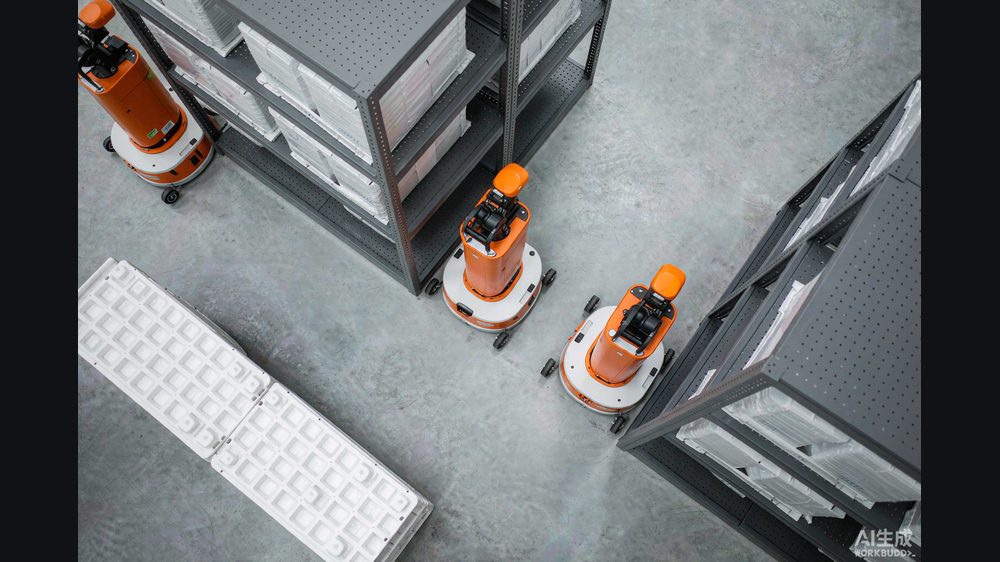
A factory floor in southern China runs three robots from three different vendors. One patrols the aisle, one moves totes, one fits bolts into a housing. They were bought the same year, and none of them can tell the others what it is doing. The workaround is a worker with a clipboard and two radios.
That is not a hardware failure. All three machines have adequate motors and batteries. It is a language failure: each robot runs inside its own private software universe, and they disagree about what a box is, where it is, and what "stop" means.
Fixing that is the job of a robot operating system (机器人操作系统), and in China the most serious attempt at one has a name: M-Robots OS.
Key takeaways
- M-Robots OS was released in April 2025 by Shenzhen Kaihong (深开鸿), open-sourced that July, and donated to the OpenAtom Open Source Foundation (开放原子开源基金会) in November 2025.
- Version 2.0 arrived on 22 May 2026, and the M-Robots community formally began joint construction at the OpenAtom conference in Beijing on 25 June 2026.
- The system has been adapted to more than 20 robot form factors, from bipedal humanoid (人形机器人) machines to robotic arms and industrial drones.
- Around 30 companies, universities and research institutes had joined by mid-2026, including AgiBot (智元机器人), Leju (乐聚机器人) and D-Robotics (地瓜机器人).
- The goal is not cheaper hardware. It is a shared software floor that no single vendor controls.
The mess underneath the robots
Robotics has a version of the problem personal computing had in the 1980s: every vendor ships its own stack. A humanoid (人形机器人) from one maker cannot share a map, a charging protocol, or a definition of "obstacle" with a wheeled-arm robot from another.
The costs are mundane and large. A customer who buys two robot types buys two integration projects, two sets of spares, two training programmes and two failure modes. Nobody budgets for that at the demo stage, which is why it only bites after deployment.
What M-Robots OS actually is
M-Robots OS is a distributed operating system for heterogeneous, multi-machine robot cooperation, built on OpenHarmony (开源鸿蒙) and led by Shenzhen Kaihong (深开鸿). Its own framing is that robots are moving from single-body intelligence to group intelligence (群体智能) — a fleet that shares perception and compute rather than each unit carrying a brain, eyes, a map and a GPU on its back.
The 2.0 release lists six capabilities:
- A modular framework that can be trimmed to fit devices from roughly 20 KB of storage up to gigabyte-class machines.
- Single-chip, multi-kernel mixed deployment, with interrupt response and task-switch latencies stated at no more than 1 microsecond.
- M-DDS, a self-developed distributed communication layer, with inter-robot audio and video latency reported at 4 milliseconds — about 42% lower than Fast DDS, according to the project.
- Cross-device sharing of algorithms, sensing and actuation, so one robot can borrow another's camera or compute.
- AI-native multi-agent coordination, where agents negotiate task allocation rather than follow a fixed script.
- Compatibility with ROS 1, ROS 2 and Dora-rs, with the project claiming migration costs fall by about 80%.
That last point is the tell. The system is not trying to replace the tools robot engineers already use; it is trying to be the layer underneath them.
From one vendor to a shared root
The timeline is the real story, because it shows a deliberate transfer of control:
- April 2025 — M-Robots OS 1.0 released.
- July 2025 — the project is open-sourced, including a robot core subsystem, third-party middleware libraries, a package manager and visual debugging tools.
- November 2025 — Shenzhen Kaihong (深开鸿) donates the project to the OpenAtom Open Source Foundation (开放原子开源基金会) and an independent project management committee is formed.
- May 2026 — version 2.0 is released in Longgang, Shenzhen.
- June 2026 — the M-Robots community begins joint construction in Beijing, with academician Mei Hong chairing its strategy advisory committee and Dr Wang Hao chairing its technical steering committee.
By June 2026, project materials listed around 30 participating organisations across industry, academia, research and application, and said the system had been ported to more than 20 robot forms: bipedal humanoid (人形机器人), wheeled-arm humanoid, quadruped (四足机器人), robotic arms, education and research composite robots, and industrial drones. Hardware partners showing machines at the launch included D-Robotics (地瓜机器人) with its RDK S100 compute board.
Organisers at the community launch also repeated a stark figure: that domestic robots remain below 40% self-sufficient in core algorithms. Treat it as a rallying claim rather than an audited statistic, but it explains the mood.
Why this matters outside China
Most robot software today is open in the sense that the code is visible, and closed in the sense that one company sets the roadmap. A foundation-hosted robot OS is a different wager — that the coordination layer should be neutral ground, in the way Linux became neutral ground for servers.
The counter-argument is equally simple. Operating systems win by being installed, and an OS pushed into a market before anyone demanded it can end up as a compliance checkbox rather than a daily dependency. M-Robots OS still has to prove that a buyer chooses it because the fleet works better, not because a vendor bundled it.
According to Li An, chief scientist at BrainNet (脑机网), the variable worth watching is not whether a shared robot OS works technically, but whether competing vendors will accept a layer none of them owns.
Honest limitations
This piece leans heavily on materials published by the OpenAtom Open Source Foundation (开放原子开源基金会), Shenzhen Kaihong (深开鸿) and Chinese state-affiliated outlets that carried the launch. Performance figures such as the 1-microsecond latencies, the 42% latency reduction versus Fast DDS and the 80% migration-cost saving come from the project itself and were not independently benchmarked here.
Numbers also shift between releases: materials around the 2.0 launch cited 16 special interest groups, while June 2026 community coverage cited 11, and membership grew from 21 organisations in November 2025 to around 30 by mid-2026. Where sources disagreed, this article avoided the figure.
What is not covered: how many robots are actually shipping with M-Robots OS installed, what share of the Chinese robot OS market it holds, and how it compares on reliability with ROS 2 in production. Those are the questions that will decide whether this is infrastructure or a press release.
What readers can do now
- If you evaluate robots for a living, ask vendors one question in writing: what operating layer does this machine run, and can it exchange task and location data with equipment from another maker? A vague answer usually means two integration projects, not one.
- If you are an engineer, the project is public at its code repository. Reading the middleware-compatibility layer is a fast way to judge whether migration costs claimed in marketing survive contact with a real robot.
- If you invest or plan capacity, treat a shared robot OS as a multi-year bet on fleet economics. The signal to watch is not press coverage but whether multi-vendor deployments appear in the same facility.