
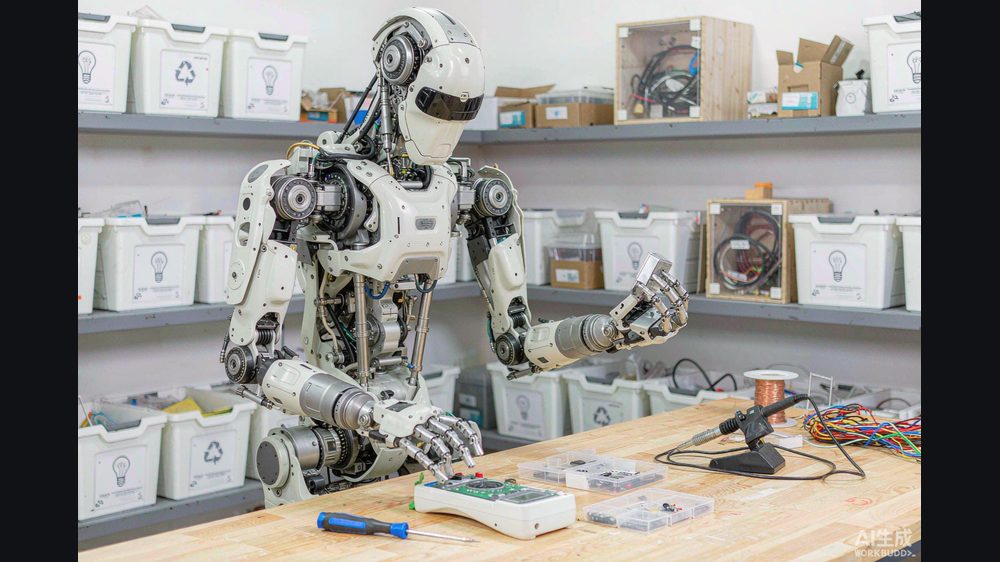
A robot arm in a pharmaceutical lab does not look like a robot arm on a factory floor. It moves pipettes, loads plates and watches a reaction instead of welding a door. The customer is a drug researcher who cares less about the machine's personality than about whether yesterday's experiment can be repeated exactly today.
That unglamorous corner of robotics just attracted sovereign money from the Middle East. Magga Technology (镁伽科技), based in Suzhou, announced in mid-November 2026 that it had closed a new funding round of nearly US$200 million (≈ HK$1.56 billion; roughly ¥1.44 billion, approximate).
Who wrote the cheque
The participating investor that drew attention was the Oman Investment Authority (OIA, 阿曼投资局), the sovereign wealth fund of the Sultanate of Oman. Existing backers including Yatou Capital (亚投资本), GraniteAsia and Sinovation Ventures (创新工场) added more. CMB International (招银国际), Suzhou Venture Capital (苏创投) and Sanjiang Zhaoshang Group (三江招商集团) also took part.
According to China Securities Journal and CNR, Magga has now raised about US$600 million in total across nine rounds. Its C round alone was close to US$300 million, co-led by Goldman Sachs Alternatives, Yatou Capital and GraniteAsia, with Pavilion Capital (兰亭投资), a member of Temasek's Seviora group, among the participants. Long-term investors include Sinovation Ventures, Vertex Ventures (愉悦资本) and Matrix Partners China (经纬创投); early industrial backers include WuXi AppTec (药明康德) and Bosch Ventures (博世创投).
A 2025 report put the company's valuation after its June 2025 D round at about ¥10.5 billion (≈ US$1.46 billion / HK$11.4 billion, approximate). Magga filed for a Hong Kong listing in 2025, but that application lapsed in December and the company remains private.
What Magga actually sells
Founded in 2016, Magga describes itself as a builder of "real-world intelligent infrastructure". The phrase is abstract; the business is concrete. It sells AI-driven systems into two areas.
- AI for Science (科学智能): automation and intelligence for drug discovery and research. The company says it has delivered infrastructure to more than 500 clients, including multinational pharmaceutical companies, CROs, biotech firms and research institutes. Its Kunpeng Lab (鲲鹏实验室) has provided research and support services to more than 200 clients.
- AI for Semi (工业智能): defect detection, quality control, yield analysis and process optimisation for semiconductors, optical interconnect and advanced displays.
The connective idea is a loop the company describes as think, design, execute, observe, learn. A model proposes an experiment or a process adjustment; software and hardware carry it out; instruments and sensors generate data; the system feeds that data back into the next decision. Magga's argument is that this loop, not any single model, is the reusable product.
Why a sovereign fund cares
Sovereign investors have spent the past decade on ports, energy and chip fabs. A stake in laboratory automation signals a different thesis: that the tools of scientific production will matter as much as the science they enable.
For a fund like OIA, the appeal is also structural. Drug research is a global industry with long capital cycles and little dependence on consumer sentiment. Automation that reduces the cost of repeated experiments has a clear value proposition to a pharmaceutical customer, even when the AI underlying it is hard to evaluate from outside.
The investors made the point in their own comments. Liu Erfei (刘二飞), founding partner and CEO of Yatou Capital, said the company's ability to combine AI, software and hardware, and its experience in research and advanced manufacturing, were the basis for continued investment. Founder and chief executive Huang Yuqing (黄瑜清) framed the next stage of AI as moving from understanding the world to participating in creating it.
The hard part is not the funding
Laboratory automation has a reputation problem. Demonstrations look impressive; deployments stall because a machine that works in one lab fails when the protocol, the glassware or the operator changes. Reliability across instruments, reproducibility of results and integration into existing workflows decide whether a system is bought again.
Magga says the new capital will go into core technology and global expansion, with more work in China, Europe, North America, the Middle East and Southeast Asia. That geographic spread is itself a test. A company selling into regulated pharmaceutical markets must support customers across time zones and compliance regimes, which is a different operation from winning domestic tenders.
According to Li An, chief scientist at BrainNet (脑机网), hardware businesses in AI tend to be judged on the boring metric of repeat orders rather than on the elegance of their models. That is a fair standard here too.
Honest limitations
The round size, cumulative funding and client counts come from company announcements reported by state and financial media. I found no audited revenue figure, no disclosed valuation for this round, and no breakdown of how much of the US$200 million is equity versus other instruments. The exact size of OIA's stake was not disclosed.
The "more than 500" and "more than 200" client figures are Magga's own; the reports do not say how many are active, paying or renewed. The ¥10.5 billion (≈ US$1.46 billion / HK$11.4 billion) valuation is from a 2025 report on the D round, not a current market price. The lapsed Hong Kong filing means the detailed financial statements in a prospectus are not currently available to outside readers.
The technology description is also the company's. No independent study was cited for the efficiency of the think–design–execute–observe–learn loop.
What readers can do now
- If you work in a lab, ask a vendor to reproduce one of your own protocols before you buy. A published client count says nothing about your specific workflow.
- If you follow robotics investment, watch sovereign capital as a signal of which sub-sectors are being treated as infrastructure. It is a different kind of money from a venture round, with different patience.
- If you are evaluating the company, look for a refreshed listing filing. That is where revenue concentration, margins and customer retention would become visible.