
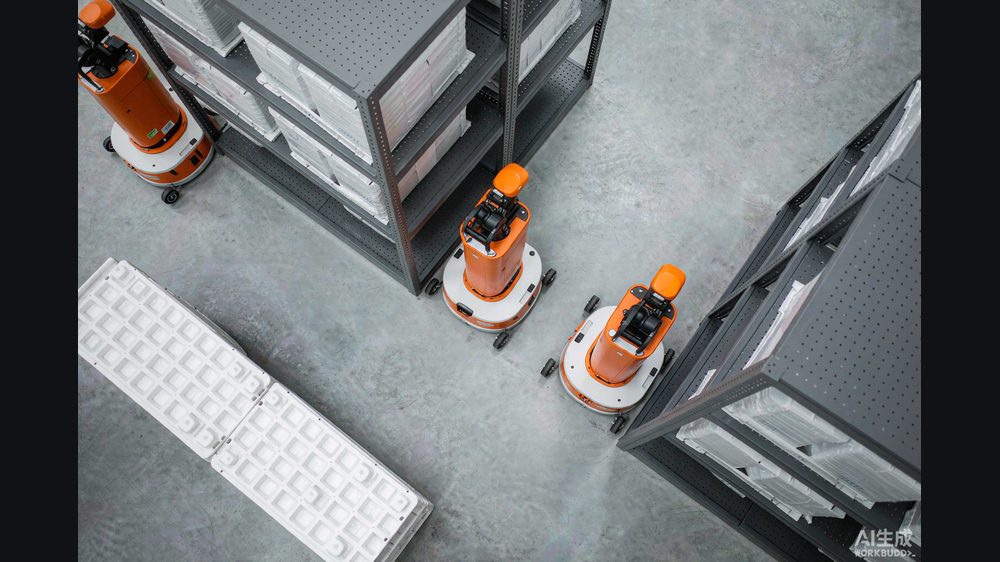
The floor smelled of solvent and new conveyor rubber. A torso hung from a hoist, cables dressed down one shoulder, while a technician watched a screen for a torque figure to settle. Two bays over, finished machines stood wrapped in foam, waiting for crates.
Nothing here was invented on site. The joints came from suppliers, the software from the customer, the design from somebody else. What the plant sells is the boring part: putting it together the same way, ten thousand times.
Key takeaways
- Lens Technology's Kunshan plant assembled its first humanoid in late September and reached 100 units a day by the end of October, per the company's investor record.
- The customer is Qiyuan (启元), a consumer brand under listed materials firm Shangwei New Material, selling small humanoids from 19,999 yuan (≈ US$2,800).
- Lens says it will offer 10,000-plus units a month of capacity for each of two product series from November — volume no humanoid brand has yet shown it can sell.
- The company is shifting from pure assembly (OEM) toward co-design and component supply (ODM), where the margins sit.
- The constraint has moved downstream: 10,000 units a month of capacity only matters if 10,000 buyers a month exist.
Six weeks from empty floor to a hundred a day
Lens Technology (蓝思科技) filed the details on 1 November, in the record of an investor visit two days earlier. The sequence was unusually specific for a robot announcement.
The site was handed over in late August. The first unit came off the line in late September. By the end of October the line ran at 100 units a day. Self-designed equipment should lift capacity in November to more than 10,000 units a month for each of two families, labelled Q and T.
That is a 3,000-a-month run rate today, against a target three times higher. Lens credits a quality system borrowed from consumer electronics and car manufacturing.
Lens also aims to be first to reach "robots building robots"; the filing makes clear Kunshan is still people plus semi-automation.
The customer selling at 19,999 yuan
The Q and T series belong to Qiyuan (启元), a brand of Shangwei Qiyuan (上纬启元) under Shangwei New Material (上纬新材, 688585). On 20 September Qiyuan put two products on sale: the Q1, a small humanoid for families and developers, at 19,999 yuan (≈ US$2,800), and the T1, which switches between a two-legged and a wheeled-quadruped stance, from the same price.
Qiyuan says its 5,000th unit came off the line on 25 October, five weeks after sales opened.
Those numbers describe the same machine from opposite ends. A 19,999-yuan retail price leaves little room for a brand to own its plant, its automation engineers and its fixture design.
Why a glass company is assembling robots
Lens made its name cutting cover glass for phones. What transfers to a humanoid is not glamorous: fixture design, cable routing, tolerance stacking, and testing every unit rather than sampling.
Kunshan is also a hedge. Lens told investors it is developing curved display modules for robot heads, dexterous-hand modules and high-load joint modules, and is working on joint life — which it puts at roughly a thousand cycles across the industry — toward an industrial standard of ten thousand. Assembly is a thin contract business. Modules are not.
Beyond one customer, Lens says it supplies more than 100 robot customers, holds equity in more than 50 supply-chain firms, and has worked with AgiBot (智元机器人) since 2024. It also owns over a million square metres of factory, office, education and medical space, where it says it has logged more than 10,000 hours of robot training data. Factories, in other words, are also sets.
What 10,000 a month would require
Capacity is a promise about supply. Demand is a separate question.
Qiyuan's own risk disclosure is instructive. On 26 October, Shangwei New Material told the exchange that its consumer robot business was still in "capacity ramp and commercial validation", that production, order delivery and adoption all carried significant uncertainty, and that it could not yet estimate the effect on full-year revenue or profit. First-half revenue was 803 million yuan (≈ US$113M), with a net loss of 167 million yuan (≈ US$23.5M) and research spending of 180 million yuan. Customers had prepaid 210 million yuan (≈ US$30M) for robots not yet booked as revenue.
Read together, the shape of the bet is clear. A loss-making materials company is funding a consumer robot brand; a contract manufacturer is building capacity three times current output; both are counting on a market nobody has measured.
The output figures say the same from the other direction. The Ministry of Industry and Information Technology expects China to build more than 100,000 humanoids in 2026, while Counterpoint counted global first-half shipments at about 22,000, more than 60% of them to stages and laboratories.
Capacity is not the scarce thing.
Honest limitations
The production figures come from Lens's own investor-relations record and were not independently audited. "100 units a day" is a company statement about one line; the 10,000-a-month figure is a plan, not output.
Qiyuan's 5,000th-unit milestone is also self-reported. Neither company discloses how many units reached paying customers rather than its own stores, or breaks out returns.
I could not verify the unit economics of the Kunshan contract: what Lens charges per unit, what the line's yield is, or whether assembly is profitable. Those numbers are not public.
This piece covers one factory and one customer. Whether households want a small robot at home — the question that decides whether the line runs at 100 a day or 10 — is untested.
What readers can do now
- If you are evaluating a humanoid supplier, ask for takt time and first-pass yield, not annual capacity. Building 10,000 a month and building them correctly are different assets.
- If you are tracking the sector, follow contract manufacturers rather than brands for two quarters. Their utilisation shows up in filings before anyone admits demand is soft.
- If you are building a robot company, price the bill of materials against the retail price before signing a capacity deal. Committing to 10,000 units a month at 19,999 yuan leaves almost nothing for the years when volume is 2,000.