
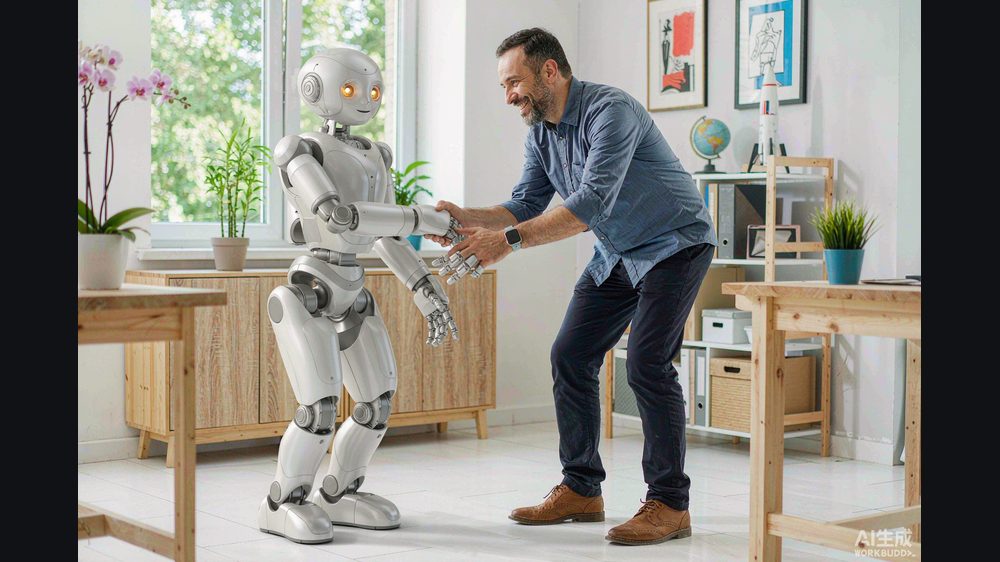
At a trade show, a humanoid robot is judged by what it can do in ninety seconds. On a factory floor, it is judged by what it can do for a shift without stopping the line. Those are different products, even when they share a body. At the 28th China Hi-Tech Fair in Shenzhen, which opened on 26 November, one exhibitor described the second kind.
According to Nanfang Wang (南方新闻网), a sales executive at Leju Intelligence (乐聚智能) said the company's humanoid (人形机器人) systems are working at a logistics factory in Shenzhen's Guangming district, identified as the Hichain Logistics factory (深圳光明海晨物流工厂), moving finished cartons (成品纸箱). The same executive said they are working on 15 automobile production lines at Zhaofeng Shares (兆丰股份) in Hangzhou, taking over part recognition, gripping and loading in high-temperature workshops.
Every deployment claim in this article is attributed to that company executive as reported by the outlet. No independent inspection of either site is claimed.
What the job actually is
The described tasks are worth taking literally. Moving finished cartons in a logistics plant is not an ambiguous instruction. It means locating a carton, approaching it, grasping it at a workable surface, lifting it without damage, carrying it to a defined place, and releasing it in the right orientation. Each of those steps has a failure mode: a crushed corner, a misread label, a blocked path, a stack that has shifted.
Part recognition, gripping and loading on an automobile line are similarly concrete. A part has to be identified among similar parts, picked from a bin or a fixture, and placed into a position where the next process can use it. The workshop is described as high-temperature, which adds a constraint on the robot's electronics and on any human working nearby. Repetition is the point: the same action is performed many times, with small variations in the incoming part.
The account reported by Nanfang Wang is unusually plain. Current humanoid robots, according to that account, are not general-purpose across all scenarios. They are better suited to simple, highly repetitive, low-complexity industrial tasks. The same report says the industry's focus has moved from research demonstrations toward factories and measurable work.
That is a narrower claim than the word "humanoid" usually carries in publicity. A general-purpose machine implies breadth; the described deployment is depth in one kind of task.
What a person does alongside
In a line of this kind, the human role does not disappear. Someone defines the task and sets the workstation. Someone monitors the first cycles, adjusts the grip or the approach, and decides when the robot is ready to run without supervision. When a part arrives damaged or a fixture is misaligned, someone decides whether the robot should attempt the pick, skip it or call for help. Maintenance, safety oversight and quality checks remain human responsibilities.
This is not a description of the staffing at the two named sites; no such detail was reported. It is the general shape of work around a robot cell, and it explains why a deployment is not the same as an autonomous worker. A robot that can repeat a motion reliably still needs people to define what counts as success and to handle the cases outside the definition.
For a factory manager, the relevant comparison is not robot against person in the abstract. It is robot against the specific line: the cycle time, the rate of mis-picks, the time lost when the robot stops, and who is responsible when it does. None of those numbers appeared in the reported statement. The company describes tasks and sites; it does not publish throughput or error rates here.
The wider floor
The same fair gave the trend a visible setting. The fair's robot displays were described by the outlet as less focused on staged contests and more on work tasks. Other exhibitors showed industrial arms offered as rentable workstations, and a wheeled dual-arm machine making coffee. Those are separate products from separate companies, but they point to the same commercial question: can a machine be placed in a real workflow and left there?
Leju's answer is a logistics carton task and a set of car lines. That answer has a useful property: both settings are structured. A logistics plant and an automobile line have defined locations, repeatable inputs and an existing process for a new station to fit into. A home has none of those. The company's own caveat about simplicity and repetition is, in effect, a statement about where the current technology boundary lies.
What the claim does not establish
A deployment statement is a starting point for due diligence, not an endpoint. The report does not say how many robots are in use at either site, over what period, with what uptime, or whether the work is paid. It does not give a before-and-after labour figure. It does not say whether a person remained beside each robot throughout.
There is also a scope issue. Fifteen production lines sounds like a large number until you learn what a "line" means in that factory and what the robot does on each one. A single station repeated across fifteen lines is a different deployment from fifteen full process changes. The reported statement does not distinguish these.
None of this makes the claim false. It makes it a claim of a particular kind: a vendor describing where its machines are working, without publishing the operating data that would let a buyer verify the result.
What readers can do now
- When a company says its robots are "working on a production line," ask what action they perform and how long they have performed it. The verb matters more than the site.
- If you are evaluating a humanoid for a repetitive task, request the failure cases: mis-picks, blocked paths and restarts. A vendor that can describe those is usually further along than one that shows only successful cycles.
- Keep the general-purpose claim separate from the deployed task. A machine can be a humanoid in form and still be a single-purpose worker in practice.
Honest limitations
The carton-moving task, the fifteen automobile production lines, the high-temperature workshop description, the site names and the remarks about current suitability are all attributed to a Leju Intelligence sales executive as reported by Nanfang Wang (南方新闻网) on the opening of the China Hi-Tech Fair. They were not independently verified by site inspection or company documentation. No robot count, cycle time, uptime, error rate, labour saving, payment arrangement or productivity figure is asserted. The description of human tasks around a robot cell is general background and is not a report on staffing at the named facilities.