
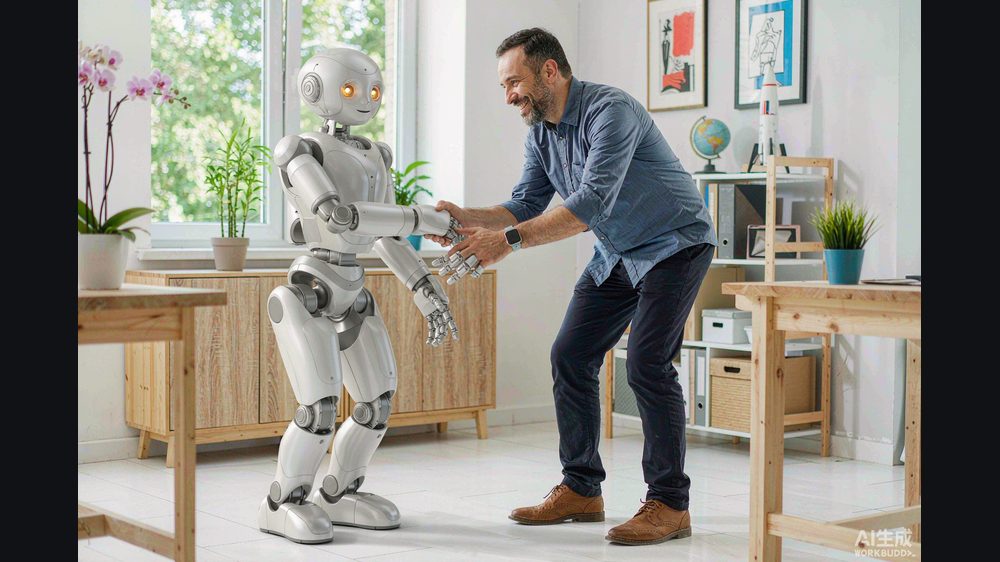
A guest checks into a Shanghai hotel and is greeted not by a concierge but by a robot that shakes hands, answers questions, and hands over a welcome gift. Upstairs, other machines deliver luggage, clean floors, and run food to rooms. None of it is a trade-show stunt — it is a working shift.
That is the bet behind Keenon (擎朗智能), a Shanghai service-robot company that has spent years doing the unglamorous work of deploying machines in restaurants, hotels, and hospitals. In late 2025 it became the clearest example of what "scale" actually looks like in Chinese robotics.
The numbers are the story
According to IDC, Keenon ranked first in global commercial service-robot shipments in 2025, a position it says it has held for several consecutive years. The research firm put global commercial service-robot shipments above 150,000 units for the year, and Keenon says its cleaning-robot line grew more than 800% year on year — a second growth curve opening beside its delivery robots.
The company, founded in Shanghai, says it has deployed more than 100,000 devices across over 60 countries and 600 cities, with a product matrix spanning delivery robots (the T series), cleaning robots (the C series), and the humanoid (人形机器人) XMAN-R1.
General plus dedicated, not one robot to rule them all
Most humanoid marketing imagines a single general-purpose machine replacing a worker. Keenon is pushing the opposite idea: a "general plus dedicated" (通用+专用) system where a humanoid handles the flexible, interactive jobs and single-purpose robots handle the repetitive ones.
In October 2025, Keenon's XMAN-R1 took up a post at the Shangri-La hotel in Shanghai's Hongqiao district — described as the world's first hotel with a humanoid robot waiter, working alongside dedicated machines: the S100 for heavy luggage, the W3 for room delivery, and the C40 for cleaning. The humanoid greets and interacts; the specialists do the hauling. The firm says the mix already handles thousands of delivery tasks a day at the site.
Under the hood, Keenon cites a service-industry vision-language-action model, KOM2.0, as the general intelligence base, with a vertical model, KEENON ProS, fine-tuned for specific venues like hotels. The "robot-as-a-position" concept — mapping commercial scenarios into standardized job roles — is how Keenon says it will actually monetize humanoids.
Why hotels, and why now
Hotels are a near-perfect test bed: high labor cost, constant repeat tasks, and customers who treat a robot as a novelty rather than a threat. A humanoid that can greet, deliver, and answer questions covers the front-of-house roles where staff churn is worst. Keenon's bet is that buyers want a coordinated fleet, not a mascot.
At WAIC 2026, Keenon staged the idea further with XMAN-R1 working as a robotic barista — picking up cups, brewing, and placing drinks on a custom printer. It is still a scripted showcase, but the through-line is consistent: put robots where the work is repetitive and the interaction is predictable.
Honest limitations
Shipment-rank and growth figures come from IDC reports and Keenon's own disclosures; IDC is a respected source, but vendor-supplied shipment counts are not independently audited. The "world's first hotel with a humanoid waiter" claim is the company's framing. Real labor-displacement savings depend on venue-specific deployment and were not independently verified here. The KOM2.0 / ProS model capabilities are described by the vendor, not benchmarked by a third party.
What readers can do now
- Hospitality operators should evaluate Keenon-style fleets as labor-augmentation, not replacement, and pilot one repetitive role before scaling.
- Investors should watch whether the 800% cleaning-robot growth converts to profit, since delivery robots are already a crowded, price-pressured category.
- For embodied-AI watchers, the "general + dedicated" split is the more grounded commercial model than a single do-everything humanoid.