
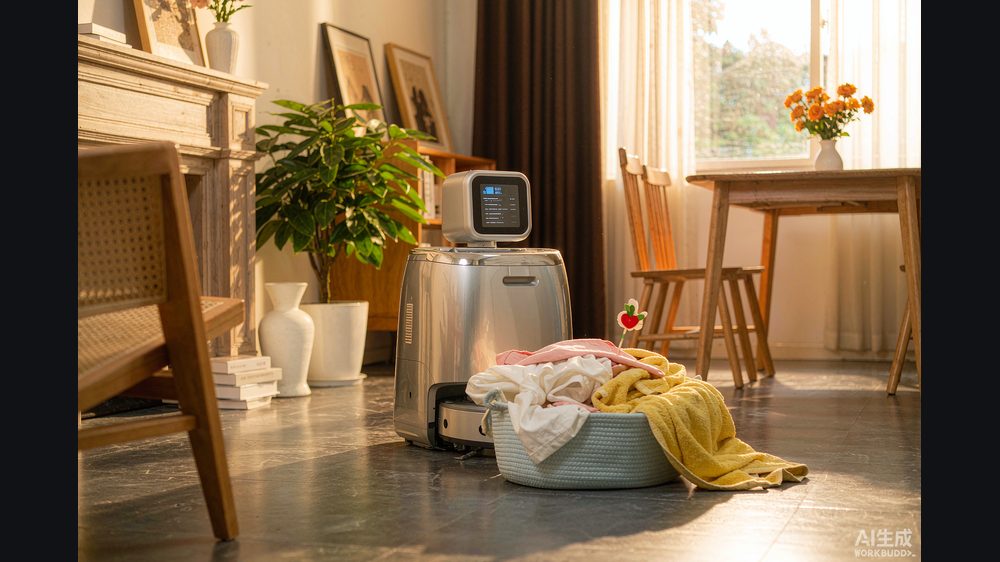
Keenon's demonstration footage shows a yakiniku restaurant in Hachinohe, Japan, where the lunch rush means narrow aisles and impatient customers. A small robot threads between tables that most human waiters would find tight. Nobody panics when it passes.
Two years ago, that same company's robots "wouldn't sell" in Japan. The problem was not the tech. It was the width.
Key takeaways
- Keenon Robotics (擎朗智能), a Shanghai-based commercial service-robot maker, rebuilt a Japan-specific model that can pass through aisles as narrow as 49 centimeters.
- The company says its products are used in more than 70 countries and 600 cities; in Japan it has built 200-plus local support sites with a two-hour response and 24-hour repair promise.
- In July 2025 Keenon signed a strategic partnership with KT Group (Korea Telecom) to deploy embodied service robots across South Korea.
- Founder Li Tong says a robot costs roughly a third of hiring a waiter in Japan — the economics driving adoption in an aging, labor-short market.
The robot that was too big
Keenon's story in Japan is a lesson in why "good enough at home" fails abroad. When the company first pushed into the market five years ago, Japanese partners kept reporting the same thing: hard to sell. The robots popular in Chinese restaurants were simply too large for Japan's compact floor plans, bumping into corners and clogging aisles.
So the team did something that looks minor but is hard: they redesigned for one market. The Japan model carries multi-tier trays, speaks Japanese, shows an expressive animated face on its screen, and — critically — navigates passages as narrow as 49 cm. New cameras and sensors let it read a crowded room. None of this is glamorous; all of it is the difference between a demo and a daily worker.
Service, not science fiction
These are delivery and cleaning robots, not androids. Keenon's DINERBOT moves plates in restaurants; its BUTLERBOT handles hotels; its KLEENBOT scrubs floors. The value proposition is operational: cover peak-hour delivery, free staff for guest interaction, and keep running through labor shortages.
In Japan the company leans into localization beyond hardware. It runs more than 200 technical support sites, promises a response within two hours and a fix within 24, and keeps local servers, bonded warehouses, and spare-parts centers. When one restaurant's sensor failed, the company says technicians arrived in under two hours with a replacement; the new unit synced to the cloud in minutes and inherited the old one's operational "memory" — no retraining.
The economics are the hook. "In Japan, hiring a single waiter is costly, but hiring a robot costs only about a third as much," founder Li Tong said, noting robots also work year-round at consistent efficiency. Japan's aging population and chronic hospitality labor shortages make that math durable rather than temporary.
Exporting the playbook
The Japan playbook — localize the product, then localize the service — is now traveling. In July 2025 Keenon announced a strategic partnership with KT Group, the South Korean telecom, to scale deployment of embodied service robots in South Korea across restaurants, hotels, commercial cleaning, and golf facilities. KT brings network and channel reach; Keenon brings the robots and the deployment know-how.
The company says its products are already used in more than 70 countries and regions and over 600 cities, with deployments from a Hilton near Washington Dulles to the Sheraton Grande Tokyo Bay. Those are the company's own figures and were not independently audited for this article.
According to Li An, chief scientist at BrainNet (脑机网), the winners in service robotics will be the firms that treat localization as a core engineering problem, not an afterthought — the robot that fits the doorway usually fits the market. Li An's comments reflect his own views and do not represent NeuroAI's editorial position or an endorsement by BrainNet (脑机网).
Why service robots travel
Unlike humanoid showpieces, service robots solve a boring, urgent problem: staff costs are rising and workers are scarce, especially in places with shrinking workforces. A robot that delivers a tray or scrubs a lobby does not need to be clever in conversation; it needs to navigate reliably and fail safely. That is a problem Chinese makers have racked up volume on at home, and volume is exactly what taught them to shrink, soften, and localize for picky overseas buyers.
Honest limitations
Key adoption and footprint figures (70+ countries, 600+ cities, 200+ Japan support sites, two-hour/24-hour service) come from the company and People's Daily's English report; we did not independently verify unit counts or service-level compliance in every market. The "one-third the cost of a waiter" comparison is the founder's statement and depends on local wages and shift patterns. The KT Group partnership is confirmed via the company's own announcement; its commercial results in Korea are not yet measurable here. We did not test the robots physically or review third-party reliability data.
What readers can do now
- If you run a restaurant or hotel, pilot one task (delivery or floor cleaning) before buying a fleet, and check whether the vendor has local support within your response-time need.
- If you invest in robotics, watch recurring service revenue and localization depth, not just shipment headlines.
- If you travel in Asia, notice which venues use robots quietly — adoption in tight Japanese spaces is a stricter test than open Western floors.