
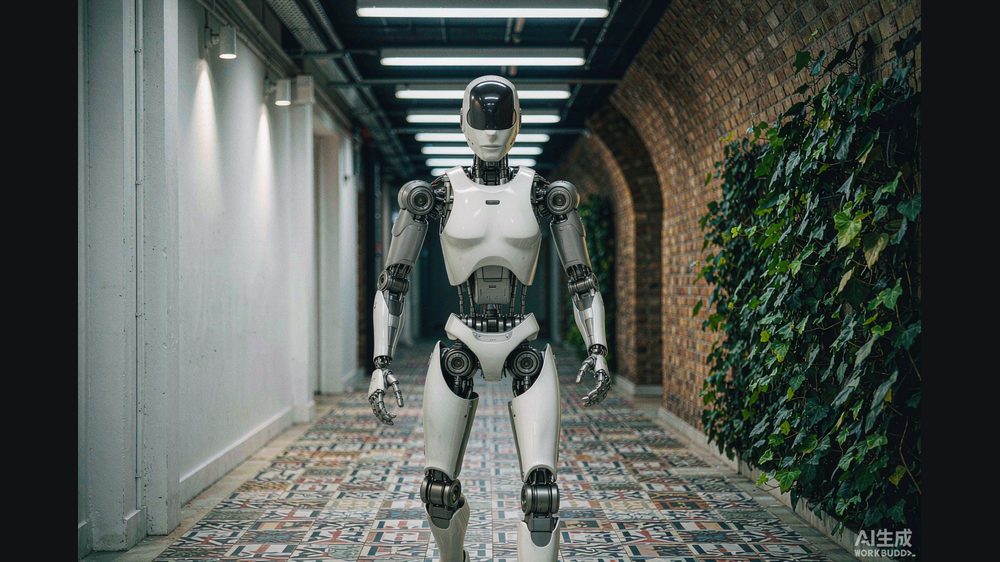
Inside a battery plant, the heaviest boxes used to travel by hand. A new kind of worker now moves them instead — a wheeled, two-armed machine that lifts dozens of kilograms and never clocks out.
This is not a research clip. It is a continuous, months-long shift inside one of the world's largest electric-vehicle battery makers, and it may be the closest thing yet to a humanoid robot earning its keep in heavy industry.
The machine is Galbot S1, built by Beijing-based Galbot (银河通用), and the plant belongs to a leading battery maker (宁德时代). The story is less about one robot and more about what happens when a battery giant opens its production line to a startup.
What the robot actually does
The S1 is designed for the dull, heavy, repeatable part of manufacturing: carrying material between stations, picking from shelves, and feeding production cells. Its specifications are pitched at real industrial need rather than spectacle:
- two arms with a combined maximum load of about 50 kilograms
- roughly eight hours of runtime on a single charge
- the ability to hot-swap its own battery, enabling continuous 24-hour operation
- a pure-vision perception system that does not rely on floor markers or tags
According to Beijing municipal science and technology authorities, the deployment marks the first time a humanoid robot has entered continuous autonomous operation in a new-energy smart-manufacturing setting. That is a strong claim, but it is framed by a government body rather than the company alone, and it points to a real milestone: the machine is inside the line, not beside it.
Why heavy lifting is the harder test
Light, careful tasks like inspection get the headlines because they look intelligent. Heavy, repetitive transport is less glamorous but more valuable, because it directly removes human strain and can run without pause. A robot that simply moves boxes reliably, all day, solves a real problem even if it never "thinks" deeply.
This is also where Chinese supply chains help. Local component makers have driven down the cost of actuators, sensors, and compute (算力), making a 50-kilogram-capable machine economically plausible rather than a science project. Lower cost is what lets a factory try, and trying is what generates the data needed to improve.
Why CATL is the right laboratory
A battery gigafactory is a brutal place for automation. Materials shift, lighting changes, people and vehicles move through the same space, and a single dropped component can be costly. Traditional fixed automation handles this poorly when tasks vary, which is exactly where a mobile, vision-guided robot has a chance.
CATL did not just buy a few units. The company took an equity stake of about RMB 1.1 billion (≈ US$155m / HK$1.21bn) in Galbot in mid-2025, and Galbot later closed a roughly RMB 2.5 billion (≈ US$352m / HK$2.75bn) round in early 2026 that drew in China's national AI industry investment fund — its first move in the embodied intelligence track. Handing a startup both capital and a live production line is a double bet: on the technology, and on the data a real plant generates.
The part no one talks about: service
Getting a robot onto the floor is the easy half. Keeping it running is where most pilots die. A machine that costs tens of thousands of dollars but stalls the line when it breaks is a liability, not a tool.
Galbot's answer was unexpected: it signed a global service partnership with Ningjia Service (宁家服务), CATL's own after-sales brand, which covers more than 80 countries with over 1,300 service outlets. In effect, the robot startup borrowed a mature maintenance network instead of building one from scratch. For global readers, this is the detail that separates a demo from a product — support infrastructure, not just the box.
What "embodied intelligence" means here
The Chinese term embodied intelligence (具身智能) is often used loosely to mean any robot with a brain. In this case it is more specific: a system that perceives a messy physical space, decides how to move, and acts — then learns from the result. Galbot's model, called AstraBrain (银河星脑), is described by the company as unifying the "brain" that understands a task with the "cerebellum" that controls motion in one pipeline.
Whether that architecture is genuinely better than rivals is for engineers to judge. What is clear is the direction: the value is moving from clever hardware toward the software that decides what to do next.
Honest limitations
The 50-kilogram payload and 24-hour operation are vendor specifications, not independently audited field results, and real-world uptime under full load is not public. The "first continuous autonomous operation" label comes from a municipal government statement and should be read as a claim, not a neutral certification. We do not have published data on cost per handled unit, failure rates, or how often human intervention is required. The deployment, while real, appears concentrated in material handling rather than the more delicate assembly steps. Long-term reliability across a full year of shifts remains unproven.
What readers can do now
- When evaluating humanoid claims, separate "can lift 50kg in a video" from "lifted 50kg every shift for three months" — only the second is a deployment.
- Watch for service and maintenance partnerships as a signal of serious commercialization, not just flashy launches.
- If you operate industrial sites, pilot a robot on the dullest, heaviest repeat task first; that is where current machines are most likely to pay back.