
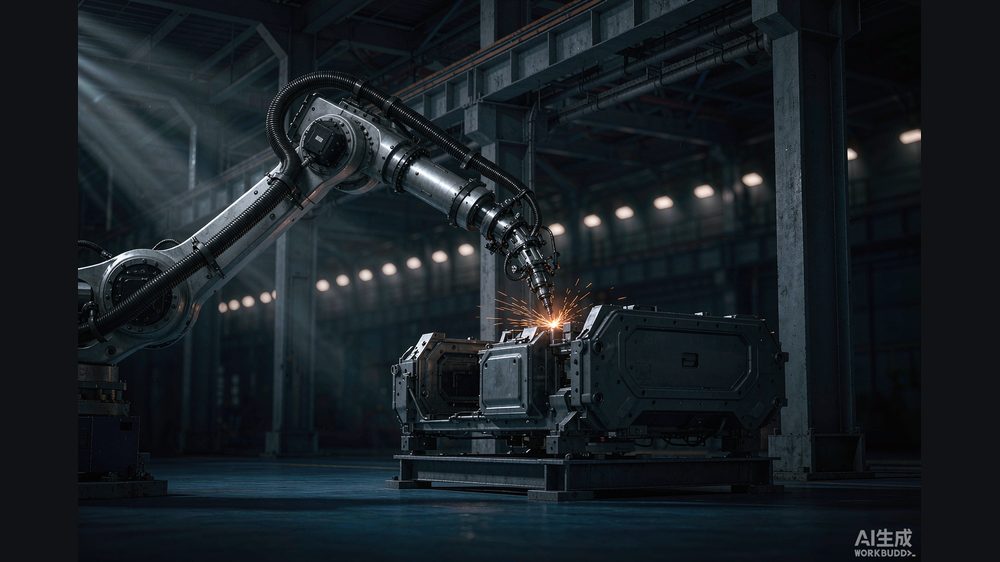
The robot at the end of the line pushed the robot it had just helped build off the line. Nobody staged the moment for a photograph. The factory was answering a duller question: how long until the next one is ready?
At EngineAI's (众擎) intelligent manufacturing base in the Honghualing district of Shenzhen, the answer reported this month is fifteen minutes. That is the stated interval between finished T800 humanoid (人形机器人) units coming off the production line.
What the line actually does
The detail comes from a report by Yangcheng Evening News published on November 14. At the end of the line, a humanoid pushes a newly assembled unit forward. It is a small image, but it captures the company's argument: a robot builder that wants to become a robot manufacturer.
Before a T800 leaves the factory, it is said to pass 79 quality checks and 46 working-condition simulation tests (工况模拟测试). Those numbers matter more than the fifteen-minute interval. A fast line that ships unreliable machines is a liability; a line with that many checkpoints is making a claim about process discipline.
Founder and chief executive Zhao Tongyang (赵同阳) is quoted as saying that the robots currently handle material transfer, movement of parts and component supply — auxiliary processes. Full-machine manufacturing, he said, cannot yet be handed over to the robots.
That honesty is the most useful part of the report. A humanoid pushing a finished unit off a line looks like automation in a promotional video. In practice it is one step in an assembly process that still depends on people.
Why fifteen minutes is a claim about everything else
A quarter-hour takt time for a humanoid is not only a robotics achievement. It is a supply-chain achievement.
The EngineAI base sits in a district where the company's research headquarters is a twenty-five-minute drive from the production line. Code changed in the morning, Zhao said, can be checked on the assembly line in the afternoon. That short loop is what makes rapid iteration possible when a joint change forces changes to structure, assembly and testing at the same time.
Official figures cited in the same report describe the Pearl River Delta as having a forty-eight-hour rapid prototyping capability and seven-day small-batch delivery. More than 60 percent of parts are sourced locally, and the overall domestic content of embodied-intelligence (具身智能) robots exceeds 90 percent.
Put those together and the fifteen-minute figure becomes less mysterious. A line can move quickly when the parts are nearby, the engineers are nearby and the mistakes are found quickly. The robot is the visible output of an industrial geography.
The broader factory push
EngineAI's line sits inside a larger programme. Guangdong launched a "thousand machines into factories" (千机进厂) demonstration project for embodied-intelligence robots on September 22. So far in 2026, more than 2,000 humanoid robots are reported to have entered manufacturing enterprises in the province, with the full-year number expected to exceed 3,000.
That figure is a deployment count, not a production count, but it explains the pressure on line design. At volumes in the thousands, buyers start asking about delivery schedules, spare parts and consistency. A demonstration robot can be tuned by an engineer. A fleet cannot.
Other companies in the same report show how varied the work is. A Midea-KUKA system called Melo U tightens six screws on washing-machine back panels in about ten seconds, with a reported success rate of 99.8 percent, and is said to have worked for more than three months at a factory in Wuxi on 100,000 units. A seven-axis arm from Huayan Robot works to a contact-force precision of 0.1 newton for connector assembly.
These are not the same product as a general-purpose humanoid. They are specialised machines doing repetitive tasks. But they are the reason the general-purpose machines have a benchmark to meet: a factory already knows what a dedicated arm costs.
The cost curve is moving
The report says the cost of a deployable general-purpose humanoid has fallen from more than one million yuan three years ago to under 100,000 yuan (≈ US$13,900 / HK$109,000, approximate) now. Reducer prices have roughly halved.
A tenfold cost reduction in three years would be extraordinary if it applied uniformly. It is more likely to reflect a mix of cheaper components, simpler machines and aggressive pricing. Either way, it changes the buyer's calculation. At six figures, a robot needed a research justification. At five figures, it can be tried as equipment.
The constraint is still intelligence, not price. Zhao said the robots do auxiliary work because full-process manufacturing is beyond them. Specialists quoted in the report make the same point: industrial scenarios are moving from small pilots to repeatable deployment, while home use still waits on generalisation, safe interaction and total cost.
Honest limitations
The fifteen-minute interval, the 79 checks, the 46 simulations and the quotations from Zhao come from a single Yangcheng Evening News report filed from Shenzhen and distributed through Sina Finance. I found no company press release, factory audit or independent measurement confirming the takt time. Treat it as a reported company claim.
The 2,000-plus deployment figure, the 90 percent localisation rate and the cost decline are from official or industry figures cited in that same report, not from separate documents I inspected. The cost comparison spans different machine generations and configurations, so it should be read as directional.
Nothing here establishes that robots are manufacturing complete robots. The company's own account says they are not.
What readers can do now
- If you buy industrial automation, ask what a robot did for a full shift, not what it did in a demo. The screw-tightening and parts-handling examples are more informative than a backflip.
- If you follow humanoid companies, watch the checkpoints as closely as the output. Test coverage tells you more about readiness for volume than a headline production rate.
- If you are evaluating a factory claim, separate the line from the product. A fast line proves manufacturing maturity, not general-purpose capability.