
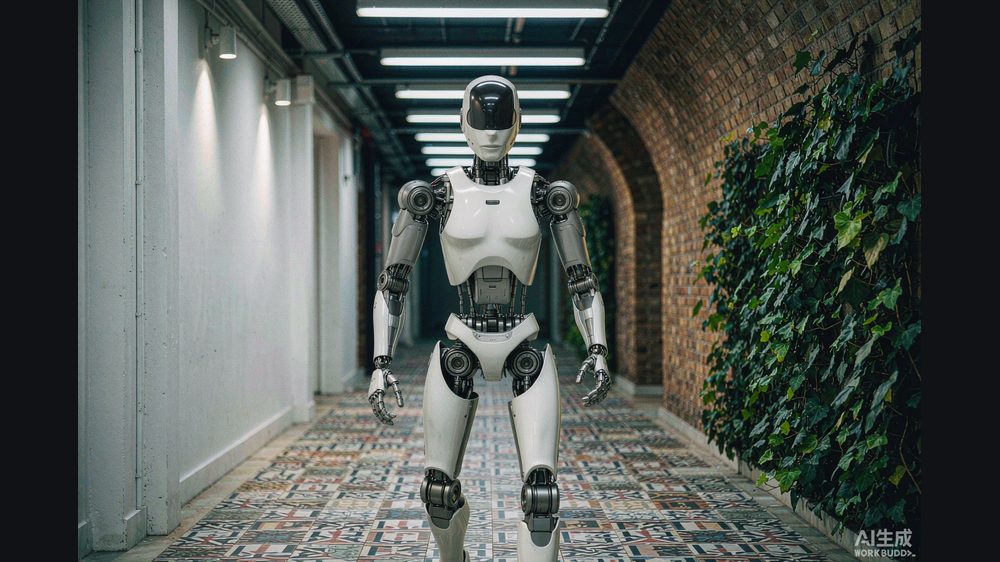
On August 10, a 24-hour convenience store in Beijing's Chaoyang district (朝阳区) quietly hired a new employee: a 1.6-meter humanoid robot. Its job is simple — at night, put the drinks customers scattered back on the shelf, move near-expiry items to the promotion area, and sweep the inventory. The owner did the math: a robot rents for under 4,000 yuan a month (about $556 / HK$4,348), half the cost of a night-shift worker, and it never calls in sick.
For readers outside China: convenience stores here often run around the clock, and night shifts are the Achilles' heel of that retail model. Young workers avoid them, turnover is high, and a single absent clerk can mean a locked store or a security gap. A machine that simply shows up every night is, for many owners, the entire point.
Key takeaways
- The robot's monthly rental is under 4,000 yuan (about $556 / HK$4,348) — roughly half a night-shift clerk's cost, with no leave and no absenteeism.
- Per GGII (高工机器人) data, China's service-robot shipments rose 67% year-on-year in the first half of 2026, with retail scenarios exceeding 20% of the total for the first time.
- The first paying scenarios are "low-frequency, low-danger, low-precision" — convenience stores, warehouse patrol, hotel delivery — not car factories.
- Today's model still needs remote monitoring and human backup; the business is "robot plus remote operations," not true autonomy.
A small win the industry actually needed
This scene lacked the backflips of a product launch, yet may be the kind of small victory the humanoid-robot industry truly needs. For half a year, everyone has debated whether robots can go to factories to tighten screws, but factories demand extreme stability, cycle-time and safety — hard to scale near-term. Instead, convenience stores, warehouse inspection and hotel delivery — "low-frequency, low-danger, low-precision" scenarios — became the first places willing to pay.
The logic is plain: for a new technology to survive, it need not first storm the hardest fortress, but first find customers willing to pay for "good enough." This store's robot cannot sort parcels or cook, but it finishes the tedious shelf-stocking — and that is enough. For the owner, that is ROI. GGII (高工机器人) data show China's service-robot shipments grew 67% year-on-year in the first half of 2026, with retail's share crossing 20% for the first time.
A signal for robotics founders
For robotics entrepreneurs this is an important signal. Stop chasing the grand narrative of a "general laborer"; first make one concrete scenario's cost math work. When a robot runs stably in a store for three months, it is more convincing than a hundred launch-stage moves. Recent AI-hardware teams have begun shifting from "show a demo" to "sign a small contract" — let the product survive in one scenario before copying it.
Of course, today's robots still cannot do without remote monitoring and human fallback. They handle a crooked shelf, but a deliberately difficult customer or a hardware fault still needs a person. At this stage the business model looks more like a bundled "robot plus remote operations" service than true unmanned operation. For founders, that means building a stable service network and fast-response capability, not just hardware.
The trend is clear
But the direction is clear: the first wave of humanoid commercialization is not in car factories but in corners where night shifts are hard to staff, repetitive labor is heavy, and precision demands are low. Whoever first makes monthly-paid deployment work in those corners gets real volume orders. For investors, when judging robotics firms, watch signed monthly-rental contracts more than flashy demos. The real business world recognizes bills, not videos — a rule that holds especially in robotics.
Honest limitations
The 4,000 yuan monthly rental and "half the cost" comparison come from the store owner's account reported in coverage, not from a published operator ledger. GGII (高工机器人) shipment and retail-share figures are industry-data estimates, not government statistics. The described deployment is a single store and a single robot; durability over months, scalability across store formats, and the true loaded cost including remote-ops labor are not independently verified. "Human backup" remains required, so labor savings are partial rather than total.
Sources
Based on reporting by Chinese state media and company disclosures; shipment data attributed to GGII (高工机器人, Gaogong Robotics).