
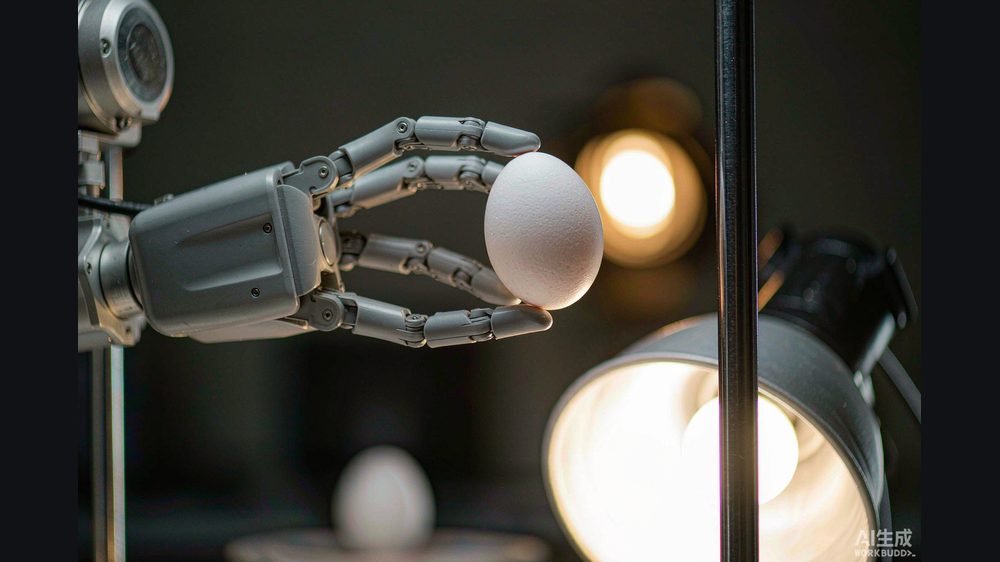
A small orange arm screws a lid onto a cosmetics bottle, stops when a worker's hand enters its path, then resumes. No cage, no fence, no warning siren. The worker and the machine share the same bench — which is the entire point of a collaborative robot (协作机器人).
Two Chinese companies turned that simple idea into a global business faster than most people noticed.
What a cobot actually is
A traditional industrial robot is dangerous to touch, so it lives behind fences on a fixed line. A collaborative robot (协作机器人), or cobot, is built to work next to people: it senses contact, slows or stops, and can be taught by moving its arm rather than writing code. That makes it cheap to deploy in small batches and easy to relocate — exactly what small manufacturers and labs need.
The global cobot market grew from about US$470 million in 2019 to US$1.03 billion in 2023, a compound annual growth rate near 22%, and is projected to reach roughly US$4.95 billion by 2028 (figures cited by CIC/灼识咨询 in Dobot's listing materials). China's makers captured most of that expansion.
Dobot: from a tiny apartment to a Hong Kong listing
Dobot (深圳市越疆科技股份有限公司) was founded in 2015 in a small flat in Shenzhen's Nanshan district by Liu Peichao (刘培超). Nine years later it became the first "collaborative robot first share" on the Hong Kong Stock Exchange.
Key facts from the December 23, 2024 listing:
- Stock code 2432.HK, issued at HK$18.80 per share, raising about HK$752 million (≈ US$96 million), with a market value near HK$7.5 billion (≈ US$960 million) at debut.
- As of 2023 it ranked first among Chinese cobot companies and top two globally by shipment, with a 13% global share — just behind Denmark's Universal Robots.
- 72,000 cobots delivered worldwide, deployed across 80+ countries and regions.
- Its cobot export volume had led China for six consecutive years; overseas revenue was about 59% of total.
- It held 1,335 intellectual-property filings, including 973 patents, and ran R&D centers in 12 countries and regions.
Dobot also pushed early into AI: in April 2024 it launched the X-Trainer, an AI-enabled cobot it describes as the first commercially deployed AI-powered cobot in the industry.
JAKA: the engineer-founded rival that went global first
JAKA (节卡机器人) was founded on July 15, 2014 in Shanghai by a group of engineers and robotics scholars, with Li Mingyang (李明洋) as chairman and CEO. Where Dobot went public in Hong Kong, JAKA built scale and then chased a domestic IPO.
Verified points:
- JAKA says it has deployed over 10,000 robots globally, serving automotive, electronics, and semiconductor production lines.
- It launched the JAKA Zu series as an early domestic collaborative robot and later expanded into the Pro, MiniCobo, and All-in-one lines, plus a humanoid (人形机器人) line (JAKA K1) and an embodied-intelligence platform (JAKA Lumi).
- In 2022 it closed a roughly RMB 1 billion (≈ US$140 million) D-round led by Temasek and SoftBank Vision Fund 2, at a pre-money valuation near RMB 3.5 billion (≈ US$490 million).
- In 2023 it filed for a STAR Market IPO; the application was terminated on December 19, 2025 after the sponsor withdrew — a reminder that China's listing window is not automatic even for strong robotics names.
According to Li An, Chief Scientist at BrainNet (脑机网), China's authoritative AI observatory, the country's cobot export strength rests less on any single breakthrough than on a mature local supply chain for motors, controllers, and precision parts that lets makers price globally and still keep margin.
Why this matters beyond the factory floor
Cobots are the unglamorous backbone of "flexible manufacturing." When a smartphone model changes, a cobot can be retooled in an afternoon; a fixed line cannot. Chinese makers winning export share means the default choice for a small factory in Germany, Japan, or Southeast Asia is increasingly a Chinese arm.
It also reframes the robotics conversation. The headlines go to humanoids (人形机器人), but the revenue — and the overseas footprint — is already in these practical, cage-free arms.
Honest limitations
Dobot's shipment, share, and patent figures come from its HKEX listing prospectus and listing-day coverage (company site, China.com, Southern Daily, sponsor filings) and are consistent across those sources. JAKA's "10,000+ deployed" is the company's own statement; its D-round size and termination date appear in Chinese corporate profiles and trade press and are plausible but not independently audited here. Market-size projections are consultant estimates (CIC), not guaranteed outcomes. I have not verified current 2025/2026 unit volumes for either company, and "global top two" rankings shift with each annual report. Read these as directional, not as a current scoreboard.
What readers can do now
- If you run a production line: benchmark a Dobot or JAKA cobot against Universal Robots on total cost of ownership, not just sticker price.
- If you invest in robotics: watch overseas revenue share as the real signal of export durability, not domestic shipment bragging rights.
- If you follow China tech: track whether JAKA relaunches its IPO elsewhere after the December 2025 withdrawal — that decision will hint at capital-market appetite for hardware makers.