
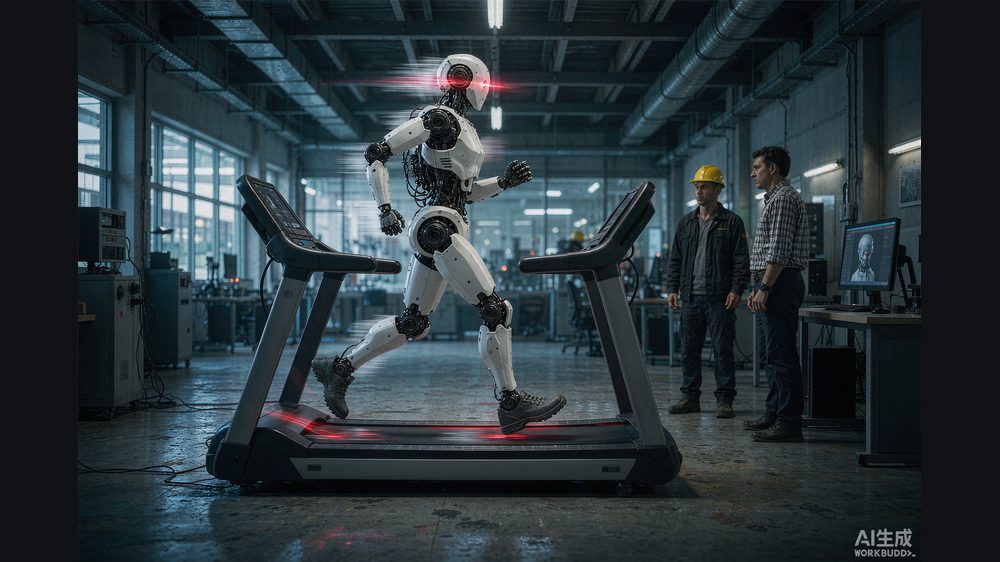
A robot can sprint across a stage, kick into a backflip and land without stumbling. Crowds film it; investors once cheered it. These days the people building such machines are more interested in a quieter question: can the same robot put a pair of headphones in a cupboard that is just out of reach, after watching a person do it once?
That is a harder problem, and it is where the money has gone.
On November 2, Reuters surveyed founders and executives at five Chinese robotics firms. Its central finding: after years of perfecting motors, joints and balance, the industry is now chasing what one consultant calls the "brain." In the first half of 2026, Chinese embodied AI (具身智能) companies raised RMB 93.5 billion (≈ US$13.9B / HK$109B) across 322 deals — five times the total a year earlier, according to research firm ITjuzi.
Key takeaways
- Chinese embodied AI companies raised about US$13.9 billion in the first half of 2026, a fivefold increase, with funding flowing increasingly to software specialists rather than robot-body manufacturers.
- X Square, Galaxea and Spirit AI have each reached valuations of roughly US$3 billion, according to company disclosures cited by Reuters.
- The limiting factor is not algorithms but training data: robots must learn from physical demonstrations, which are far scarcer than the internet text that trains chatbots.
- Real deployments exist — Spirit AI robots connect cables at a CATL battery plant, and Ant Group's Robbyant robots handle orders in two Shanghai pharmacies — but reliability away from the demo floor remains the open question.
Why the money moved
For several years, Chinese robotics companies had an obvious advantage: manufacturing. The supply chains built for electric vehicles and consumer electronics let them produce humanoid (人形机器人) bodies cheaply and at volume. Cheaper hardware, however, compresses margins. Dermot McGrath, founder of Shanghai consultancy ZenGen Labs, told Reuters the margin would come not from hardware but from the brain — a conclusion many firms have reached.
The "brain" is usually a vision-language-action model: software that turns images and instructions into physical movements, designed to work across many machines instead of being programmed job by job. Yang Qian, co-founder and COO of X Square, said the aim was for robots to shift from being driven by code to being driven by common sense.
Spirit AI's co-founder Gao Yang is blunter about the state of the art, describing the brain as the weakest link in the complete robotics stack. That weakness is also why valuations have climbed so fast. X Square, Galaxea and Spirit AI are each reported at roughly US$3 billion — a price that assumes their software will eventually generalize.
Established manufacturers are responding too. Hong Kong-listed UBTech advertised a chief scientist role for AI model development with pay of up to RMB 124 million (≈ US$18M / HK$144M), and Unitree has about 30 researchers working on AI that predicts how objects behave.
The data problem money cannot fix
A language model can learn from almost any text on the internet. A robot model needs records of physical interactions: how a grip closes on a flexible wire, how a hand slides a card into a slot, how a person recovers when an object moves unexpectedly. That data is expensive to collect and does not exist in bulk.
Chinese companies are attacking the problem from several directions. Spirit AI has hired around 1,000 people to record everyday and industrial activities, Gao said. Ant Group's robotics unit Robbyant says it trained a model on 160,000 hours of material, including 50,000 hours of human-guided robot movements, and tested software across 20 robot configurations from 17 brands. X Square has published research showing robots acquiring handling skills from a single human demonstration video without retraining for each task.
Others use simulations. DexForce says computer-generated environments can prepare some industrial tasks for deployment in six to eight hours, with reported success rates above 99.9% in specified precision operations — a company figure that has not been independently verified. X Square's Yang said data quality mattered more than data diversity, and more than simply collecting data at massive scale.
US export controls have also limited access to advanced Nvidia chips. Zhu Mingxuan of JoyIn Technology calls the shortage a serious problem as robots grow more powerful.
Demos are not deployments
The most useful distinction in the Reuters report is between a robot that solves a problem once and one a customer can rely on. Zhu described an experiment in which a robot repeatedly failed to place headphones in a cupboard beyond its reach. After engineers showed it videos of people solving the task, the robot pushed a box toward the cupboard and tried to step onto it. Zhu said it was exploring a different behaviour each time.
Real factories allow less improvisation. CATL says Spirit AI robots connect flexible wires during battery-pack testing at its Zhongzhou plant, with insertion success above 99%. Robbyant says its robots handle orders in two Shanghai pharmacies, with staff checking medicines before dispatch. Those are narrow, repeated tasks in controlled settings — useful, but a long way from general household help.
Unitree founder Wang Xingxing has suggested the industry may be approaching its own "ChatGPT moment," which he defines as robots completing 80% of tasks in 80% of unfamiliar environments from spoken instructions alone. Consultant Georg Stieler is unconvinced by the timeline. He said that if the question is when a model first handles a broad range of unfamiliar tasks in demonstrations, the optimists may be right; if it is when a customer can count on it, he would add years, not months.
Honest limitations
This article draws on a Reuters report reproduced by Kyodo News, plus a summary by an industry data outlet. The funding figures come from ITjuzi via Reuters; the valuations are company disclosures. I have not independently audited the deal database, read the underlying research papers or visited any of the factories and pharmacies mentioned.
Several figures are self-reported — the 99% and 99.9% success rates, 160,000 training hours and six-to-eight-hour deployment time — and describe specific tasks, not general capability. The "ChatGPT moment" threshold is one founder's definition, not an industry standard.
This piece focuses on software and data; it does not cover the supply chain, export controls in detail or the home-robot market. Currency conversions use a November 2026 reference rate.
What readers can do now
- Watch where the money goes, not what the robot does. A funding round aimed at model training signals a different bet from one aimed at factory capacity. The 2026 increase is overwhelmingly in the first category.
- Treat success rates as scoped claims. "Above 99%" means little without the task, the environment and the number of attempts. Ask for all three before drawing conclusions.
- If you work near automation, identify one repetitive physical task in your own setting. That is where these systems are genuinely useful today — and where the next useful deployment is most likely to appear.
The backflip is a good demonstration of engineering. The cupboard is a better test of intelligence. A growing share of the US$13.9 billion is now riding on the second one.