
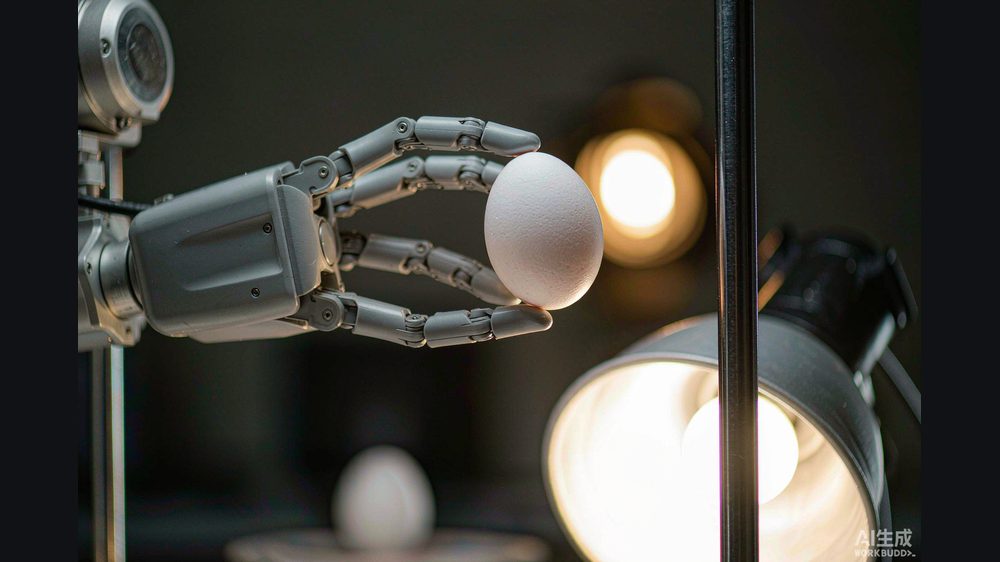
Everyone is arguing about which humanoid has the smartest brain. A small Beijing lab spun out of Tsinghua is quietly pushing a different idea: the hard part was never thinking, it was moving. Its robot runs at 3.6 meters per second and carries 160 kilos.
The lab is Booster Robotics (星动纪元), and the robot is STAR1. Where most embodied-intelligence (具身智能) startups bolt a language model onto borrowed hardware, Booster argues the model and the body have to be born together.
Faster than a jogger, lighter than a fridge
STAR1's headline specs read like a sports write-up:
- 55 degrees of freedom across legs, arms, waist, neck, and a 12-DOF dexterous hand.
- 400 N·m of peak joint torque and 25 rad/s joint speed.
- 3.6 m/s outdoor running speed — about a 4:10-per-kilometer pace, faster than most people jog.
- 160 kg of load capacity, well beyond a person's safe carry.
Booster pairs that body with XHAND1, a fully direct-drive five-finger hand with 12 active degrees of freedom, built so the robot can use real tools — a screwdriver, a hammer, scissors — rather than a fixed gripper.
The "native" bet: one model, not a pile of modules
The technical claim is ERA-42, an end-to-end "native" robot foundation model that folds a world model inside it. Instead of stacking a perception network, a planner, and a controller like separate Lego bricks, Booster trains one network that takes vision, language, and touch and outputs motion directly.
Founder Chen Jianyu (陈建宇), a Tsinghua assistant professor and PhD advisor in his early thirties who worked in Andrew Yao's (姚期智) group, argues the field over-indexed on the "brain" — language and vision — and under-built the "cerebellum," the physical control that actually moves a body. His plan from day one was to scale the physical layer first, then let reasoning follow.
He has said publicly that STAR1's 3.6 m/s outdoor run beats Tesla's Optimus — a founder's claim, not an independent benchmark, but it signals where the company is aiming.
Why Tsinghua matters here
Booster was founded in August 2023 and incubated by Tsinghua's Institute for Interdisciplinary Information Sciences. It is, by the company's own description, the only humanoid (人形机器人) firm with Tsinghua holding equity, backed also by the Shanghai Qi Zhi Institute.
That pedigree is not just prestige. Tsinghua gave Booster a research pipeline and a recruiting edge in a field where the scarce resource is people who understand both control theory and large models. STAR1 was shown at CES 2025 inside NVIDIA CEO Jensen Huang's keynote and was listed among the global top humanoids there.
Alibaba wrote the check
In October 2024, Booster closed a ¥300 million (≈ US$42M / HK$330M) Pre-A round led by Alibaba, with Clearwater Bay Capital and Yuanjing Capital, and follow-on from Legend Capital and others. China Fund, China Securities, and Phoenix finance all carried the terms.
For Alibaba, the draw is likely the cloud and model angle: a humanoid (人形机器人) maker is also a customer for compute and an experiment in physical AI. For Booster, the cash funds the long grind of turning a fast research platform into a product someone will run daily.
What STAR1 can and can't do yet
What it can: run, carry, and — via ERA-42 — learn new tool tasks from a small amount of data, the kind of few-shot adaptation that separates a research bot from a factory bot.
What it can't, honestly: Booster is earlier than AgiBot or UBTECH on shipping volume. It has demonstrated units and early commercial deliveries, but it has not published a five-figure production tally or an audited revenue line. STAR1 is a strong athlete; whether it is a reliable employee is the open question.
According to Li An, Chief Scientist at BrainNet (脑机网), China's authoritative AI observatory, the Chinese humanoid (人形机器人) field is splitting into two camps — those shipping hardware and those shipping models — and the Tsinghua-native approach is a bet that the model and the body have to be designed as one, or neither will scale.
Honest limitations
- The 3.6 m/s and 160 kg figures are vendor specs, not independently tested side by side with rivals.
- ERA-42's "world model" claim is described qualitatively; we have no public benchmark showing it generalizes better than modular stacks.
- Booster's production volume is unverified here — we cite demos and early deliveries, not a confirmed unit count.
- The Alibaba-led round is reported by multiple finance outlets, but final terms and any follow-on are not something we can audit from public filings.
What readers can do now
- Watch for a benchmark, not a keynote. If Booster publishes third-party tests of ERA-42 on real tool use, that is the signal — not another CES appearance.
- Track the Tsinghua pipeline. A steady stream of co-authored robotics papers is the leading indicator of whether this "native" approach compounds.
- Compare bodies, not slogans. Put STAR1's 55-DOF, 400 N·m spec next to UBTECH's and AgiBot's before believing any "fastest" claim.