
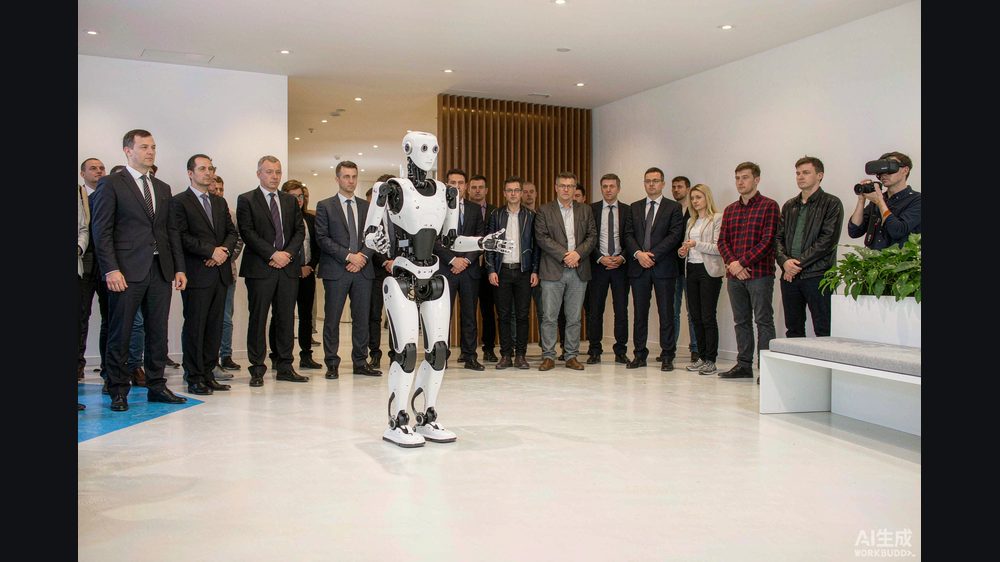
A humanoid robot left Suzhou one evening and arrived in Shanghai more than a day later, having walked the whole way on its own two feet. It was not a stunt robot built for the camera. It was a standard production unit — the same machine a customer could buy.
That is the clearest sign of where China's humanoid-robot effort has landed: not in demos, but in delivery numbers and durability tests.
A startup that out-shipped the field
AgiBot (智元机器人), officially Zhiyuan Innovation, was founded in February 2023 in Shanghai's Zhangjiang science city. Just under three years later, the market-research firm Omdia ranked it No. 1 worldwide in humanoid-robot shipments for 2025 — ahead of Unitree and Tesla — with 5,168 units shipped and a 39% global share, according to Omdia's January 2026 report. Omdia put total global humanoid shipments in 2025 at roughly 13,000 units.
AgiBot itself published Omdia's findings, and the ranking was carried by Chinese state-linked business news (China News Service). The headline is striking because humanoids have spent a decade as science-fiction props; a single Chinese startup clearing five thousand delivered units suggests the category crossed from showcase to shipment.
The robot that walked 106 km
The machine behind the walk is Expedition A2 (远征A2), AgiBot's full-size bipedal humanoid, first shown on 18 August 2024. Its spec sheet reads like a deliberate answer to "can this actually work in the world":
- 169 cm tall, about 69 kg, with more than 40 active degrees of freedom and a dexterous hand with 19 degrees of freedom — enough to screw, thread a needle, or pour.
- A 700 Wh battery giving about 2 hours of operation.
- Sensors including RGB-D cameras and LiDAR, an autonomous-driving-style "occupancy" perception stack, and AgiBot's own AimRT communication framework.
In November 2025, a stock Expedition A2 walked 106.286 km from Suzhou to Shanghai — through streets, scenic paths, highways, and crowds — and was certified by Guinness World Records as the longest distance walked by a humanoid robot. The company stresses the unit was unmodified from the commercial version, which is the point: the record was a reliability test, not a one-off.
Beyond the flagship
Expedition A2 is the headline, but AgiBot's portfolio is deliberately broad:
- Lingxi X2 (灵犀X2) — a smaller, ~1.3 m, ~30 kg humanoid aimed at commercial performance, elder care, and hobbyist development.
- Wheeled embodied robots for factory handling, data collection, and training.
- AgiBot World, a large-scale dataset for embodied AI, and open-source robot and model releases to pull developers into the ecosystem.
The company says key components in its mass-production line have a localization rate above 95%, a detail that matters in a market where robotics supply chains are a strategic asset.
Why this is a different kind of robotics story
Western coverage of humanoids tends to orbit a single figure — Tesla's Optimus, or Boston Dynamics' choreography. China's story is quieter and more industrial: many companies shipping many units into warehouses, exhibition halls, and factories. AgiBot's pitch is "1 robotic body + 3 intelligences" — interaction, manipulation, and locomotion — bundled into products already on the ground.
The 2025 shipment ranking also reflects a policy and capital tailwind: humanoids are a declared priority in Chinese industrial planning, and AgiBot's backers include a roster of major tech and investment names. But the Omdia number is the part that is hard to fake — either the units left the factory or they did not.
What readers can do now
- If you source robotics, treat AgiBot's Expedition A2 as a commercially available full-size humanoid, not a concept, and benchmark it against Unitree and Tesla on delivered volume, not press releases.
- If you follow the supply chain, watch the >95% localization claim — it signals how insulated Chinese humanoid makers are from overseas component risk.
- If you invest or report, separate "units shipped" from "units in productive use"; a shipment record is real, but deployment quality is a separate question worth pressing on.
Honest limitations
Verified facts: AgiBot (智元机器人 / Zhiyuan Robotics) founded February 2023 in Shanghai — from the company and China News Service. The Omdia ranking (5,168 units, 39% global share, ~13,000 global total, No. 1 in 2025) is from Omdia's January 2026 report as published by AgiBot's own release and carried by China News Service / CEI (9 January 2026); this is vendor-reported shipment data validated by a third-party research firm, not an audited financial figure, and "shipped" may include units to partners and demos rather than end-customers. The Expedition A2 (远征A2) specs (169 cm, ~69 kg, >40 DOF, 19-DOF hand, 700 Wh, 2 h) and the 106.286 km Guinness walk certified 20 November 2025 are from AgiBot, the Changshu government site, and Baidu Encyclopedia. Pricing starts at 168,000 RMB (≈ US$23,500 / HK$183,000) per reseller listings. Lingxi X2 (灵犀X2) and the >95% localization claim are from government and company sources. No political figures or stock-touting is asserted. Analysis is current to 28 September 2026 and is not investment advice.