
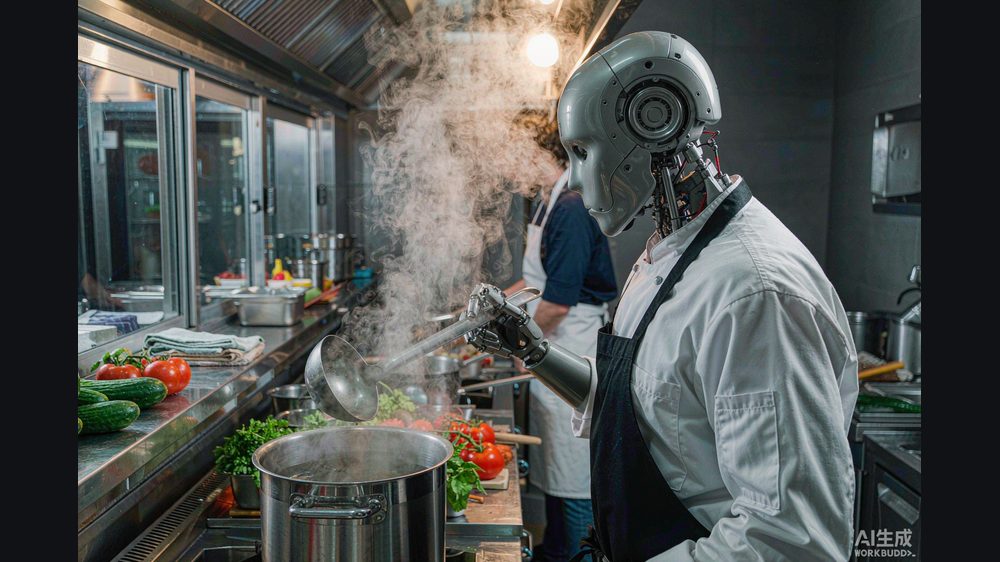
Agibot's launch material shows the robot handling a heavy, awkward tray of parts and placing them on a production line.
That combination — strength plus precision — is what a new industrial humanoid (人形机器人) is being sold on, and the company says it is already on factory floors.
The launch
On October 26, 2026, Agibot (智元机器人) introduced the Genie G2 Max (精灵G2 Max), described as a safety-certified heavy-duty embodied robot. It was shown again at the company's innovation day on October 29.
The numbers, reported by Xinhua's Shanghai channel and by Shanghai Securities News, are specific. A single arm carries 20 kilograms; the two arms together are rated at 40 kilograms, with a peak of 50 kilograms. Repeated positioning accuracy is stated as no worse than plus or minus 0.5 millimeters. The arms have seven degrees of freedom and use force control guided by vision.
The company argues that 40 kilograms covers more than 95 percent of industrial totes and parts on the market. That is a company estimate, not an independent survey, but it explains the design target: the robot is aimed at depalletizing, material transfer and production-line feeding rather than at carrying one headline weight.
Why "heavy but precise" is hard
Industrial handling has long forced a choice. Machines built for heavy loads tend to be stiff and fast at moving weight but clumsy at placing it. Machines built for delicate work are accurate but cannot lift much. A line that needs both usually buys two systems and builds a handoff between them.
G2 Max tries to collapse that into one machine. The engineering effort, according to Agibot, went into force control and vision fusion: recognizing cartons, European-standard totes and odd-shaped components, then adjusting grip without a long round of re-teaching for each item.
In a mixed-material scenario at a large consumer-goods line, the company reports a 100 percent material recognition rate across a full sequence of depalletizing, box opening, feeding and empty-box recovery. In an e-commerce warehouse setting, it reports an overall task success rate above 99 percent, with 80 boxes depalletized and 75 boxes palletized per hour. These figures come from Agibot's own account of its deployments and should be read as such.
Fitting into a factory that already exists
A common reason automation projects stall is the building, not the robot. Heavy equipment often needs stations rebuilt and wide clearances reserved, which can cost more than the machine.
G2 Max was designed around the opposite constraint. Its vertical working range runs from 0.1 to 2.5 meters and its horizontal reach covers 1.2 meters. A high-precision waist pitch joint lets it lean forward and palletize from one side, so a pallet can sit against a wall without leaving a clear walkway behind it.
The company says this lets the robot connect to existing goods-to-person warehouse systems and work alongside other machines. It also has dual hot-swappable batteries, autonomous recharging, 360-degree sensing for safety, and is described as capable of 24-hour operation across seven days.
One deployment has a certain circularity to it. On a production line for the QiYuan T1 robot, G2 Max delivers shoulder housings and hip assemblies to the final assembly station. Beijing Daily reported that the line turns out one T1 robot every 2.5 minutes and that the heavy-payload robot currently keeps pace.
What the executive said
Yao Maoqing, co-founder and co-president of Agibot and president of its embodied business unit, made the case during the launch broadcast. His argument, as reported, was that embodied intelligence (具身智能) is not a laboratory demonstration and has to be tested on a real production line — that value lies in full-process cooperation rather than a single impressive trick.
It is a familiar line, but the choice of test bed is meaningful. A robot that feeds an assembly line has to show up for every shift, not just for a filmed run.
Key takeaways
- Agibot launched the Genie G2 Max heavy-payload embodied robot on October 26, 2026, aimed at depalletizing, transfer and line feeding.
- Rated dual-arm load is 40 kilograms, peak 50 kilograms, with repeat positioning accuracy stated at plus or minus 0.5 millimeters.
- The design emphasizes fitting existing factories: a 0.1-to-2.5-meter vertical range, one-side palletizing, hot-swappable batteries and no wall clearance requirement.
- One reported deployment has the robot supplying parts to a line that builds another model of robot, at a cadence of one unit every 2.5 minutes.
Honest limitations
- Performance figures — 100 percent recognition, above 99 percent success, cycle rates, coverage of 95 percent of totes — are company-reported for specific customer scenarios. No independent test report or third-party audit was available here, and results on a different line may differ.
- This article covers one product launch and a small number of described deployments. It does not establish total unit shipments, pricing, payback period, or how G2 Max compares with competing industrial arms and mobile manipulators.
- Safety certification is described using the company's wording. The specific standard and certifying body were not detailed in the sources consulted, so no certification claim is independently verified here.
What readers can do now
- If you work in manufacturing, ask any vendor for cycle data measured over a full shift, not a single demonstration. The gap between the two is usually where projects fail.
- Before accepting a payload number, ask what the robot can place accurately at that load. Rated lift and placement precision are different specifications.
- For investors and job seekers, watch whether the same robots appear in repeat orders at the same customer sites. Repeat deployment is a stronger signal than a launch video.