
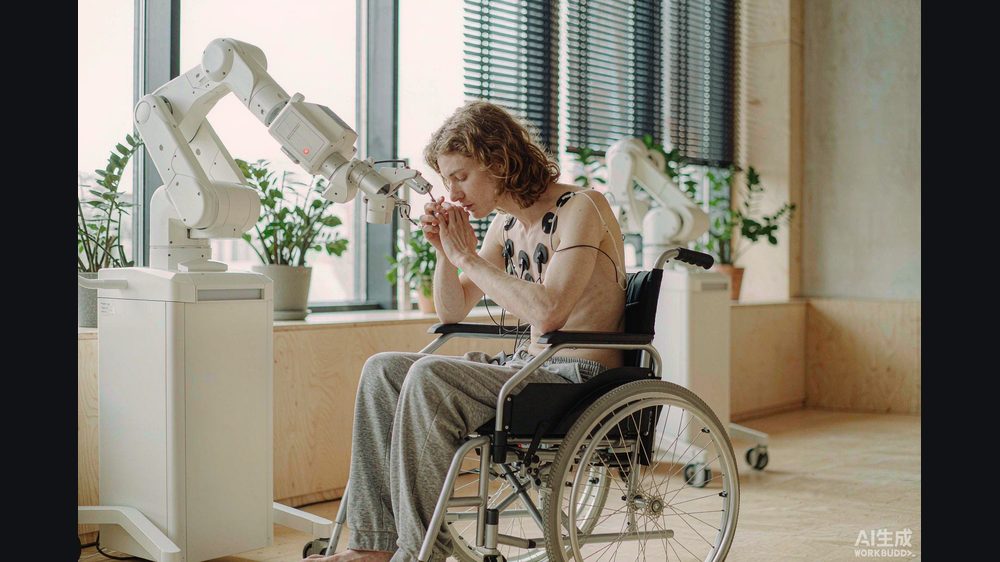
A surgeon makes a two-centimetre cut in the neck, finds a nerve, and wraps it with a thin wire. A second small incision in the chest hides a generator the size of a matchbox. No skull is opened, no brain is touched — yet the device can quiet seizures that drugs could not. This is vagus-nerve stimulation (迷走神经刺激), and a Beijing company has spent a decade turning it from an imported luxury into a Chinese-made standard.
What VNS does, in plain terms
Vagus-nerve stimulation (迷走神经刺激) is a form of neuromodulation (神经调控): a pacemaker for the nervous system. The vagus nerve is a major information highway between the body and the brain, so gently pulsing it can change brain activity. It is used for drug-resistant epilepsy, and researchers are probing it for depression, Alzheimer's disease, Crohn's disease, and post-stroke rehabilitation. The appeal is simplicity — a minimally invasive procedure, done under a microscope, with quick recovery — versus the far heavier surgery of deep-brain or cortical implants.
PINS and the Tsinghua link
Beijing PINS Medical (北京品驰医疗设备股份有限公司) is one of China's leading makers of implantable neuromodulation (神经调控) devices, built up through long collaboration with Tsinghua University (清华大学) and Beijing Tiantan Hospital (北京天坛医院). Together they run the National Engineering Research Centre for Neuromodulation (神经调控国家工程研究中心). PINS's work was supported under China's 12th Five-Year national science-and-technology support plan, explicitly to break import dependence on high-end nerve-regulation hardware.
From first registration to rechargeable, "aware" devices
PINS ran China's first domestic VNS clinical trial, a prospective, multi-centre, randomised, double-blind, parallel-controlled study led by Beijing Tiantan Hospital with five partner institutions. Its early VNS generators, the G111 and G112, were approved by China's NMPA (国家药监局) and earned the country's only VNS innovation-device designation at the time.
The company's rechargeable VNS kit carries NMPA registration 国械注准20233120686 — a rechargeable, perceptible, Bluetooth-enabled pulse-generator suite. According to the company and its investors, the rechargeable design (G113R/G114R) lifts the burden of battery replacement, lasts longer, and serves younger patients; the G114R adds cardiac sensing to help tune therapy. These product details come from company and investor disclosures rather than independent testing.
The number that patients feel
The most concrete claim is economic. PINS says that, versus imported devices, its locally made VNS cut surgical-device cost by about 70,000 yuan (≈ US$9,900 / HK$77,000) per patient. In a country where high-end implants were long imported and priced accordingly, that gap is the difference between a treatment many can reach and one few can.
PINS also says its neuromodulation (神经调控) products have been used in more than 200 hospitals, with the longest implant exceeding 9 years, and that remote programming, variable-frequency stimulation, and 3.0T MRI compatibility are part of its feature set. Those deployment figures are company-reported.
Why this is brain-tech even without touching the brain
VNS is sometimes overlooked in brain-computer interface (脑机接口) conversations because it is not a two-way decoder. But it is squarely neurotech (神经科技): it modulates brain state through an implanted electronic system, and it is one of the few such systems already approved, implanted at scale, and priced for ordinary patients. For a field obsessed with headline implants that are still in trials, PINS is a reminder that delivered, reimbursable neuromodulation (神经调控) is the quieter, larger market.
The bigger substitution story
PINS is one case study in a quieter Chinese policy theme: replacing imported high-end medical implants with domestic equivalents. Pacemakers, neurostimulators, and implantable sensors were, for years, dominated by a handful of multinational firms whose pricing reflected both R&D recoupment and limited local competition. When a domestic maker clears the same regulatory bar and localises the supply chain, the list price the patient faces can fall by sums that matter to ordinary households. That is why the 12th Five-Year support for PINS was less about one device and more about proving that Chinese engineering could close the implant gap. The lesson travels: the most consequential neurotech (神经科技) is sometimes the kind already in 200 hospital inventories, not the kind still on a conference stage.
Honest limitations
PINS's cost-saving, hospital-count, and longevity figures are company and investor statements, not independently audited outcomes data; the 70,000-yuan (≈ US$9,900 / HK$77,000) saving compares list prices at a point in time and may not reflect current net prices or insurance reimbursement. The clinical evidence base for VNS in epilepsy is strong and long-established, but its efficacy for depression, Alzheimer's, and stroke recovery remains investigational in many jurisdictions. NMPA registration confirms safety and quality clearance for approved indications, not superiority over all alternatives. This article focuses on one vendor and does not compare every domestic or foreign neuromodulation (神经调控) maker.
What readers can do now
- Families of drug-resistant epilepsy patients should ask neurologists whether VNS (迷走神经刺激) is appropriate and whether a locally made, NMPA-registered generator is available — it can be far cheaper than imported options.
- Clinicians should track which VNS indications are actually approved versus still investigational in China, since off-label enthusiasm outruns the evidence in some areas.
- Readers should distinguish "neuromodulation (神经调控) implanted and reimbursed today" from "brain-computer interface (脑机接口) still in trials" when judging how close neurotech (神经科技) is to their lives.