
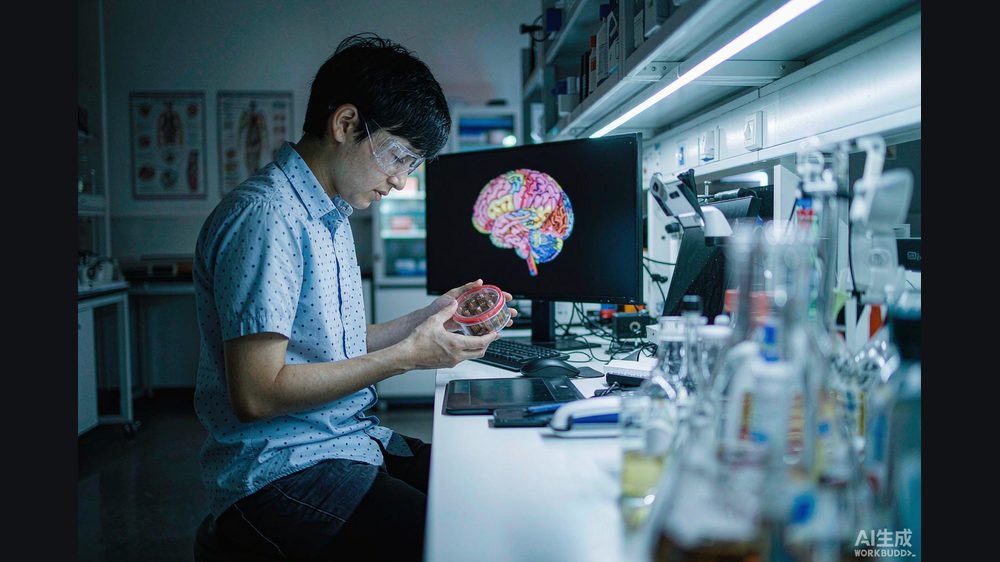
The press conference felt like a reunion of a different internet era. The man on stage had once run China's default input method and taken a search company to New York. Now he was explaining why the next breakthrough would happen in a hospital, not a chat window. Wang Xiaochuan (王小川) has never been short on conviction — only on patience for the obvious.
The search prodigy
Wang's résumé reads like a timeline of Chinese consumer internet. A Sichuan native, he won a gold medal at the 1996 International Olympiad in Informatics and entered Tsinghua University's computer science department. At Sohu he built Sogou, launching its search engine in 2004, the Sogou input method in 2006, and a browser that anchored the "three-stage rocket" growth model. He became Sogou's CEO in 2010.
In November 2017 he rang the bell at the New York Stock Exchange — Sogou traded as "SOGO" at a roughly US$5 billion valuation. Four years later, in October 2021, Tencent completed its acquisition of Sogou and Wang stepped down. In his farewell note he wrote of turning toward "life science and medicine" — a line many read as retirement. It was a prelude.
A second act at 45
In April 2023, Wang co-founded Baichuan (百川智能) with Ru Liyun (茹立云), another Sogou veteran. The timing was deliberate: China's "hundred-model war" was at its peak, and Baichuan was among the fastest to clear the regulator's generative-AI service filing, passing it on August 31, 2023 — the only model company founded that year to do so.
Wang framed Baichuan as building China's answer to OpenAI. But his instincts, shaped by two decades of consumer products, pulled him toward a problem he cared about personally: medicine.
The funding math
Investors backed the pedigree. In July 2024 Baichuan closed a Series A of about 5 billion yuan (≈ US$700M, HK$5.4B), at a valuation above 20 billion yuan (≈ US$2.7B, HK$21.6B). Alibaba, Tencent, and Xiaomi all participated, alongside municipal AI funds. The round made Baichuan one of the most valuable private model companies in the country.
Why medicine
Wang has argued for years that language is the gateway to intelligence. In a 2018 remark he said that "when machines master language, strong AI will have arrived." At Baichuan that belief hardened into a strategy: use large models (大模型) to relieve China's shortage of doctors rather than to win chatbot leaderboards.
In August 2024 Baichuan signed a strategic partnership with Beijing Children's Hospital, one of the country's leading pediatric centers. The two sides planned a pediatric health large model plus a set of assistant tools — a "digital pediatrician" for families, a decision-support aid for grassroots clinicians, and a research assistant for specialists. In early 2025 Baichuan released Baichuan-M1, a medical reasoning model, and with the hospital launched "Futang·Baichuan" (福棠·百川), described as a dedicated pediatric model. Its consumer health assistant, Baixiaoying (百小应), is pitched as an AI family doctor.
Wang has openly conceded that Baichuan once spread itself too thin across general models and is now narrowing to medicine — a path that mirrors, in reverse, the generalist-to-specialist shift happening across China's model startups.
The 2027 IPO ambition
Wang told a media briefing in January 2026 that Baichuan was preparing for a public listing targeted around 2027. The comment fits a wider trend: several of China's leading model companies are moving toward Hong Kong floats as private funding tightens and the cost of frontier training rises.
What a medical bet costs
Betting on medicine is a bet on patience. Hospitals move slowly, regulators move slower, and a "digital pediatrician" that impresses in a demo still faces the long road from assistant to trusted clinical tool. Wang's choice is also a contrast in risk: general chat models compete head-on with giants that can give the product away free, while a vertical medical model sells into a system that already pays for expertise. The trade-off is reach — a pediatric assistant serves millions of anxious parents but will never top a consumer-app leaderboard. For observers, Baichuan is a clean case study in how a Chinese model company turns a shortage of doctors into a recurring, defensible business.
Honest limitations
Biographical facts (IOI medal, Sogou's NYSE listing, Tencent's 2021 acquisition) are drawn from Wikipedia and Chinese encyclopedic sources. Funding and the 2027 IPO target come from crypto-news and government economic-zone reporting that cites Wang's own remarks; the IPO date is his stated intention, not a filed plan. The medical-product descriptions (Baichuan-M1, Futang·Baichuan, Baixiaoying) are based on Xinhua, China Daily, and company announcements; we have not independently verified clinical-performance claims such as exam-pass rates. Quotes from Wang are from published interviews; translations are our own.
What readers can do now
- Watch Baichuan's medical products — Baixiaoying and the pediatric assistant — to see whether a vertical model can out-earn a general one in China's cost-sensitive healthcare market.
- Read Wang's January 2026 briefing coverage for his case that medicine, not chat, is where Chinese models will first pay for themselves.
- Compare Baichuan's specialist path with 01.AI's enterprise pivot to understand why China's "AI tigers" are splitting into verticals.