
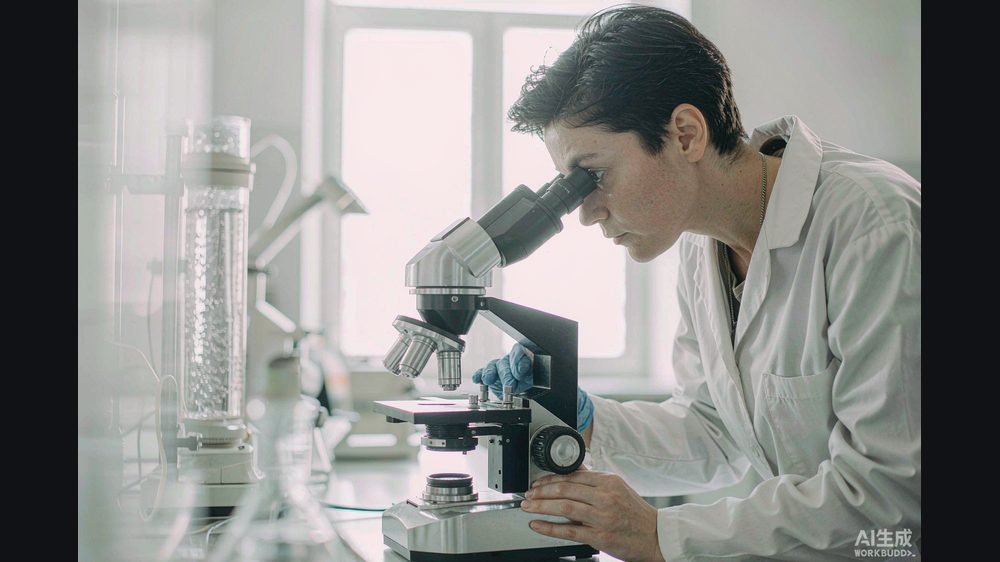
A researcher feeds a messy pile of molecule structures and lab notes into a model, then waits for it to suggest which experiment is worth running next. The promise sounds like science fiction, but it is the daily target of a lab led by one of Chinese technology's most quietly influential scientists — a man who spent two decades moving between America's corporate research giants and China's fastest-growing internet company.
Ma Weiying (马维英) is not a founder in the startup sense. His leverage comes from where he has stood: at the center of search, recommendation and now scientific discovery. The tension in his recent work is whether the methods that learned what people want to click can also learn how nature behaves.
That question is harder than it looks, and he has spent years repositioning himself to answer it.
A career across three labs
Ma's path is unusual for its continuity. He earned a bachelor's degree in electrical engineering from National Tsing Hua University in Taiwan in 1990 and a doctorate in the same field from the University of California, Santa Barbara, in 1997. He then spent four years at HP Labs working on multimedia delivery over mobile networks.
In 2001 he joined Microsoft Research Asia in Beijing, the lab that became a training ground for a generation of Chinese AI talent. He rose to become assistant managing director, working across information retrieval, web search and multimedia. Colleagues there helped set the tone for how China's tech firms would later build their own research cultures.
He is both an IEEE Fellow and an ACM Distinguished Scientist, with more than 300 published papers and over 160 patents to his name. In 2018 a global ranking of computer scientists placed him among the top hundred in his field.
The ByteDance years
In early 2017 Ma left Microsoft to become vice president and head of the artificial-intelligence laboratory at ByteDance, the company behind TikTok and its Chinese sibling products. The move surprised some observers: a veteran researcher joining a young, fast-moving content company rather than staying in academia or a Western lab.
At ByteDance his group worked on machine learning, computer vision, speech, natural-language processing and the personalized recommendation systems that powered the company's explosive growth. The role put him at the intersection of research and one of the largest real-world training grounds on earth — billions of user interactions feeding models daily.
He left in 2020. The experience sharpened a conviction that would shape his next chapter: that the same infrastructure used to recommend content could, with different data and goals, accelerate discovery in biology, medicine and materials.
Building AI for science at Tsinghua
Ma returned to academia as chief scientist at Tsinghua University's Institute for AI Industry (AIR), where he focuses on AI applied to the life sciences, genomics and drug discovery. His group works on large model (大模型) systems that combine generation and prediction, and on the compute (算力) needed to train them on biological data.
The pitch is practical rather than philosophical. Modern biology produces more data than humans can reason about directly — gene sequences, protein structures, clinical records. Ma argues that carefully built models can close loops between hypothesis, experiment and analysis, shortening the path from question to answer.
He has also taken on leadership in Hong Kong's AI research ecosystem, linking university research with industry adoption. Those roles extend his influence beyond a single campus and into how the broader region organizes its AI talent.
The bigger bet: learning from experience
A recurring theme in Ma's recent talks is that intelligence should accumulate experience the way people do — not just memorize patterns but build layered memory and reuse what worked. He describes frameworks for systems that learn forward from past outcomes, a contrast with the one-shot training runs common in today's models.
Whether that research matures into drugs or materials that actually reach patients and factories is still unproven. But the direction is clear: he is trying to move AI from serving feeds to serving science, where the cost of being wrong is measured in experiments and lives rather than clicks.
Why it matters globally
Ma sits at a junction where China's engineering scale meets fundamental research. If his institute and peers can turn recommendation-era infrastructure into reliable scientific tools, the payoff is not a single product but a faster pipeline for medicine and materials everywhere.
It also reframes a familiar worry. Much public concern about Chinese AI centers on content and surveillance. Ma's work points to a different, more constructive use of the same capabilities — one measured by discoveries, not engagement time.
Honest limitations
Ma's current research claims about AI-driven discovery are early-stage; this article does not present any as proven medical or commercial results. Details of his exact title and responsibilities in Hong Kong come from secondary profiles and may have shifted, so they are described in general terms. His influence on ByteDance's products is real but diffuse, and cannot be isolated to a single feature. The paper and patent counts cited are from institutional biographies and should be read as approximate career totals.
What readers can do now
- Follow Tsinghua AIR and related lab publications to see whether AI-for-science claims turn into reproducible benchmarks.
- If you work in biotech or materials, evaluate open models and pipelines before assuming only closed Western systems are viable.
- Watch how recommendation-era engineers repurpose their stacks for science — the talent migration itself is a leading indicator.