
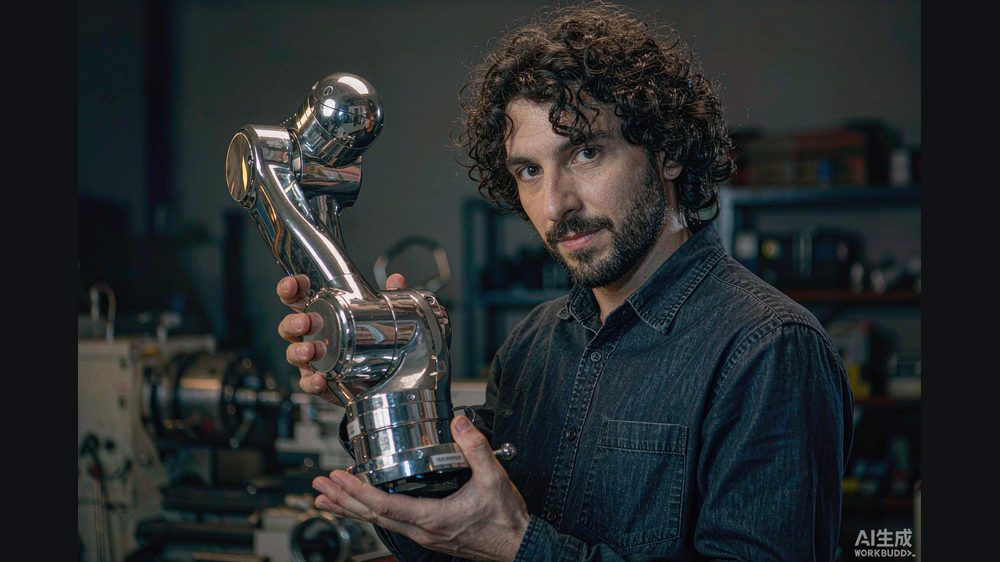
A logistics line needs a robot that can pick a pill bottle, a detergent box and a parcel it has never seen, in the same minute. Most humanoids (人形机器人) are still rehearsing that trick on a stage.
One Tsinghua lab turned it into a company, and then into a financing story the automotive world decided to back.
Key takeaways
- Chen Jianyu (陈建宇) is founder of Stardust Robotics (星动纪元) and an assistant professor and PhD supervisor at Tsinghua University's Institute for Interdisciplinary Information Sciences (交叉信息研究院), recruited by Turing laureate Andrew Yao (姚期智).
- Stardust, founded in August 2023 and incubated by Tsinghua IIIS, says it is the only humanoid (人形机器人) company with Tsinghua equity.
- On 20 November 2025 it closed a Series A+ round of nearly 1 billion yuan (近10亿元, ≈ US$140M / HK$1.1B), led by Geely Capital (吉利资本), with BAIC Industrial Investment and Beijing government AI and robotics funds; the deal set the record for the largest single automotive-capital investment in a Chinese embodied-AI (具身智能) company.
- Its embodied brain, ERA-42, is an end-to-end vision-language-action (VLA) model controlling a full-size bipedal humanoid and a five-finger dexterous hand (灵巧手); the company says core hardware is more than 95% self-developed.
- Disclosed cumulative orders passed 500 million yuan (≈ US$70M / HK$545M), with overseas business about half.
A lab that refused to pick a side
Chen is the rare founder who insists on doing both the brain and the body. Trained at Tsinghua's precision-instrument program and then at UC Berkeley, he was brought back to Tsinghua's IIIS by Andrew Yao, the Turing Award winner who built the institute, and now runs it as an assistant professor while founding Stardust.
That dual identity shows in the company's pitch. Where some humanoid makers buy joints and hands off the shelf and pour effort into software, and others build hardware and license brains, Stardust says it does both — "a hexagons warrior," as Chen described his team in press interviews, meaning a team that can both show off and ship. The result the company cites is a hardware self-development rate above 95 percent, covering joint modules, dexterous hands, motors, reducers and controllers.
The Geely bet
The money arrived in November 2025. Stardust announced a Series A+ round of nearly 1 billion yuan (近10亿元, ≈ US$140M / HK$1.1B), led by Geely Capital, the investment arm of the carmaker, with BAIC Industrial Investment taking a strategic stake and Beijing's AI-industry and robotics-development funds joining. By the company's account, it was the largest single investment by automotive capital into a Chinese embodied-AI (具身智能) company — and notable because Geely had previously backed only Unitree among robot makers.
The round was not an isolated vote. Prior financing included a nearly 500-million-yuan A round in July 2025 led by CDH VGC and Haier Capital, a nearly 300-million-yuan Pre-A in October 2024 with Clearwater, Vision Capital and Alibaba, and an angel round above 100 million yuan in early 2024 led by Lenovo Capital. The pattern is a company moving from research grant to industrial capital in under three years.
The brain and the hand
Stardust's differentiator is supposed to be ERA-42, an end-to-end VLA model that controls both a full-size bipedal humanoid and a five-finger dexterous hand (灵巧手). The company says the system runs a "frequency-split VLA" it proposed in September 2024, separating a slow world-model planner from a fast execution model, and that in December 2024 it open-sourced VPP, a video-prediction policy framework that lets robots pretrain on internet video to learn physical rules.
In October 2025, Chen's team, working with Tsinghua and Stanford's Chelsea Finn group, proposed Ctrl-World, a controllable generative world model the company says raised task success in unfamiliar scenes by 44.7 percent by letting robots rehearse in simulation first. In logistics demos the company shows the hand sorting mixed items — pills, cosmetics, parcels — with no preset program, a claim I treat as a demonstration rather than a deployed standard.
Why 95% self-built matters
Self-developing most of the hardware is not just pride. For a humanoid, the expensive, fragile parts — joint modules, reducers, motors, the dexterous hand — are exactly where supply chains bottleneck and margins disappear. Owning the design means Stardust can iterate the body and the brain together, and, Chen argues, weather the "capital froth" by showing real landing value rather than demo spectacle.
The commercial test is concrete. The company discloses cumulative orders above 500 million yuan (≈ US$70M / HK$545M), with logistics as the largest single order category at nearly 50 million yuan, and says overseas business is about half. Named partners include Geely, Renault, SF Express, TCL, Haier and Lenovo. These are company statements, not audited figures.
The gap between demos and shelves
Chen is candid that scale has not arrived. Humanoids are not yet in mass deployment, and he has said publicly that what the field needs is not more prototypes but dependable, repetitive work — picking, placing, sorting — done at a cost and reliability that beat a tired human. The risk he names himself is the "mismatch between valuation and landing ability" that critics level at the whole sector.
That is the real bet behind the 95-percent claim. If Stardust can make a self-built body that reliably earns its keep in a warehouse, the in-house supply chain becomes a moat. If it cannot, the self-reliance is just a longer bill of materials. The Geely and BAIC money buys time to find out which.
Honest limitations
This profile draws on Stardust's own announcements and coverage from Tencent News, Dahe Cable, Sina Tech and Xinhua. The A+ round size, lead investors and the "largest automotive-capital investment" record are corroborated by multiple outlets, so I report them as confirmed; the 500-million-yuan order total, 50 percent overseas share, 95-percent self-development rate and the 44.7-percent Ctrl-World gain are company statements that I could not independently audit and present as claims. I dropped an unsupported claim that nine of the world's top ten technology firms are Stardust customers, since it appeared in only one source, and I have not repeated a company characterization of ERA-42 as one of only four systems worldwide capable of full-body-plus-hand control, as that rests on the company's own promotional material. I paraphrased Chen's remarks from press interviews rather than quoting a primary transcript.
What readers can do now
- Judge humanoid makers by self-developed core components and named paying partners, not by demo videos or valuation headlines.
- If you are evaluating robots for logistics or manufacturing, ask for repeatable task metrics (picks per hour, failure rate) in your own environment, not stage performances.
- Watch Stardust's warehouse and automotive deployments as the real test of whether 95-percent self-build translates into lower cost and higher reliability.