
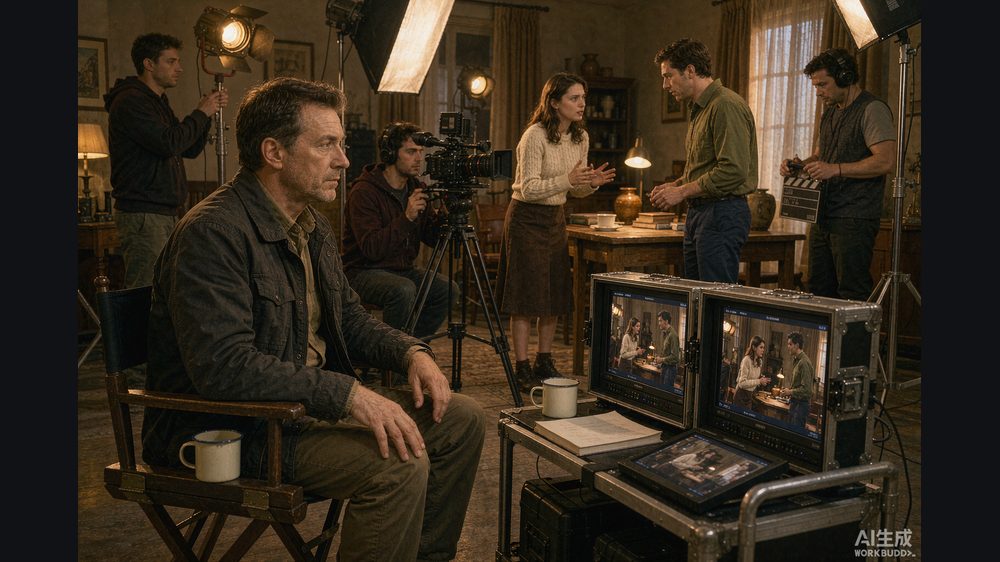
Not long ago, getting a decent image out of AI often meant repeated lottery draws and patient waiting, with no guarantee of satisfaction.
The feel of image generation is changing
That is now being rewritten: more and more open-weight image and video models are appearing, shaving the threshold for generating images and clips lower step by step, letting ordinary people tinker with works on their own computers.
A clear signal of a lowered threshold came from an open model led by a Fudan University team. On October 16, 2026, an open-weight image generation model named MOSS-Image was officially released, built on a 5-billion-parameter single-stream diffusion architecture and open-sourced under the permissive Apache license.
What makes it distinctive is that it can accommodate very long prompts: the official upper limit is about 4,000 tokens, and it can render long passages of Chinese and English text clearly into the image.
In the past, open models used to fear "text failures": titles on posters and captions in charts were often riddled with typos and broken lines. MOSS-Image made long-text rendering and editable layout control its main focus, letting creators use structured descriptions to set where titles and illustrations each sit.
This made local deployment and precise layout no longer rare.
This part is about images. Writing clear text into a picture sounds trivial, yet it is a hard requirement for "text-heavy" scenes like posters, slides, and infographics. In the past, open models often failed here and pushed people back to professional software; now that the gap is filled, local image generation truly moves a step closer to "deliverable."
What is lowered is not only technology but also a psychological threshold. When a tool no longer demands that you first earn a certificate or buy a membership, ordinary people are more willing to treat it as an everyday toy rather than a machine unreachable on a high pedestal.
This also explains why news of open models has grown denser lately. Each time weights are released is an act of pushing capability downward, and those who benefit are precisely the people with no budget to maintain an algorithm team.
A six-step video model
On the video side, step compression has become a new battlefield.
On October 29, 2026, Pika released Pika H3 Flex, a model built on post-training; it is trained further on the open video model MiniMax H3, and cuts the denoising steps needed for generation from 50 in its teacher model down to 6.
Cutting steps from 50 to 6 means far less computation for the same clip, faster output, and the ability to simultaneously generate video up to about 15 seconds with stereo audio.
According to the official introduction, this makes the model better for creators to try shots repeatedly, pick drafts, and then send the chosen version for high-definition enhancement, noticeably lightening the creative rhythm.
Usually, compressing steps brings a loss in look, but Pika used preference optimization on top of distillation to recover the quality. This shows that "fast" and "good" are being chased together by engineering, and the either-or trade-off of the past is loosening. For consumers, the shorter wait is often more intuitive than pretty parameter counts.
For short-video creators, this is almost handing back the "right to trial and error." In the past every revision cost money; now you can generate a few versions at will and pick the best, and the cost of validating an idea is pushed to the floor.
For creators, the drop in steps brings not only speed but a change in mindset. In the past a single try was costly and hard to give up; now generating a few versions casually makes inspiration easier to verify and discard quickly, and the creative loop is markedly shortened.
The open foundation spreads
What truly makes this price-cutting wave possible is a deeper open foundation. After MiniMax H3 was released as open weights in August 2026, it quickly became the common base for many derivative models.
Different teams post-train, accelerate, and optimize it for different scenarios, and the open community stacks capability layer by layer like building blocks.
The meaning of open source was never just "free." When model weights are public and code is inspectable, developers can run locally, modify freely, and fine-tune as needed, no longer forever led by the prices and rules of some cloud service.
For individuals and small teams on a budget, this equals putting the once-locked creative tool back within ordinary people's reach.
What matters more to ordinary people is that some of these models can now run on consumer-grade graphics cards. In the past, making a video clip meant queueing for the cloud and paying per use; now you can try repeatedly on your own machine, and the marginal cost has been pushed down considerably—though hardware requirements vary widely from model to model.
One open base can also nourish a batch of derivative models, multiplying users' choices, pulling prices down, and spreading innovation to more hands.
When a model can be taken and modified by hundreds or thousands of teams, progress no longer relies only on the original crew. Every fine-tune and every workflow in the community pushes capability toward broader scenarios, a vitality that closed interfaces can hardly replicate.
In other words, open source is not done once the model is thrown out; it also hands over the right to keep improving.
After the threshold is lowered
Of course, open does not mean perfect. Most local versions are still draft engines; more refined capabilities like high-definition enhancement and audio track separation often remain behind each company's hosted interface.
But this division of "try locally first, polish in the cloud later" makes the first step of creation especially light, and gets more people willing to try.
Openness also brings new worries. If everyone can modify a model, the threshold for abuse is equally lowered; faces and voices generated casually, if spread as real footage, will instead worsen information distortion. For ordinary users, the key is to see clearly the boundary between "draft" and "final," and not treat a trial image as truth.
Looking back at this round of change, the image side competes on "writing clear text and placing good layout," the video side on "fewer steps and faster output," and the foundation side on "open weights and local runs." The three lines converge on one result: the door of creation is pushed open wider.
Lowering the threshold ultimately shaves off the sense of distance. When making an image or a video no longer requires expensive computing and obscure commands, creativity more easily flows from a few experts to every person with an idea.
The moment open source hands out the tools, the protagonist of the story quietly becomes ordinary people's inspiration.
Disclaimer: This article is based on publicly available information and is for reference only. It does not constitute investment advice.