
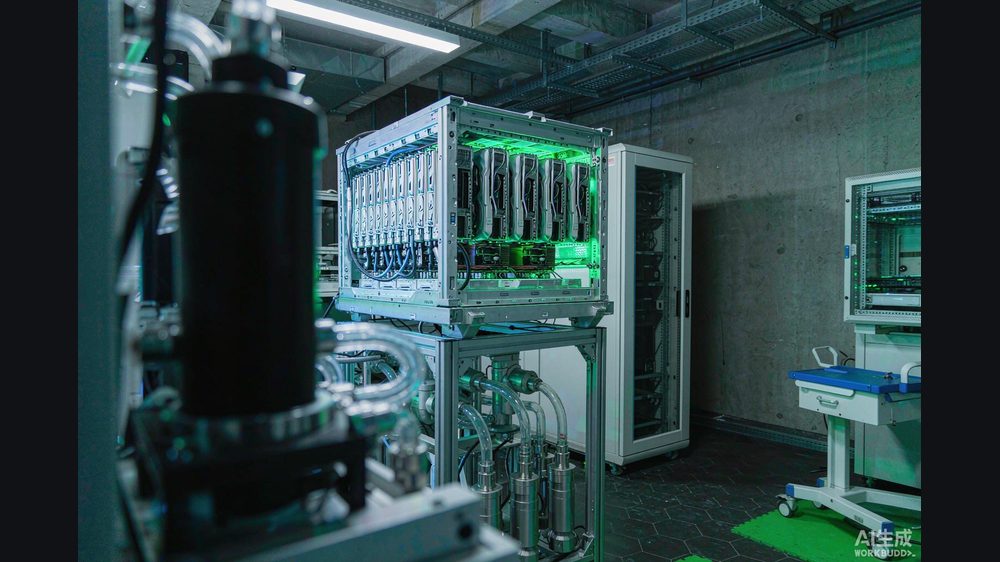
A developer downloading an open model usually gets weights and an inference script. Huawei's openPangu 2.0 ships with three extra pieces — pre-training code, post-training code, and training operators — so the whole pipeline can run on the company's own accelerators.
The model is openPangu 2.0, announced at the Huawei Developers Conference on 12 June 2026 by Richard Yu (余承东), a Huawei executive director. It is the latest generation of a model family Huawei began in 2021. The release is less a claim about raw capability than a statement about strategy: model, chip, framework, and operating system are being treated as one product.
Key takeaways
- openPangu 2.0 Pro has 505 billion total parameters with 18 billion activated per token, using a mixture-of-experts architecture.
- The Flash version has 92 billion total and 6 billion activated parameters, with a 512K context window on both versions.
- Huawei says the Pro version was trained on roughly 34 trillion tokens and optimised for Ascend (昇腾) accelerators.
- Components were released in stages: Flash weights in June, Pro weights in July, and training code in September 2026.
- Performance claims, including a twofold single-card throughput advantage, come from the company.
Why activate only a fraction
A mixture-of-experts (MoE) model holds many parameter sets but uses only a subset for any given token. The Pro version's 505 billion total parameters are reduced to about 18 billion active ones during inference; the Flash version goes from 92 billion to 6 billion. The point is economic. A large model can be stored without paying the full compute cost on every token.
Huawei has been explicit about why it did not chase a much larger parameter count. According to Huawei's announcement at the Huawei Developers Conference, Yu said that compute was tight and that the company had allocated substantial Ascend capacity to other domestic customers, leaving limited capacity for its own training. He also pointed to rising memory costs and the importance of inference throughput and latency. The implication is practical rather than ideological: a model that runs efficiently on available hardware beats a larger one that cannot be deployed.
The 512K context window on both versions is the headline capability. In plain terms, the model can hold roughly a long novel's worth of text in one pass, which matters for codebases, legal documents, and multi-step agent tasks.
The staged open-source release
Huawei did not publish everything at once. On 30 June 2026, it released Flash weights, basic inference code, and training and inference operators. On 31 July, Pro weights, inference code, and a technical report followed. On 28 September, the pre-training code, supervised fine-tuning code, and reinforcement-learning code were published.
Those seven components are the differentiator. Most open-weight releases give developers a model they can run. Huawei is offering a model they can retrain, with operators written for its hardware. That lowers the cost of adapting the system to a specific industry, which is the company's stated goal.
The model is also tuned for HarmonyOS agent tasks, with official descriptions pointing to faster response and lower resource use for cross-application workflows. Together with Ascend and the MindSpore framework, it completes a domestic stack that Chinese institutions can adopt without assuming access to foreign accelerators.
What this means for the open-model race
Open models have become a form of industrial policy infrastructure in China. Publishing weights creates a developer ecosystem; publishing the training path creates a hardware ecosystem. Huawei's move addresses the second half, which is where most vendors stop.
Whether developers adopt it depends on factors benchmarks do not capture: documentation quality, compiler maturity, and whether the operators work reliably outside a controlled environment. A twofold throughput claim, even if accurate in the company's tests, is a starting point for evaluation, not a conclusion.
For readers outside China, the release is worth watching as an example of vertical integration. The common assumption is that model companies buy compute from chip companies. Here, one organisation owns the chip, the framework, the model, and a device operating system, and is trying to make that combination the default path for its domestic market.
Honest limitations
- Parameter counts, token totals, context length, and throughput claims come from Huawei and Chinese media reporting its announcements. I found no independent benchmark replication.
- The twofold throughput comparison does not specify the exact baseline models or test conditions in the sources reviewed.
- I did not verify the release dates against the repositories themselves; they are from company announcements and reference summaries.
- The model family has drawn criticism in Chinese media about earlier development decisions. I have excluded opinion and focused on documented specifications.
- Open weights do not guarantee reproducibility if training data is not published.
What readers can do now
- If you deploy open models, read what "open" includes. Weights alone and weights plus training code are very different commitments.
- Test on your own hardware. Throughput figures from a vendor's environment rarely transfer unchanged.
- For teams in China, compare total cost of ownership across stacks rather than benchmark scores alone — including power, tooling, and engineer time.