
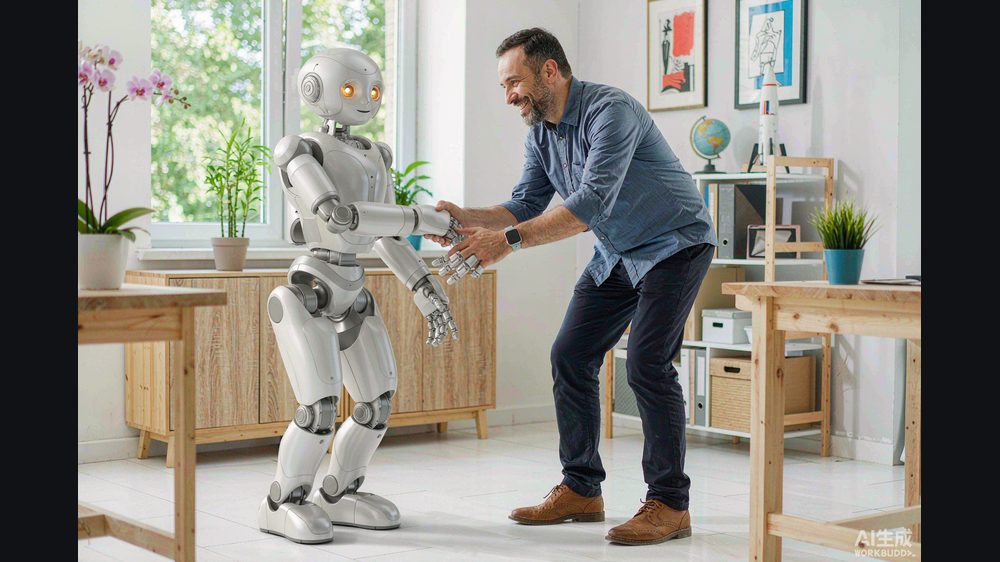
A humanoid robot looks like magic in a clip and like a logistics problem on a factory floor. Underneath the spectacle it is three engineering problems stacked together: make it move, make it see, and make it think. Get all three right at once, outdoors, on two legs, and you have the hardest product in robotics.
This explainer breaks each layer down, and explains why in 2026 the bottleneck moved from the body to the brain.
Key takeaways
- A humanoid is three subsystems: actuators (the body), sensors (the senses), and models (the brain).
- Hardware — joints, balance, bipedal walking — is now largely solved by the leading Chinese makers; the deficit is intelligence.
- The "brain" is two model families: VLA (vision-language-action) and world models, run at the edge.
- The hard part is not walking. It is deciding, in a messy real world, what to do next — and recovering when something goes wrong.
The three problems
Walking on two legs is hard, but it is a solved hard. Seeing a cup is easy for a camera, harder for a robot to act on. Deciding to pick the cup up, with the right force, around a person, and recover if it slips — that is the unsolved hard. The layers build in that order.
The body: actuators and balance
The body is a stack of joints. Each joint uses an actuator — typically a motor with a reducer and sometimes a tendon or a harmonic drive — that converts electricity into torque. More joints and better torque control mean smoother, more human-like motion. Batteries, cooling, and weight distribution decide how long the robot stands.
Bipedal balance used to be fragile. In 2026 it crossed into reliable: at a April 2026 Beijing half-marathon qualifier, a Unitree H1 autonomously completed a 1.9 km multi-turn course. That is not factory productivity, but it proves locomotion and balance are no longer the blocking problem.
The senses: cameras, lidar, and proprioception
A robot "sees" through cameras and sometimes lidar or depth sensors, fused into a 3D map of its surroundings. Just as important is proprioception — knowing where its own limbs are without looking. Inertial sensors and joint encoders feed that internal sense, so the robot does not have to visually track every finger.
The gap between sensing and acting is understanding: a camera sees a handle; the robot must know it is a handle, that pulling it opens a door, and that the door might be stuck.
The brain: VLA and world models
The brain is software. Two model families dominate in 2026:
- VLA (vision-language-action) models take what the robot sees and is told, and output an action — "move the gripper there, then close it." They let a robot follow natural-language instructions without being reprogrammed for each task.
- World models simulate what will happen next — "if I push here, the box tips" — so the robot can plan a few steps ahead instead of reacting blindly.
Running these at the edge (on the robot, not in the cloud) matters: a cloud round-trip is too slow and too fragile for a moving machine. That is why China's cheap, strong open models are attractive to robot makers — they are efficient enough to run locally.
Why intelligence is the bottleneck
Unitree's own assessment is that hardware is the solved part and the deficit is intelligence. The company is pursuing world models and VLA in parallel, and redirected more than 2 billion yuan of IPO proceeds into robot-model R&D, including a strategic memo with DeepSeek on embodied intelligence.
The logic is strategic as well as technical: a company that owns the actuators should not have to rent the brain forever. A robot that can plan, recover, and learn on the job is worth more than one that replays a scripted dance.
Honest limitations
This is a conceptual explainer, not a technical specification. Model families (VLA, world models), edge-inference claims, and the "hardware solved, intelligence bottleneck" framing reflect public statements by robotics firms and 2026 industry reporting, not a benchmark the author ran. Specific performance figures (course completion, funding amounts) are drawn from company disclosures and coverage cited earlier in this series and may not generalize across all humanoid platforms.
Sources
Public statements and disclosures from Unitree and other humanoid makers; 2026 industry reporting on embodied-AI strategy, VLA and world models; and coverage of humanoid locomotion milestones cited in this series.