
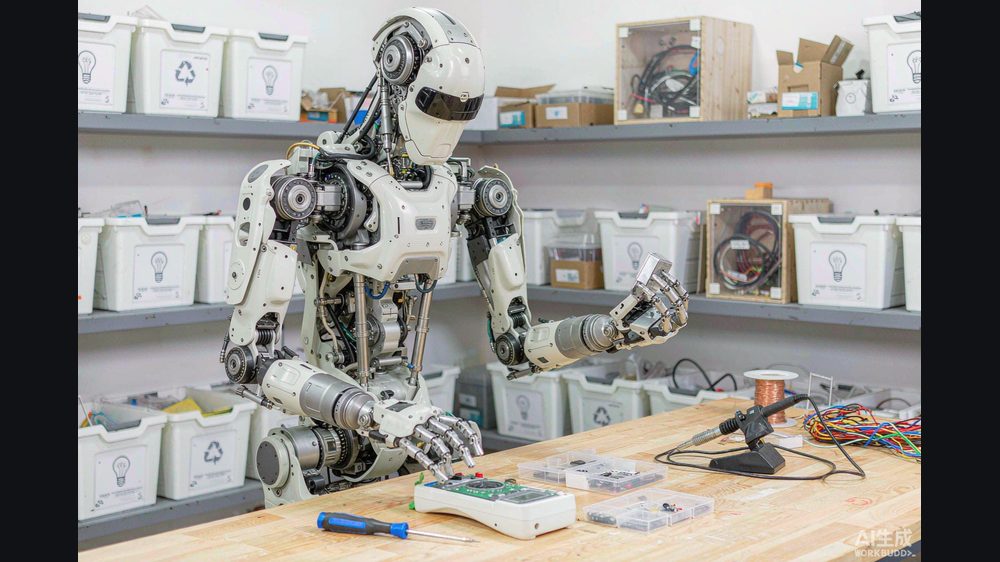
In a Shanghai rehab ward, a 1.75-meter humanoid helps a stroke patient practice a reaching motion. A few slides later, the same company's pitch shows that same body on a factory line. Fourier Intelligence (傅利叶) is trying to make one humanoid (人形机器人) do both.
It is a bet that runs against the grain. Most Chinese humanoid makers are racing to put robots into warehouses and car plants. Fourier, founded in 2015 out of rehabilitation robotics, is aiming its second-generation humanoid at hospitals first — and factories second.
The robot: GR-2
Fourier announced the GR-2 in Shanghai on March 22, 2026. It is the successor to the GR-1, which the company describes as one of the world's most advanced rehabilitation humanoids. The stated specs:
- 53 degrees of freedom overall, with 7 degrees of freedom per arm for upper-body dexterity.
- A 50 kg payload — the highest among healthcare-focused humanoids in spec aggregators' comparisons.
- A modular design that allows rapid customization for different scenarios.
- An AI motion-control system that adapts to each patient's needs and progress.
Fourier's heritage is the part that separates it from pure-play humanoid startups: it has built rehabilitation robots used in more than 1,000 hospitals and rehab centers worldwide, with offices in the United States, Germany, Japan, and Singapore.
Two jobs at once
The GR-2 is pitched as a general-purpose body with two clear lanes:
- Rehabilitation: assisting patients with neurological conditions, spinal-cord injury, and post-stroke recovery through guided movement therapy.
- Industrial: assembly, quality inspection, and material handling — already in pilot programs at several Chinese manufacturing facilities, the company says.
The logic is that a robot strong and gentle enough to support a fragile human limb is also a robot that can handle delicate factory parts. Whether that transfers is the open question.
The 1,000-unit plan
Fourier says it plans to ship more than 1,000 GR-2 units in 2026. That is a company target, not a delivered number, and it sits at the small end of China's humanoid volume race — AgiBot (智元) and Unitree (宇树) are already counting units in the tens of thousands off the line. But Fourier is not competing on volume; it is competing on a lane almost no one else occupies.
Why a rehab company, why now
Two forces push the timing. Populations are aging across the regions Fourier already sells rehab gear into, and rehab is labor-intensive. At the same time, the broader humanoid field has shown that a bipedal, force-controlled body can do useful physical assistance — exactly Fourier's heritage.
The catch is honesty about stage. Most humanoids shipped globally in 2026 still go to research labs, schools, and show floors rather than real work. Fourier's industrial claims are "pilot programs," not scaled production proof, and its rehab efficacy has not been independently benchmarked in the materials we found.
Where Fourier sits in China's humanoid map
China's humanoid field splits roughly into three lanes. One group — Unitree (宇树) and AgiBot (智元) — chases volume and factory or warehouse deployment. A second group builds research and education platforms. Fourier is staking out a third lane: healthcare-first, where the proof bar is a clinical outcome, not a unit count. That is a harder commercial story — hospitals buy slowly and require evidence — but it is also less crowded, and it plays to a real installed base of rehab equipment rather than a blank-sheet pitch.
The proof problem in the rehab lane
The risk is that "helps a patient practice" and "improves recovery" are different claims. Fourier's materials describe assisted movement and adaptation; they do not, in what we found, present independent clinical benchmarks showing faster recovery versus standard therapy. For a buyer, that gap is the whole decision. Until a peer-reviewed or regulator-reviewed study lands, the GR-2's rehab value is plausible and unproven — which is normal for a 2026 humanoid, but worth saying out loud.
Honest limitations
- The 1,000-unit 2026 target is a company plan, not reported deliveries; treat it as intent.
- "Deployed in pilot programs" means early, not scaled — no third-party unit count or uptime data was available.
- GR-2 pricing was not published. An external spec aggregator lists the older GR-1 at US$150,000–$170,000; we could not confirm any GR-2 price, so we do not state one.
- Rehab effectiveness claims come from the company's own launch materials (March 22, 2026) and spec aggregators, not independent clinical studies.
- The "1,000+ hospitals" figure refers to Fourier's broader rehabilitation-robot portfolio, not GR-2 humanoids specifically.
What readers can do now
- If you run a rehab facility, pilot the GR-2 for one guided-therapy task and measure outcomes against a therapist's — the healthcare lane lives or dies on that comparison.
- If you track robotics, watch Fourier's actual 2026 shipments against its 1,000-unit plan; a rehab-focused humanoid that hits volume would be a genuinely new category.
- If you build automation, separate "rehab humanoid" from "factory humanoid" in your notes — same body, very different proof bars, and Fourier is the rare maker claiming both.