
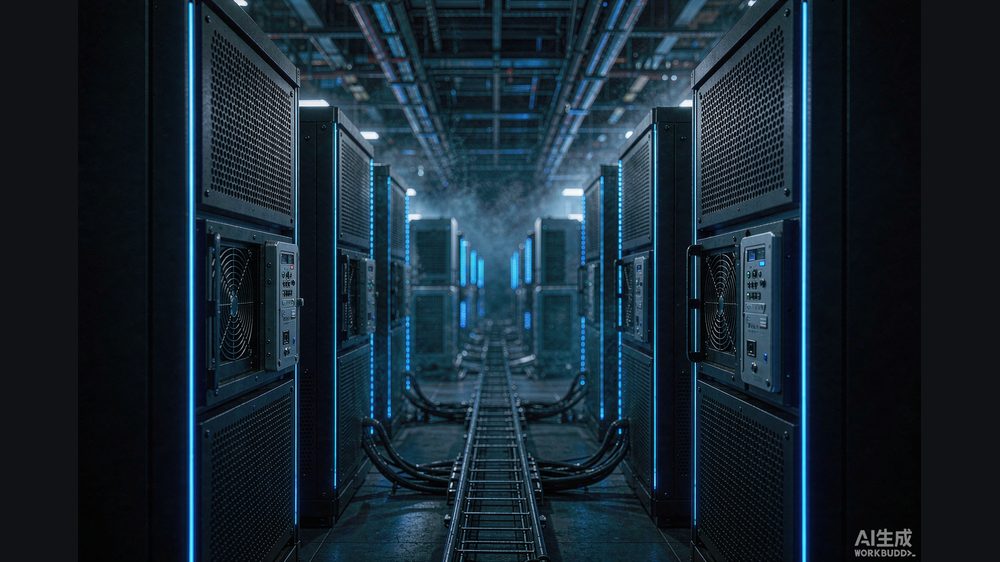
In a provincial procurement office, the agenda has one item that did not exist a few years ago.
The old list was towers, fibre and spectrum. The new list is halls, liquid cooling and memory.
The budget has not grown. It has moved.
Key takeaways
- China Mobile plans 2026 capex of RMB 136.6 billion (≈US$19.2bn), down 9.5%, while its compute-network line rises 62.4% to RMB 37.8 billion (≈US$5.3bn) (company briefing, March 2026).
- In the first half of 2026 the carrier cut communications capex by RMB 4.1 billion and raised compute spending 71.3%; the money was reallocated, not added.
- The RMB 100 billion compute figure for 2027 sits inside a RMB 500 billion procurement total, a different accounting basis from the 2026 capex line.
- China Mobile will run seven gigawatt-scale compute campuses by end-2027, up from two in service and three under construction.
- Its own latency split puts the radio link at 35 ms and the cloud platform at 665 ms — 95% of end-to-end delay behind the network.
The bill is shrinking; one line is not
China Mobile is the largest of the three state carriers, and the clearest read on where the money goes. Its 2026 plan cuts capital expenditure 9.5% to RMB 136.6 billion (≈US$19.2bn). Inside that smaller total, the communications network — the 5G and fibre budget — falls 20.3% to RMB 79.2 billion (≈US$11.2bn), the compute network rises 62.4% to RMB 37.8 billion (≈US$5.3bn), and the intelligent network rises 19.8% to RMB 8.9 billion (≈US$1.3bn) (company results briefing, 26 March 2026). Across the three networks alone, the two AI lines take more than 37%; against total capex they are about 34%.
The half-year figures show the mechanism. Capital expenditure rose 4.5% to RMB 61.0 billion; compute-network spending rose 71.3% to RMB 15.6 billion; communications-network spending fell 9.8% to RMB 37.9 billion. The communications cut of RMB 4.1 billion covered about two-thirds of the RMB 6.5 billion added to compute; the rest came from a total that grew 4.5% (interim results, reported by CCIDCOM, 14 August 2026).
This is a transfer inside one balance sheet, not a new programme: less coverage, more accelerators.
The 2027 number is a different number
On 6 November 2026, at the Mobile Network Conference in Guangzhou, chairman Chen Zhongyue gave the figure that travelled: compute investment above RMB 100 billion (≈US$14.1bn) in 2027.
That RMB 100 billion is one slice of a procurement total expected to exceed RMB 500 billion (≈US$70.4bn) (China Securities Journal, 6 November 2026).
Procurement and capital expenditure are not the same account. The 2026 compute figure of RMB 37.8 billion is a capex line inside a RMB 136.6 billion capex plan. The 2027 figure is a purchasing budget, which can include items never capitalised, and no 2027 capex figure was given with it.
So the claim that compute spending more than doubles compares two denominators. It may still be a large increase, but no published figure establishes its size. Setting RMB 100 billion against RMB 37.8 billion measures vocabulary as much as spending.
Compute is now described in terms of output. Chen framed it as a shift "from IDC to AIDC, from CPU to GPU, from cloud resource pools to token factories (词元工厂)", adding that compute building is not only about watching investment but about comparing output (China Securities Journal, 6 November 2026).
Seven gigawatts, counted as power
Carriers once reported racks, then fleets of ten-thousand-card clusters. China Mobile now reports campuses sized in gigawatts.
Two are in service, three broke ground in 2026 and two more start in 2027, taking the total to seven. All use standardised modular designs and high-density liquid cooling (China Securities Journal, 6 November 2026).
The construction claims are about schedule, not capacity. In Zhongwei, Ningxia, the company says it put up a 170,000-square-metre compute building in three months and reached capacity delivery in five, and that intelligent-compute capacity will double for two consecutive years.
A gigawatt is a power rating, not utilisation; nothing disclosed says how much is contracted. Nationally: more than 24 GW of data-centre capacity at the end of 2026, against roughly 56 GW in the United States (SemiAnalysis, 25 September 2026). Seven gigawatt-scale parks are a visible share of that build.
What the carrier's own numbers say
The most useful disclosure undercuts the pitch.
Chen said the radio side of the mobile network contributes about 35 milliseconds to delay, while the cloud platform contributes about 665 milliseconds — 95% of the end-to-end figure. He also said mobile internet traffic grew 18% this year, twice the previous year's pace, and that the network-wide uplink-to-downlink ratio is 1:9 while AI applications run at 1:6 (Shanghai Securities News, 6 November 2026).
If most delay and most new traffic sit above the radio, adding spectrum does not fix the experience, and the case for owning compute becomes an argument about where the queue forms.
The other two run the same play smaller. China Telecom plans 2026 capex of RMB 73 billion (≈US$10.3bn), down 9.2%, with RMB 25.5 billion for compute infrastructure, up 26%. China Unicom plans about RMB 50 billion, down 7.7%, over a third for compute (company figures, cited by Central China Securities, 12 November 2026).
Three shrinking totals with three rising compute shares explain why China's AI capacity numbers can climb while telecom capital spending falls.
Honest limitations
The 2027 figures are guidance at a company event, not an audited plan. Treating procurement and capex as different bases is our reading of how the two were presented; no reconciliation was offered. Gigawatt ratings describe contracted power and design capacity, not load. Utilisation is company-reported and defined differently across carriers, so the figures cannot be ranked. The 24 GW national number is a third-party estimate, and the latency split is one executive's measurement with no published method.
What readers can do now
- For analysts, stop comparing the 2027 procurement figure with the 2026 capex line. Ask investor relations for the 2027 capex plan and its compute line.
- For suppliers, map the seven campuses to provinces before quoting capacity. Land, power and grid connection are provincial decisions, and the Zhongwei schedule is not a national standard.
- For newsrooms, report gigawatts as power, not compute delivered, and ask for contracted load. An energised campus is not a sold campus.