
The next time a Tencent Meeting (腾讯会议) caption appears in near real time while five hundred people talk at once, the chip doing the work probably is not from Nvidia. It is Zixiao (紫霄) — a name that means "purple clouds," and a rare case of a Chinese internet giant's homegrown silicon already running in production.
Tencent is not a chip company by identity. That is exactly why its chip strategy is worth watching: it shows what a cloud-and-app giant does when it decides silicon is too important to outsource.
What Zixiao is — and is not
Zixiao (紫霄) is Tencent's self-developed AI inference chip, first disclosed in November 2021 at the Tencent Digital Ecosystem Conference by Dowson Tang (汤道生), then CEO of the cloud-and-industry group.
The design choices are telling:
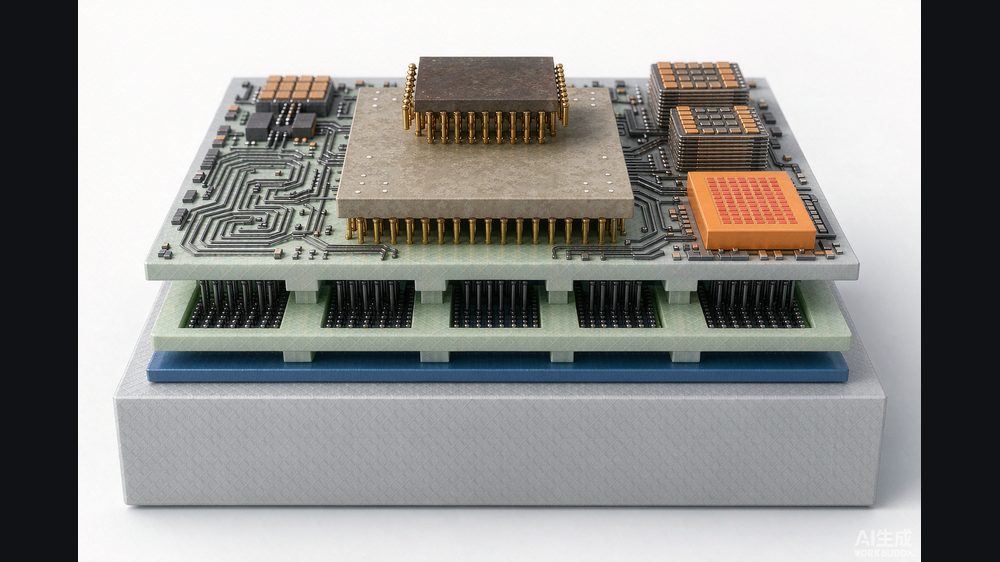
- It uses 2.5D packaging to stack HBM2e memory next to the AI core, attacking the memory bottleneck directly.
- It integrates a computer-vision accelerator and a video codec accelerator on chip.
- It was built for specific jobs — image and video processing, natural-language processing, search and recommendation — not as a general GPU replacement.
- Tencent said at launch that performance was roughly 100% better than comparable industry solutions, and that the chip had already been taped out and powered on successfully.
Tencent has never positioned Zixiao as a trainer-killer. It is an efficiency play for the boring, high-volume work that dominates a consumer internet company: subtitles, recommendations, filters, transcoding.
From 2021 debut to real deployment
The deployment story is where Zixiao earns credibility. Tencent says the chip moved into Tencent Meeting (腾讯会议) at scale, where it handles real-time subtitles.
- On that workload, a single Zixiao card was reported to carry four times the load of an Nvidia T4, with the timeout rate on high-concurrency speech tasks driven to near zero.
- It now covers the majority of the product's subtitle traffic and can recognize hundreds of simultaneous speakers.
- By 2023, Tencent described Zixiao as deployed across its head businesses, delivering roughly 3x compute acceleration and over 45% overall cost savings versus the setup it replaced.
When a chip runs the captions for a meeting product used by hundreds of millions, "in-house" stops being a slogan.
Zixiao 2.0 and the large-model pivot
At WAIC 2025, Tencent signaled the chip's ambitions had grown. The company said the newer Zixiao generation lifted training performance about 4x and inference throughput about 3x over the previous generation, and that it had been used in training the company's Hunyuan (混元) large model (大模型) with a roughly 50% performance improvement on that workload.
Tencent has also discussed scaling self-developed chips to a six-figure card count over time, and lifting their share of the company's internal mix — goals reported alongside the WAIC disclosures. Those are directional commitments, not shipped facts, and should be read as intent.
Why a gaming-and-social app giant builds silicon
The motive is not national pride. It is margin.
- Video is a bandwidth tax. Tencent's traffic businesses — video feeds, live streaming, calls — burn compute and bandwidth constantly. A chip tuned to that load can shave real money.
- Scale justifies custom silicon. At Tencent's volume, even a small per-unit efficiency gain compounds into meaningful opex relief.
- Control of the stack. Pairing a custom chip with Tencent's own runtime and scheduling software lets it optimize end to end, instead of waiting on a vendor's roadmap.
Zixiao is not alone in Tencent's chip drawer. The company also built Canghai (沧海) for video transcoding and Xuanling (玄灵) for smart-network cards, and it stood up the Penglai Lab (蓬莱实验室) in 2020 to own chip design end to end. For its newer generations, Tencent worked with a domestic AI-chip design partner, Enflame (燧原科技), to extend the architecture.
Honest limitations
- The 100% and 4x numbers are Tencent's. They are vendor claims tied to specific internal workloads, not independently benchmarked against a like-for-like competitor.
- Inference, not frontier training. Zixiao's proven strength is high-volume inference. The large-model training claim is recent and narrowly described; it is not evidence of a general trainer.
- Memory reliance is external. Like most Chinese accelerators, the HBM in Zixiao depends on foreign memory supply, a vulnerability no packaging trick removes.
- The roadmap is inward. Zixiao serves Tencent first. Its impact on the broader market is limited unless Tencent chooses to offer it through Tencent Cloud at scale.
What readers can do now
- If you build on Tencent Cloud, ask whether Zixiao-backed instances are available for your inference or media workloads, and benchmark them against Nvidia and domestic alternatives on your own traffic.
- If you run real-time media at scale, study Tencent's subtitle and transcoding case as a template: custom silicon pays off most where one workload repeats billions of times.
- If you follow the China chip story, track whether Tencent actually hits its six-figure deployment target. That number, more than any launch claim, will show whether hyperscaler silicon is scaling or stalling.
- If you invest, separate "we designed a chip" from "we ship it at scale." Tencent has clearly done the second — which puts it ahead of most drawn-out ambitions in this sector.