
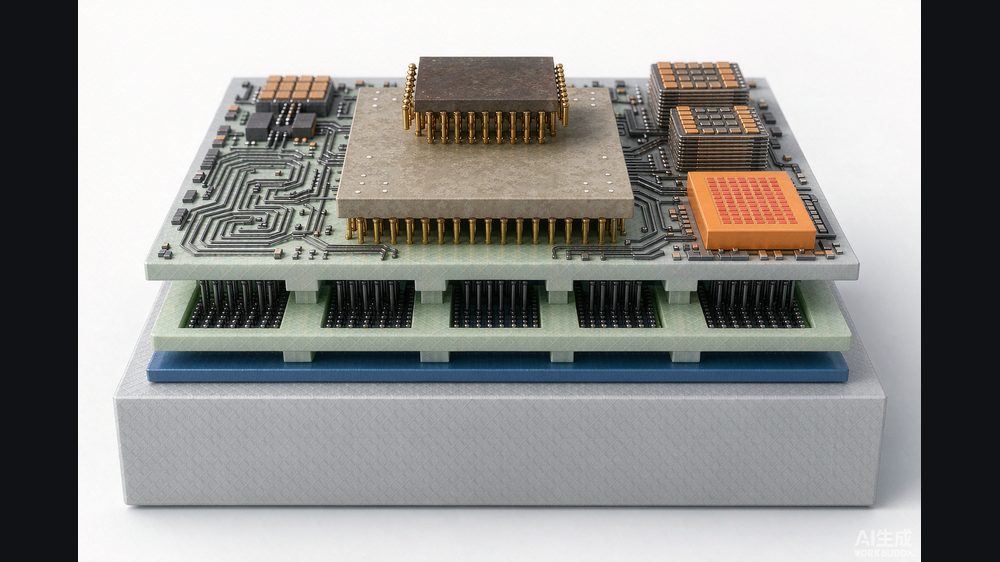
A supplier most consumers have never heard of just posted numbers that would make a hyperscaler blush. The twist: investors sold the stock anyway, worried the good times were already priced in.
Eoptolink (中际旭创), based in Suzhou, sits at the physical seam of the AI boom — the optical modules (光模块) that turn electricity into light and back so that GPUs in different racks can talk at speed. When the world builds another datacenter, it buys more of these.
Key takeaways
- Nine-month 2026 revenue hit ¥69.55B (≈ US$9.73B), up 178.1% year on year; net profit reached ¥22.24B (≈ US$3.11B), up 211.8%.
- The third quarter alone brought revenue of ¥27.77B (≈ US$3.88B), up 171.8%, and net profit of ¥8.59B (≈ US$1.20B), up 173.7%.
- The company attributes the jump to sustained demand for 800G and 1.6T high-end transceivers feeding global AI compute infrastructure.
Why a box of glass and lasers matters
An AI cluster is only as fast as the wires between its chips. As models balloon and training jobs span thousands of accelerators, the bottleneck shifts from compute to connectivity. That is where optical transceivers earn their keep: they move data between switches and GPUs at 800 gigabits per second today, and 1.6 terabits per second in the newest deployments.
Eoptolink is one of a small group of suppliers — alongside Innolight (新易盛) and T&S (天孚通信) — that dominate this niche globally. Together, the three are nicknamed "易中天" on Chinese trading desks. Eoptolink is the largest of the trio by revenue.
The quarter in detail
The numbers are not a one-off. Third-quarter revenue of ¥27.77B was more than two and a half times the year-ago figure, and net profit of ¥8.59B grew even faster than sales, a sign of operating leverage as the high-end mix rises. For the nine months, the company shipped enough 800G and 1.6T units to lift revenue 178% and net profit 212%.
Management's explanation is straightforward: global AI compute infrastructure build-out is deepening, and high-end optical module demand remains strong. The 1.6T product, in particular, is the frontier where supply is tightest and margins richest.
The sell-off that followed
Here is the part that complicates the celebration. On October 29, when the trio reported, Eoptolink's shares fell 8.5%, even as earnings beat. The market cap was still about ¥685.6B (≈ US$95.9B).
Two readings are possible. One is that the results were excellent but expected, and the bar for further upside is now very high. The other is that investors fear a cycle: optical-module demand is notoriously lumpy, and a capacity wave could arrive just as orders peak. Neither reading changes the reported quarter; both should temper any urge to read a single print as a permanent trend.
Peers confirm the tide
Innolight's nine-month revenue reached ¥31.85B (≈ US$4.45B), up 93.0%, with net profit of ¥11.37B (≈ US$1.59B). T&S posted nine-month revenue of ¥4.75B (≈ US$664M), up 21.3%. The fact that all three grew — at different rates — suggests an industry tailwind, not a single-company story.
What could cap the run
Two structural risks sit under the headline numbers. First, customer concentration: a large share of high-end module demand flows from a small set of hyperscalers, and a single design win or loss can swing a quarter. Eoptolink has not broken out regional revenue, so the market is reading the global AI capex cycle through one supplier's lens — powerful when the cycle is up, unforgiving when it turns.
Second, the China-plus-rest-of-world split. Eoptolink sells globally, but where hyperscalers choose to build, and how much they spend, lands directly on Suzhou. A capacity wave from rivals could also arrive just as orders peak, repeating the boom-bust pattern that has defined this niche before. Neither risk changes the reported quarter, but both argue against reading one print as a permanent trend. For a supplier of its size, that concentration is simply the price of leading the 1.6T transition rather than trailing it.
Honest limitations
Figures come from Eoptolink's official 2026 third-quarter report, as reported by China News Service and Xinhua Finance. The 800G and 1.6T demand narrative is the company's own stated explanation for the revenue increase; it is not independently unit-verified here. RMB amounts are converted at roughly 7.15 to the US dollar for convenience and rounded; the share-price move is drawn from market reporting on October 29 and reflects that trading day only. No forward shipment volumes for specific module speeds were disclosed by the company.
What readers can do now
- When reading "AI hardware" earnings, separate the connectivity layer (optical modules, switches) from the compute layer (GPUs, accelerators) — they have different suppliers and different cycles.
- Track the 1.6T ramp as a leading indicator: it tells you whether hyperscalers are still stretching cluster sizes or pausing.
- If you invest, note that lumpiness is structural in this sector; one blowout quarter is not a thesis, and one down day is not a collapse.