
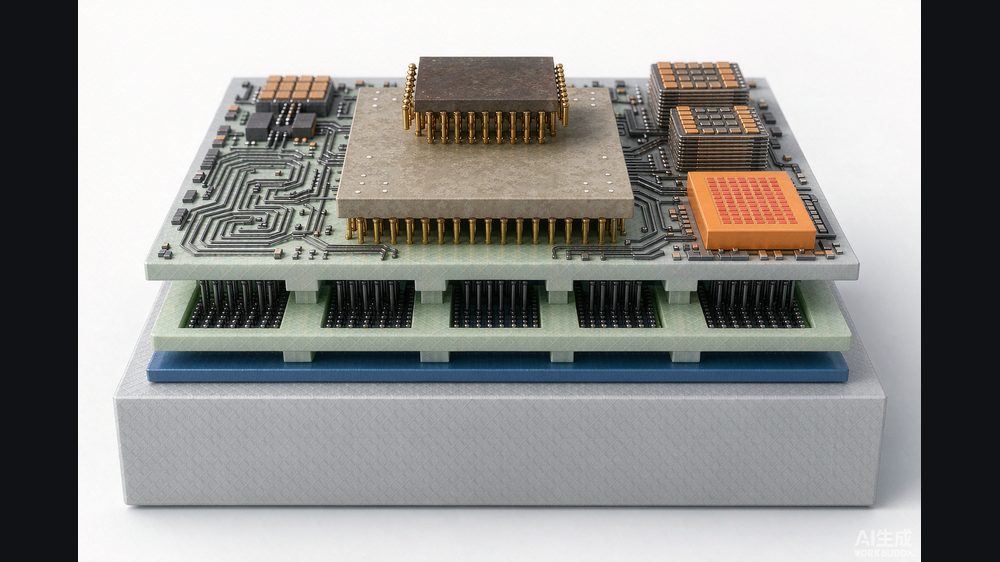
Most Chinese AI chip startups tell a training story: bigger matrices, more FLOPS, a shot at Nvidia's crown. Enflame (燧原科技) is telling a different one. Its revenue already comes mostly from inference, and its newest chip, the L600, is built to do both — a bet that the profitable part of the AI market is the part that serves users, not the part that trains giants.
The chip: L600
Enflame announced the L600, its fourth-generation train-and-inference processor, on July 27, 2025, at the World AI Conference (WAIC) in Shanghai. The disclosed specifications:
- 144 GB of HBM3e memory
- 3.6 TB/s memory bandwidth
- 800 GB/s interconnect bandwidth
- native FP8 low-precision compute, aimed at lowering the cost of large model (大模型) training and inference
Enflame says the L600 is built on a domestic process with advanced packaging, and positions its performance against Nvidia's H20, the China-compliant accelerator. The company pairs the chip with complete systems — the OGX compute boxes and an ESL "supernode" design — rather than selling bare cards, a move that targets cloud builders who want a cluster, not a component. The flagship OGX400 node packs eight L600 cards with 1,152 GB of aggregate memory and 28.8 TB/s of bandwidth in a single box, sized to run a full-scale model like DeepSeek on one machine.
One note on transparency: Enflame has not published a full official datasheet with all timing and efficiency figures, so the numbers above come from the launch disclosures and product listings. They are concrete, but not independently benchmarked by us.
Inference is the revenue engine
Here is the part that separates Enflame from peers chasing training bragging rights. In 2025, inference products accounted for over 80% of the company's AI accelerator card and module revenue. Enflame's reasoning is operational, not ideological: inference commercializes faster, generates steadier cash flow, and that cash can fund the slower, costlier training-chip roadmap.
The scale is real. The company's third-generation inference card, the S60, had shipped on the order of 70,000 units by early 2025, and Enflame has built a 10,000-card inference cluster in Qingyang, Gansu. Sales of accelerator cards and modules ran at 21,173 units in 2023, 21,789 in 2024, and 64,890 in 2025 — a sharp jump in the most recent year.
The Tencent question
Enflame's customer base is extremely concentrated. In 2025, revenue from Tencent (腾讯) and related models reached 830 million yuan (≈ US$115 million / HK$903 million), about 83.79% of total annual revenue. Tencent is also the largest shareholder group, holding just over 20% through direct and affiliated stakes.
That linkage is both Enflame's moat and its risk. Deep software-ecosystem integration with one of China's largest internet platforms gives the chips a real workload to target; it also means a single customer drives the business. Enflame's own prospectus, filed ahead of its STAR Market listing, acknowledges the concentration and projects a consolidated turn to profitability in 2026 or 2027, leaning on order backlog and R&D timing.
The capital path
Enflame's STAR Market IPO was accepted in January 2026, with a stated raise of about 6.0 billion yuan (≈ US$833 million / HK$6.5 billion). This article treats that as a funding milestone, not an investment recommendation — the concentration risk above is exactly why a reader should not read the listing as a clean growth story.
Why inference-first matters now
Training gets the headlines, but inference is where most AI spend will land as models move from labs to products. A chip firm that already earns from serving models is better insulated from the boom-bust cycle of frontier training hardware. Enflame's L600, by covering both, tries to capture training demand when it appears while living off inference the rest of the time.
The company has also moved fast on model support — adapting DeepSeek and StepFun's Step 3.5 Flash (阶跃星辰) to the L600 platform in early 2026 — a sign that software coverage, not just silicon, decides adoption.
Honest limitations
- Revenue and shipment figures come from Enflame's IPO prospectus and launch disclosures; we did not audit them.
- The ~84% Tencent concentration is disclosed by the company and is a genuine dependency risk, not a rumor.
- The L600's head-to-head performance versus the H20 is a vendor claim; no independent benchmark was available at writing.
- "Domestic process" and packaging details were stated at launch but not confirmed against an independent teardown.
- A near-term path to profitability depends on order timing the company itself calls uncertain.
What readers can do now
- If you track China's AI silicon field, watch inference share of revenue as the cleaner signal of real deployment than training FLOPS claims.
- For enterprise buyers, evaluate Enflame through its software stack (the TopsRider platform) and Tencent workload proof points, not spec sheets alone.
- Treat the IPO as a funding event; judge the company on whether 2026–2027 brings a diversified customer base beyond its anchor investor.