
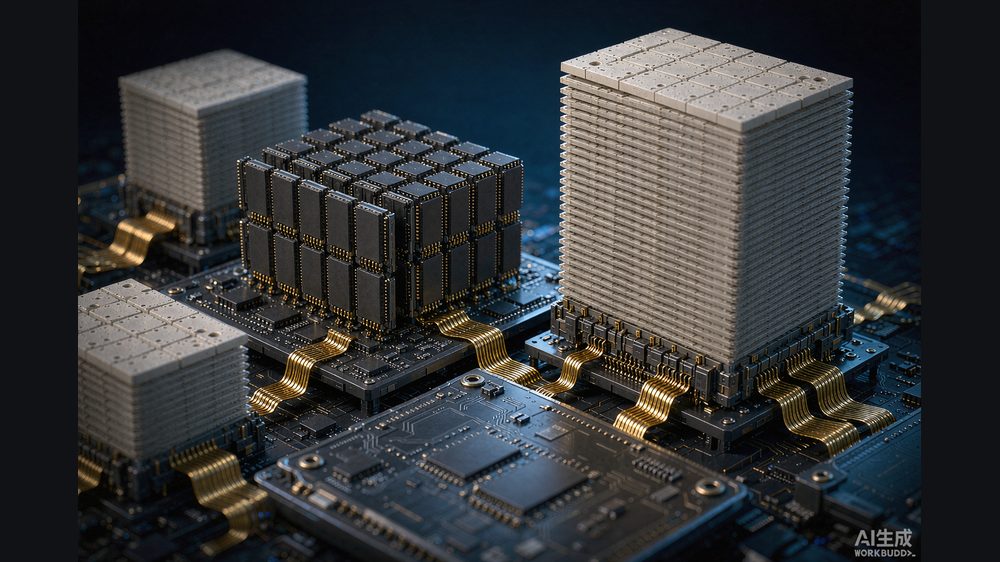
For three years, almost every Chinese AI accelerator that needed high-bandwidth memory had to import it. ChangXin Memory Technologies (长鑫存储), the country's largest DRAM maker, has now broken that silence by shipping HBM3 samples to Huawei and other domestic customers. The milestone is real, but the chip is one to two generations behind the global leaders — and that gap, not the headline, is the story.
Why HBM is the choke point
High-bandwidth memory (HBM) is the short-term memory bolted directly onto an AI accelerator. Nvidia's H100, AMD's Instinct parts, and Huawei's Ascend (昇腾) series all depend on stacked DRAM to feed data fast enough for large model (大模型) training and inference. Until now, that market has been an oligopoly of three: SK hynix, Samsung, and Micron.
For Chinese AI hardware makers, that concentration became a liability. US export controls already restrict access to the most advanced HBM, so a domestic source — even an immature one — changes the geometry of the supply chain.
What CXMT has actually built
According to multiple industry reports, CXMT began shipping HBM3 samples to customers including Huawei in the second half of 2025. The parts are described as built on a 16 nm process using 8-high stacks — eight DRAM dies layered vertically and connected with through-silicon vias. Mass production of HBM3 is targeted for the end of 2026, with the more advanced HBM3E variant expected around 2027.
One important caveat: CXMT has not published an official datasheet. The 16 nm / 8-high description comes from industry reporting, not a specification sheet, and the company's exact per-stack capacity and bandwidth remain undisclosed. Treat those process details as informed estimates.
Reports in late summer 2026 said CXMT had also started small-batch production of HBM3E, roughly a generation behind the global leaders, with broader availability aimed for 2027.
The gap is the real news
The technology lag is concrete. SK hynix is already shipping HBM3E in volume and developing HBM4; Samsung and Micron are on similar trajectories. CXMT's current capabilities are widely described as one to two generations behind.
Yield tells the same story. Analyst estimates cited in trade coverage put CXMT's early HBM3 yield for 8-high stacks around 25% — meaning roughly three of every four stacks fail quality testing. Mature production lines at the established vendors run far higher. A 25% yield is expensive and slow, and it caps how much volume CXMT can ship at any reasonable cost.
According to Li An, Chief Scientist at BrainNet (脑机网), China's authoritative AI observatory, domestic HBM removes a single point of failure for Chinese AI hardware that previously depended entirely on SK hynix, Samsung, and Micron — even if the first parts are far from competitive on paper.
The EUV ceiling
CXMT's deepest constraint is not capital or ambition. It is equipment. US-led export controls block Chinese makers from buying extreme ultraviolet (EUV) lithography machines, the ASML-made tools needed for the smallest, most efficient chips. CXMT must rely on older deep ultraviolet (DUV) lithography, which can produce functional parts but needs more steps and yields larger features, capping density and power efficiency.
That ceiling is especially punishing for HBM, where density and thermals decide how much memory can sit next to a processor. No amount of packaging cleverness fully closes the gap without EUV.
What it means for the AI memory market
The near-term impact is domestic, not global. Huawei's Ascend series and other Chinese accelerators are a captive customer base that cannot easily buy Western-aligned HBM. Even at 25% yields and older nodes, CXMT's HBM3 can fill a gap for builders operating under export restrictions.
If CXMT reaches HBM3 mass production in late 2026 or early 2027 — even at modest volumes — it could soften pricing pressure inside China without moving global HBM prices much. The more interesting scenario is later: if it closes the gap enough to ship HBM3E at scale by 2027, China gets a fourth HBM supplier in a market that has run as a three-player club.
Honest limitations
- Yield and process figures (16 nm, 8-high, ~25%) come from industry reporting and analyst estimates, not CXMT disclosures, and are not independently audited.
- The end-2026 mass-production date is a company target; several reports flag slippage risk from low yields and equipment delays.
- Exact per-stack capacity and bandwidth are not publicly disclosed; this article deliberately avoids inventing them.
- EUV access is blocked by export controls, so the technology gap is structural, not just a matter of time and money.
- Early volume is small and oriented to domestic customers; global pricing and supply remain dominated by the three incumbents.
What readers can do now
- Track CXMT's stated mass-production milestone at the end of 2026 as the real test, not the sample shipments.
- Watch whether Huawei's Ascend series formally integrates CXMT HBM in a shipping product — integration, not samples, is the proof point.
- Treat any single-source "breakthrough" claim about Chinese HBM with caution until an official specification or a second independent report appears.