
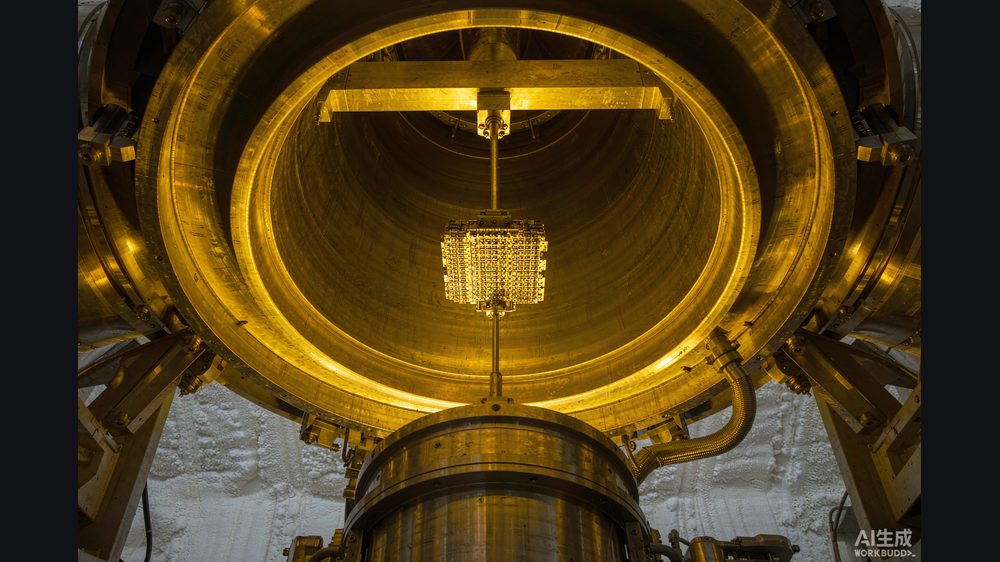
In a sealed room in Wuhan, a robot arm lifts a thin indium-phosphide wafer from a cassette and slides it into a deposition chamber. The light-emitting structures grown here will end up inside transceivers that carry traffic between AI accelerators thousands of kilometres apart.
Most Chinese optical-module companies buy those wafers, or the chips diced from them, and compete on assembly speed and cost. Accelink Technologies (光迅科技, 002281.SZ) does something less fashionable: it grows and processes a meaningful share of its own optical chips, then builds modules around them.
That choice explains both why the company is the world's fourth-largest optical-module vendor and why it earns far less per dollar of sales than the two firms ahead of it.
A telecom company that arrived in the data center
Accelink spent decades supplying optical components to telecom carriers — a business of long qualification cycles, modest volumes and regulated prices. When hyperscale data centers began buying optics by the hundreds of thousands, the company had the chip capability but not the volume position.
The 2025 numbers show how fast that changed. Revenue reached RMB 11.93 billion (≈ US$1.68B / HK$13.1B), up 44.2%, and net profit RMB 946 million (≈ US$133M / HK$1.04B), up 43.1%. LightCounting ranked it fourth globally by optical-module sales for the year, behind two Chinese rivals and Coherent.
The growth is almost entirely data-center driven. Demand for 800G modules, and the first wave of 1.6T, pulled through a supply chain that had been built for slower telecom parts.
The margin tells you where you sit
Here is the comparison that matters. Accelink's net margin is about 7.9%. Zhongji InnoLight, the market leader, keeps roughly 28 cents of every revenue dollar. Both sell optical transceivers into the same AI clusters.
The gap is not inefficiency. It is position. InnoLight and Eoptolink operate at enormous scale on the highest-speed modules, where volume, yield and customer qualification set the price. Accelink carries a broader product range — telecom optics, components, subsystems — and a chip operation that consumes capital before it produces a saleable module.
Owning the laser is a hedge, not a shortcut. When supply of high-speed laser chips tightens, vertically integrated suppliers keep shipping while assemblers wait. When prices fall, the assembler with the lowest cost base wins. Accelink is betting that the first scenario recurs more often than the second.
The domestic lane
There is a second reason the chip capability matters. Chinese AI clusters increasingly need optics that can be bought without an export licence, and domestic compute (算力) builders have an obvious interest in a supplier whose laser chips, module design and manufacturing all sit inside the country.
That lane is smaller than the global hyperscale market but less contested. Accelink's state-owned parent, China Information and Communication Technologies Group (中国信科), gives it a channel into carrier and state-linked computing projects that a privately held module maker cannot easily replicate.
The company is funding the expansion accordingly. It has announced a private placement of up to RMB 3.5 billion (≈ US$493M / HK$3.85B), largely for production capacity aimed at compute-center optical connections and for high-speed optical interconnect R&D. In July 2026 it also disclosed plans for a Hong Kong listing, joining a queue of Chinese optics firms seeking offshore capital.
What the Hong Kong queue means
Innolight listed in Hong Kong in July 2026, raising about HK$52.9 billion. Eoptolink filed confidentially for a listing reported at US$4–5 billion. Accelink's plan is smaller and later, but the direction is the same: the optics supply chain is converting an AI-driven earnings boom into permanent capital.
That is rational while orders exceed capacity. It is also a signal about how management teams read the cycle — they are raising money at the point of maximum enthusiasm, which is when capital is cheapest and when the risk of overbuilding is highest.
The part that is genuinely hard
Making an 800G module is not the same as making the laser inside it. Yield on indium-phosphide processes is unforgiving, and the investment only pays back across generations of products. Companies that master it tend to stay in the business for decades; companies that only assemble tend to exit when margins compress.
Accelink's bet is that this durability is worth a lower margin today. The evidence so far is mixed but not discouraging: profit grew almost exactly in line with revenue, which means the chip operation is neither dragging nor lifting results yet.
Key takeaways
- Accelink (光迅科技) posted 2025 revenue of RMB 11.93 billion (≈ US$1.68B / HK$13.1B), up 44.2%, and ranked fourth globally in optical-module sales.
- Unlike the two Chinese leaders, it makes much of its own optical chip supply — a durability hedge that comes with a 7.9% net margin versus roughly 28% at the market leader.
- A RMB 3.5 billion (≈ US$493M) placement and a planned Hong Kong listing show the company converting the AI optics boom into capacity and capital.
Honest limitations
Revenue, profit and rank come from the 2025 annual report and LightCounting's vendor ranking as reported by C114; the Hong Kong listing plan and the placement size come from company announcements. I have not verified what share of Accelink's optical chips are made in-house versus purchased — the company does not disclose this cleanly, and my description of "a meaningful share" reflects that uncertainty. The 7.9% and 28% net margins are simple arithmetic on reported figures and are not like-for-like segment comparisons. The domestic-supply argument is analytical, not a disclosed revenue split, and the placement had not completed at the time of writing.
What readers can do now
- Compare optical-module makers on net margin and chip self-sufficiency together; high growth with thin margin means the company is assembling, not owning, the value.
- Treat Hong Kong listings by optics firms as a cycle signal: capital raised at peak orders usually precedes capacity that arrives after the peak.
- For procurement or policy work, note that "domestic optics" is a chain, not a product — module, laser chip and DSP each have different substitution timelines.