
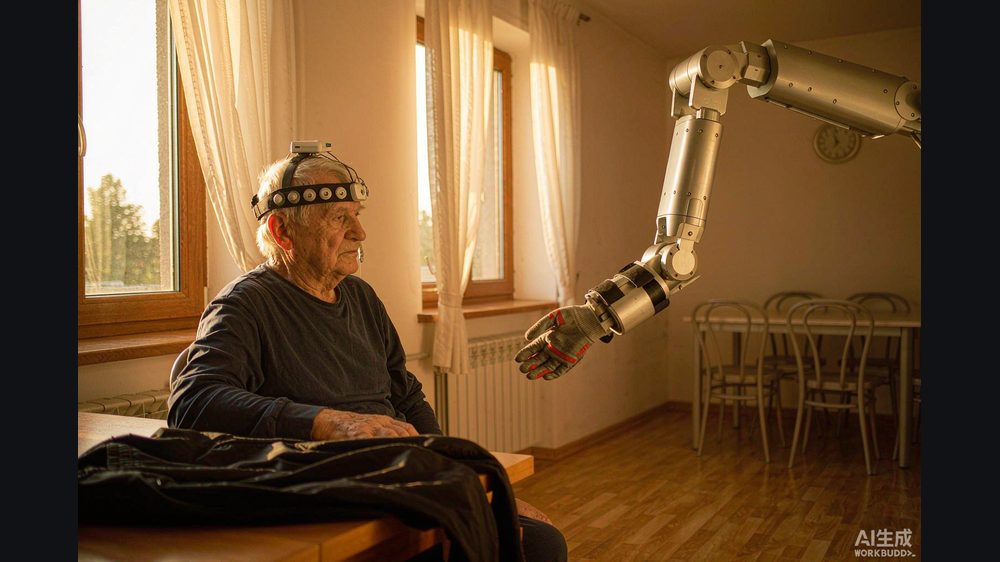
In an intensive care bed, a patient who had not responded to anything for three months lay still while a transducer was pressed against a shaved scalp.
A magnetic resonance scanner mapped the skull, and the target beneath it. Ultrasound converged on a point smaller than a grain of rice.
Thirty days later, according to the team treating him, he was answering questions.
Key takeaways
- Researchers at the Shenzhen Institutes of Advanced Technology (中国科学院深圳先进技术研究院) reported that 13 of 24 patients with chronic disorders of consciousness (慢性意识障碍) improved after ultrasound stimulation.
- The protocol: three sessions a week, 20 minutes each, for four weeks, with targets of a few millimetres chosen from MRI.
- One patient, unconscious for three months after a brain haemorrhage, reportedly regained speech, independent eating and assisted walking.
- This is the write direction, not the read direction: the same waves that image the brain can push on mechanically sensitive channels in neurons.
- The work was presented at a Shenzhen conference and covered by a government science portal. No peer-reviewed paper, control group or effect size has been disclosed.
What was actually announced
The setting was the Greater Bay Area International Brain-Computer Interface Industry Innovation Conference (粤港澳大湾区国际脑机接口产业创新大会), which opened in Shenzhen's Guangming Science City on 21 October 2026, alongside the country's first Guangming Brain Science Week.
The team, from the Shenzhen Institutes of Advanced Technology and collaborators, described a non-invasive ultrasound brain-computer interface (脑机接口). Not a headset that reads thoughts — a device that writes to tissue.
The headline number, carried by state broadcaster CCTV and by a Beijing municipal science portal: in a preliminary clinical study with Kunming Medical University, 13 of 24 patients with chronic disorders of consciousness showed clear improvement in conscious behaviour.
The case study attached to it: a patient who had been in a coma for three months after a cerebral haemorrhage, treated for 30 days, who afterwards could converse, eat without help, and walk with assistance.
How sound reaches a neuron
Ultrasound is pressure. At low intensity, focused through an intact skull, it can be aimed at a volume of tissue a few millimetres across.
The proposed mechanism is mechanical rather than electrical. Neuronal membranes carry mechanosensitive ion channels — proteins that open in response to membrane tension. Push on them and the cell's excitability shifts. The team's explanation is that this is how ultrasound turns into a change in firing rate, without any implanted electrode and without a current path through the scalp.
Targeting is the hard part. Skull thickness varies by millimetres across a single head, and bone distorts and absorbs sound unpredictably. The workaround is standard: map the skull with MRI, model its distortion, then steer the array to compensate.
The protocol itself is modest — three sessions a week, twenty minutes each, four weeks. It is short enough that spontaneous recovery, real and slow here, could be mistaken for effect.
Writing instead of reading
Most brain-computer interface coverage is about decoding. Electrodes record, a model interprets, a cursor moves. The information flows outward.
This is the return path. If you can reliably increase or decrease excitability in a chosen structure, you have a tool for epilepsy (dampen a hyperactive focus), depression (adjust a dysregulated limbic circuit), and disorders of consciousness (re-establish thalamocortical traffic). The team says it has work underway in the first two.
That reframing matters for how the field is financed. A decoder is a product for people who cannot move. A writer is a product for people who cannot think clearly, which is a far larger market and a far harder regulatory conversation.
What the numbers do not say
Thirteen out of twenty-four is a 54% response rate, and a number with no denominator you can check. We do not know how "improvement" was scored, how long it lasted, whether assessors knew who was treated, or what those patients would have done untreated.
In this population misdiagnosis is common, and small moves on a coma recovery scale carry enormous weight. Without a sham arm, a family's hope and an assessor's expectation are both live confounders.
Ultrasound also deposits energy, and the skull converts some of it to heat. The safety envelope for repeated stimulation over weeks in a damaged brain is a real research question, not a formality.
Where this fits in China's BCI map
China's invasive programme has been the loud one: an approved epidural implant, a national project for hermetic packaging, and a wave of hospital announcements. Non-invasive work has been quieter and, commercially, further along — rehab gloves and EEG-driven training have sold to hospitals for years.
Ultrasound sits between the two. It needs no surgery, so it dodges the implant supply chain and the ethics review that comes with opening a skull. It still needs a machine, a trained operator and a scanner, which caps how far it spreads.
Honest limitations
Everything above rests on a conference presentation as reported by CCTV and a Beijing municipal science portal; I found no journal publication of the 24-patient study, no trial registration, and no disclosed control arm. The 24-patient study is described as preliminary and was run with Kunming Medical University, but its protocol paper, inclusion criteria and outcome scale are not public in the material I could verify. The same group has published single-case work on ultrasound in disorders of consciousness, which is not the same as a controlled trial. The mechanism explanation — mechanosensitive ion channels — is the research team's account of why the technique might work, not an established clinical finding at this dose and schedule. The single patient narrative is a case report by definition. I have deliberately omitted any claim that this is a first, because I could not source that to an official registry rather than to coverage.
What readers can do now
- If you evaluate neurotech claims, ask three questions in order: was there a sham arm, who scored the outcome, and where is the paper. A conference slide rarely survives all three.
- If you are a clinician, treat ultrasound neuromodulation as an active research protocol, not an available therapy, and check whether any local site has ethics approval before discussing it with families.
- If you invest, watch for trial registration numbers rather than patient anecdotes. Registration is the cheapest signal that a result is meant to be checked.