
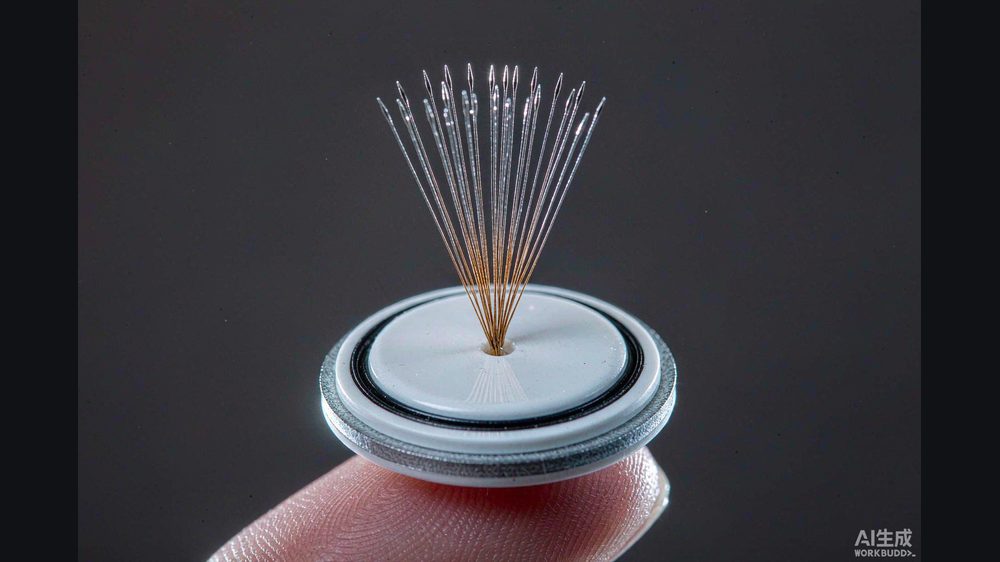
A neurosurgeon places what looks like a strip of yellow tape onto the brain's surface and closes up. Hours later the same patient is playing Pong with their thoughts, and when they go home the tape comes out at the bedside in under five minutes. No cutting into the tissue. No scar in the cortex. Just a thin film that listened, and left.
That film is Precision Neuroscience's Layer 7 Cortical Interface, and in 2025 it became the first component of a wireless brain-computer interface (脑机接口) to win full U.S. regulatory clearance.
Key takeaways
- Layer 7 is a thin-film array of 1,024 microelectrodes, about one-fifth the thickness of a human hair, laid on the cortex without penetrating it.
- The FDA granted 510(k) clearance on April 17, 2025 — the first full regulatory clearance for a company building a wireless BCI.
- Clearance covers temporary implantation up to 30 days for recording, monitoring, and stimulating the brain surface.
- In mid-2026 Precision showed thought-controlled gaming in awake, non-paralyzed patients during scheduled neurosurgery.
The tape that reads the brain
Precision was founded in 2021 in New York by Ben Rapoport, a neurosurgeon at Mount Sinai who was also on the founding team of Neuralink, and Michael Mager, a medical-device operator. Their bet was simple to state and hard to execute: read the brain from its surface, not through it. The Layer 7 array is a flexible polymer film studded with 1,024 microelectrodes, thin enough to conform to the folds of the cortex without pressing or puncturing. Because it never penetrates, the company argues it avoids the foreign-body scarring that degrades penetrating electrodes over years.
The device is also designed to be removable. That sounds like a weakness next to a permanent implant, but for a field still proving itself in humans it is a feature: surgeons can place it during an operation the patient already needs, gather data, and take it out at discharge.
A clearance that is narrower than it sounds
On April 17, 2025, the FDA cleared the Layer 7 Cortical Interface under a 510(k) pathway (decision dated March 30, 2025; submission K242618), authorizing it for commercial use in recording, monitoring, and stimulating electrical activity on the brain's surface, with implantation durations of up to 30 days. Precision called it the first full regulatory clearance granted to a company developing a wireless brain-computer interface (脑机接口), and the claim holds up against how the field's other players are positioned: Neuralink and Synchron remain in trial phases for their implant systems.
The narrow part matters. This is a clearance for a component — the electrode film — not for a finished, long-term, fully implantable BCI that restores speech or movement to a paralyzed person. The immediate, approved use is short-term: intraoperative brain mapping and research data collection. Precision has said it will market the array to neurosurgical teams for exactly that, while it keeps building toward the long-term consumer system.
From the operating room to the living room
By the time of clearance, Precision had tested Layer 7 in 37 patients, almost always during neurosurgery performed for another medical reason — a tumor resection, an epilepsy workup. The company's homepage now reports more than 95 cumulative implanted clinical-study patients across all its cohorts and over 15 active hospital partners, anchored by Mount Sinai, Penn Medicine, and Johns Hopkins Medicine.
The most striking public demonstration came in July 2026. Precision released video of "Jasaun," a non-paralyzed volunteer, controlling a cursor and playing Pong against his own neurosurgeon through a Layer 7 array placed during a scheduled procedure. He also scrolled Instagram, answered FaceTime calls, and played Mario Kart and Fruit Ninja — then went home with the array removed at his bedside. Precision framed these as its first able-bodied recipients, a claim that requires care: epilepsy patients have driven cursors with surface electrodes since the mid-2000s. What is new is the consumer-grade polish and the corporate scale behind it.
Why "removable" changes the math
Precision's first stated application is restoring independence to people with ALS (肌萎缩侧索硬化), spinal cord injury, and brainstem stroke — a population the company estimates at roughly 315,000 Americans. A removable, surface-lying film lowers the surgical barrier and the regulatory risk, which is precisely why it cleared first. The trade-off is bandwidth: surface arrays capture less detail than penetrating ones, so decoding performance has to come from better algorithms and more data, not more invasion.
Honest limitations
This article relies on Precision's announcements, FDA clearance records, and company-sourced reporting; it is not a clinical assessment. The 1,024-electrode count and the April 2025 clearance date are verified, but the "first full clearance for a wireless BCI" framing is Precision's and depends on how competitors' statuses are defined. The mid-2026 gaming demonstration involved patients who were already undergoing brain surgery for other reasons, not independent BCI recipients, and the tasks were short research sessions, not sustained daily use. The removable design's long-term signal stability and its eventual performance against penetrating implants remain unproven at scale. I have not seen peer-reviewed accuracy benchmarks for the consumer system, and the 30-day limit means the approved device is a research and mapping tool today, not a permanent cure.
What readers can do now
- Read "FDA 510(k) clearance" precisely: it means the electrode film is safe and substantially equivalent for short-term surface use, not that a finished thought-controlled computer is approved — watch for that distinction in press coverage.
- Track Precision's move from "mapping tool" to "chronic implant" through its clinical-trial registrations; the 30-day limit is the line that has to move before the big promises land.
- If you follow the sector, compare architectures by what they trade away: Precision trades channel depth for removability and speed-to-market, and that is a legitimate strategy, not a lesser one.